Museu do Estrangeiro
2017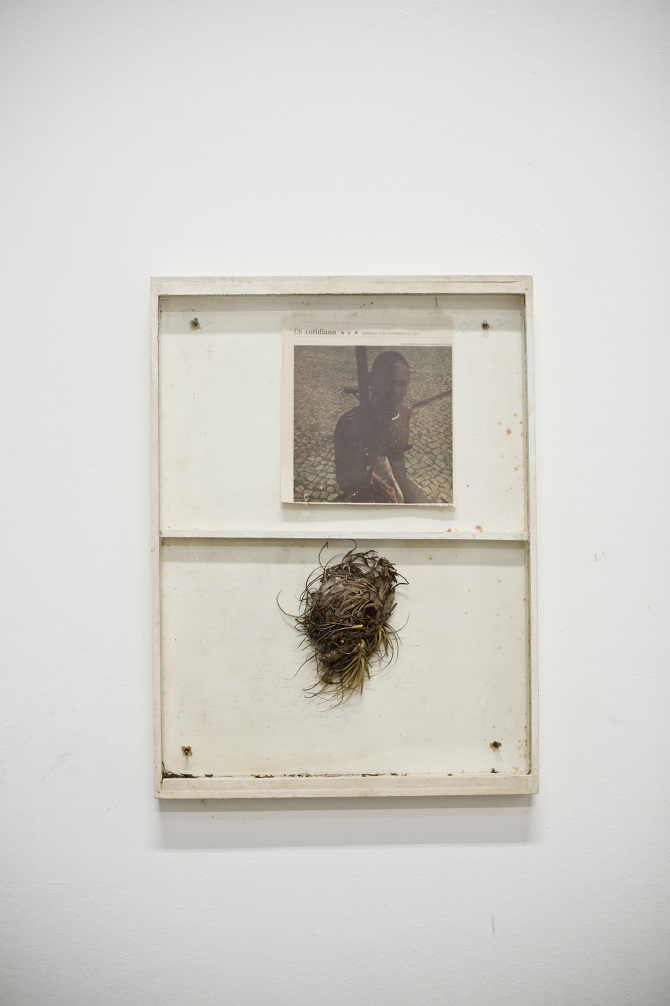
In general terms, I realize that my work starts from archival research, then from field work, and, in a third moment, it tackles how to present the research. I have been thinking of my work from two triangles: in the first, the tips are formed by: archival research, expeditions/walks, and exhibition. In the second, the tips are formed by: publication/book, site/archive, and talks/debates. At the Bahia Biennial, I think I've been able to do all these stages of the work, but this is not always the case. After meeting Juraci Dórea and the way he documents everything, I think it became more exposed in me. In the exhibitions or, for instance, on the website, I have been documenting everything: pictures of the works, reference texts, videos, links. In the visual arts, there is a path for artists that is spending all year working to produce works for an exhibition. In my case, although the exhibition ties and gives visibility to the research, it is not the end of the work, nor is it more important than the other parts. After the exhibition, there are also all these other agencings—the publication, the talks, the workshops, the videos and the website (archive), which is the repository of the whole project.
Despite the country's greater demand for foreigners, the current legislation on the subject is quite outdated. What is currently in force is the 1980 Statute of the Foreigner, considered a legacy from the military dictatorship and inspired by the paradigm of national security, which imposes a series of bureaucratic controls and restrictions on the possibilities of residing in Brazil.
The Statute of the Foreigner, among many things, denies the immigrant the right to vote, the right to demonstrate and to organize politically, the right to be the owner of a company, and the right to produce any type of media content. Museu do Estrangeiro [Museum of the Foreigner] emerged as an outgrowth of other research I have conducted on the issue of North-South migration in Brazil. As in Desterro [Exile] and Campo Geral [General Field], the focal point of this work was discussing the false idea of a mestizo and cordial Brazil. The work developed from a series of interviews with immigrants and refugees living in downtown São Paulo and from the collection of printed material produced by the various communities living in the city. Initially, it was a survey on immigration in São Paulo, with Bolivians and Koreans, but it expanded to a project on migration in general. I started to research a lot about the “whitening process”, I went back to the Nina Rodrigues and Estácio de Lima hospitals. Because of the Museu do Estrangeiro project, I was invited to work with African and Haitian refugees who live in the Cambridge Hotel occupation in downtown São Paulo. This activity in the occupation is linked to my current research, Frente de Trabalho [Work Front]. I want to work, specifically, with the removals in the big cities and their consequences—such as during the Vaccine Revolt in the 20th century—and the removals during the World Cup and the Olympics in Brazil in the last years. The proposal is to do a kind of census of the refugees, to know where and why they came here, what are their stories.
I think the main difference of a research on immigration conducted by a sociologist or anthropologist, and one made by an artist is in the form of presenting this research, a file. This is the image that I seek to unveil. For the design of my exhibitions, I do not make any installation plans, I do not draw a sketch. I gather all the things I collected during the research, including the furniture, take them to the exhibition space and organize them (the photos, the facsimiles of documents, the books from my library, the videos, objects). In Campo Geral, I brought even the blackboard and the chalks. In these works, I repeat the same elements, the pallet with the books, the box that holds the works, the wooden benches, the work table with the trestles, the shelves; they are all easy to build furniture that I take from one exhibition to another. I try to counteract the closed place of academic research, which is restricted to the university space. In fact, one thing I think about a lot is how to make a research-work that has some social function, and the artwork has a much greater freedom than an academic text.
Participation in artistic residencies is fundamental. My research is directly linked to the field work—archival research and the oral history of the places where I participate in residences. I have a very recent career, one of my first residences was in 2012, ROAD, a project of the Mobile Residences of Capacete (Rio de Janeiro). Bruno Jacomino, Lucas Sargenteli and Sofia Caesar went with me in a two-month car trip from Rio de Janeiro to Belém, and ending in Brasília. The proposal was to investigate cities that had ceased to exist or were in the process of ceasing to exist, or that we believed that would change so much they would cease to exist at some point. We mapped a series of cities. That was when we arrived at Canudos—it was my first contact with the town; besides returning after a few years to the sertão of Ceará, Quixeramobim, Senador Pompeu, and Crato, cities that had concentration camps between 1915 and 1932, during periods of drought, created by the federal government to shelter and provide housing and food to the drought exiles. The “government corrals,” as they were known, also served to contain the migration to the big cities, like Fortaleza, becoming places where these populations were confined and abandoned.
My first contact with the Amazon was also during this residency. This trip laid the foundations of the Desterro project, which was divided in three moments Cidade Partida [Broken City], in Canudos, Campo Geral, in the sertão of Ceará, and Frente de Trabalho, which is a project still in progress. To me, these works are all connected, and are developments and outgrowths of the same issues.
Statement based on Ícaro Lira's interview to Espaço Pivô (April 2017)
Museu do Estrangeiro, 2017 | Installation
Ícaro Lira
Diálogos sobre Arte, Migração e Trabalho | Residência Artística Cambridge
Artist's website
Text Um Museu no Bom Retiro, by Marta Mestre (BUALA, 2015) [port]
Project's instagram