La Huella
2012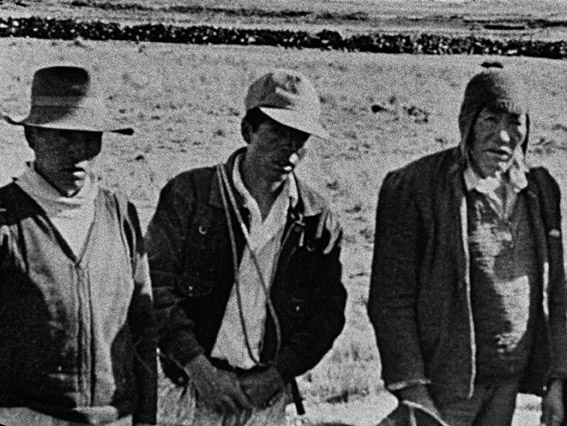
Video still
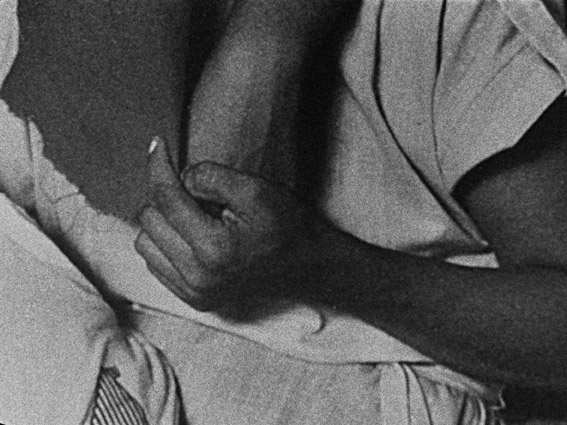
Video still
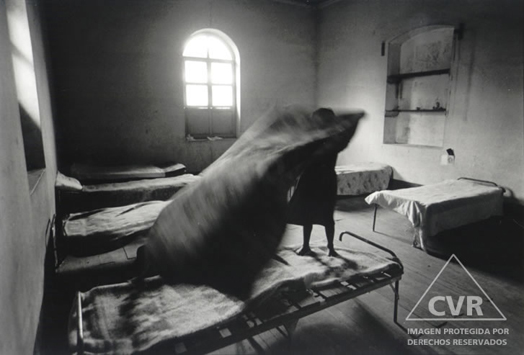
A home for children made orphans by the domestic war. Missão de Ocopa, Junín.
Photographer Cecilia Larrabure (Cecilia Larrabure’s personal archive, 1998)
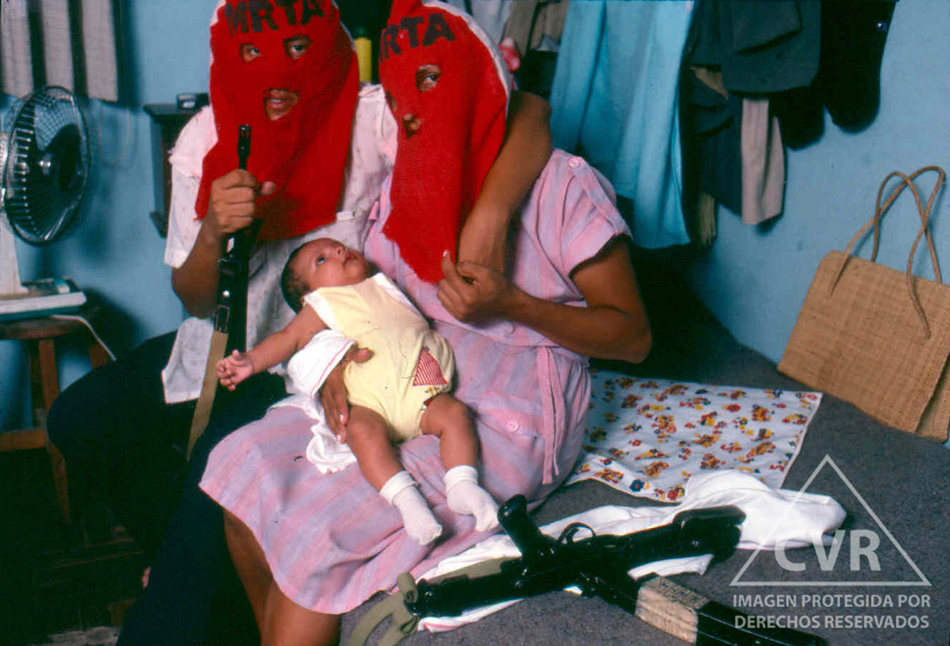
Néstor Cerpa Cartolini and his wife Nancy Gilvonio portrayed in Lima with their son, in 1985. In 1982, two small ultra-left factions, El Militante Revolutionary Left Movement (MIR-EM) and the Marxist-Leninist Revolutionary Socialist Party (PSR-ML) joined to form the Túpac Amaru Revolutionary Movement (MRTA). Inspired in 1960s and 70s Latin American Guevarista guerrilla and the MIR’s armed struggle of 1965, the MRTA ranks, led by Víctor Polay Campos, managed to settle in the state of San Martín and in the jungle strip across the states of Junín and Pasco.
Photographer Vera Lentz (Vera Lentz’s personal archive, 1985)
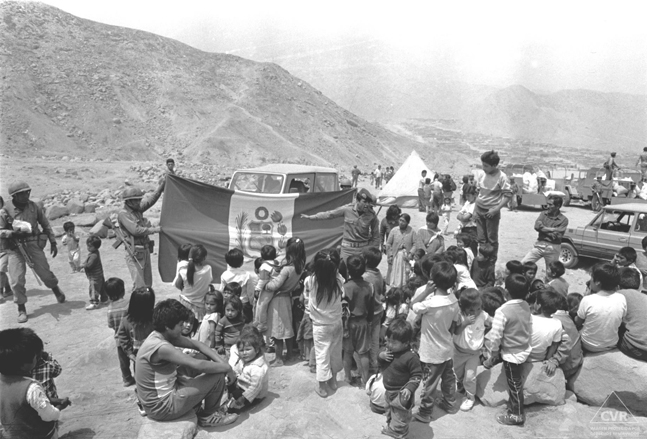
Photographer Onésimo Bottoni (El Peruano, 26/8/1991)
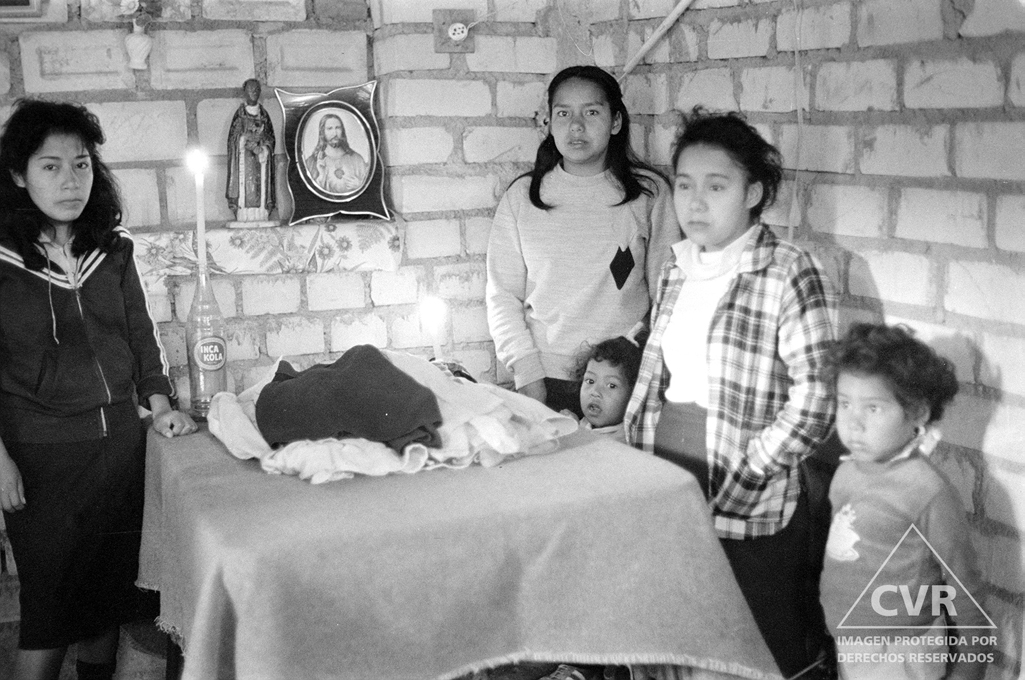
The wake of one of the victims killed during the August 16, 1985 subversive attack on War Navy officers, as a retaliation for their presence in El Frontón penitentiary island. Alledged Sendero Luminoso members attacked 60 sub-officers, technicians and civilian workers. Three sub-officers died in the clashes. Photographer Julián Espinoza (Jornal El Comercio, 1985)
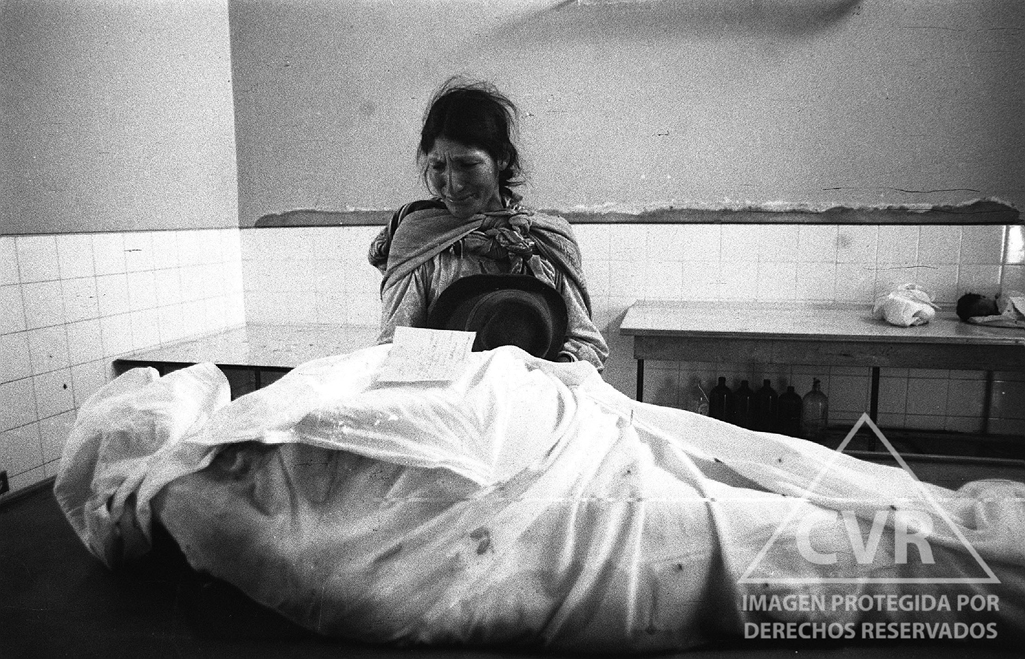
In February 1983, in Ayacucho, a peasant woman walks next to the body of a family member victimized by the armed conflict. Photographer Manuel Vilca (La República, 13/2/1983)
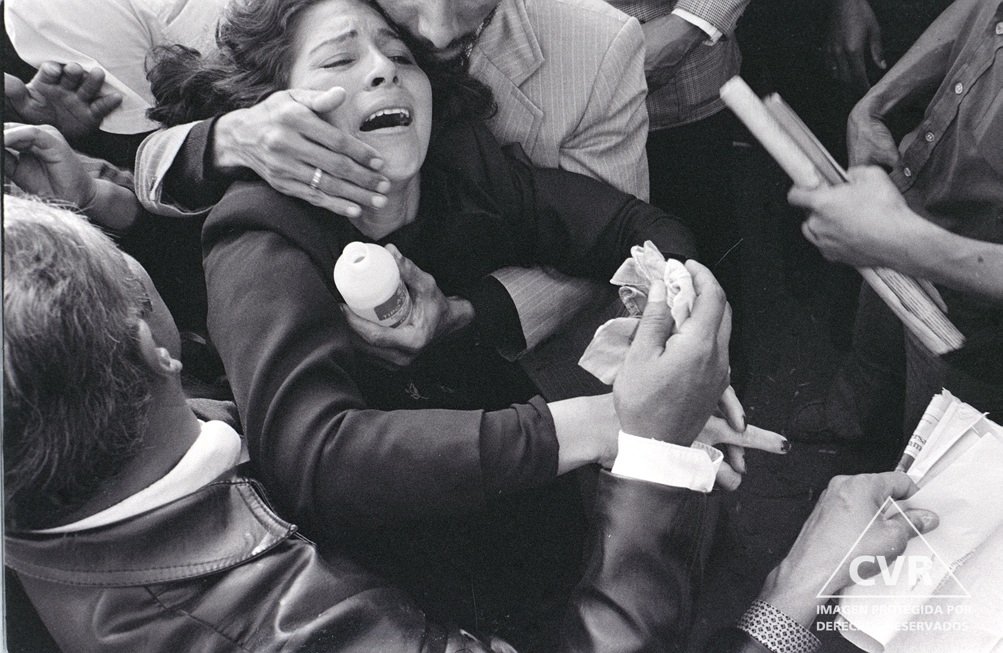
The wife of mayor Victor Arias Vicuña, an acciopopulista party-affiliated member in Pasco, Cerro de Pasco, manifests her grief at the burial of her spouse, assassinated on November 8, 1983 by Sendero Luminoso members.
Photographer Gerardo Samanamud (Jornal El Comercio, 11/11/1983)
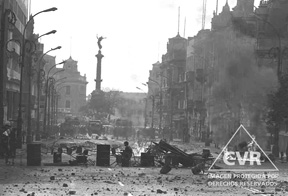
Demonstration near Plaza Dos de Mayo square, in 1989.
MRTA members burned down furniture from Universidad Nacional Federico Villarreal to protest against economic measures taken by Alan García’s administration.
Photographer Alejandro Balaguer (Alejandro Balaguer’s personal archive, 1989)
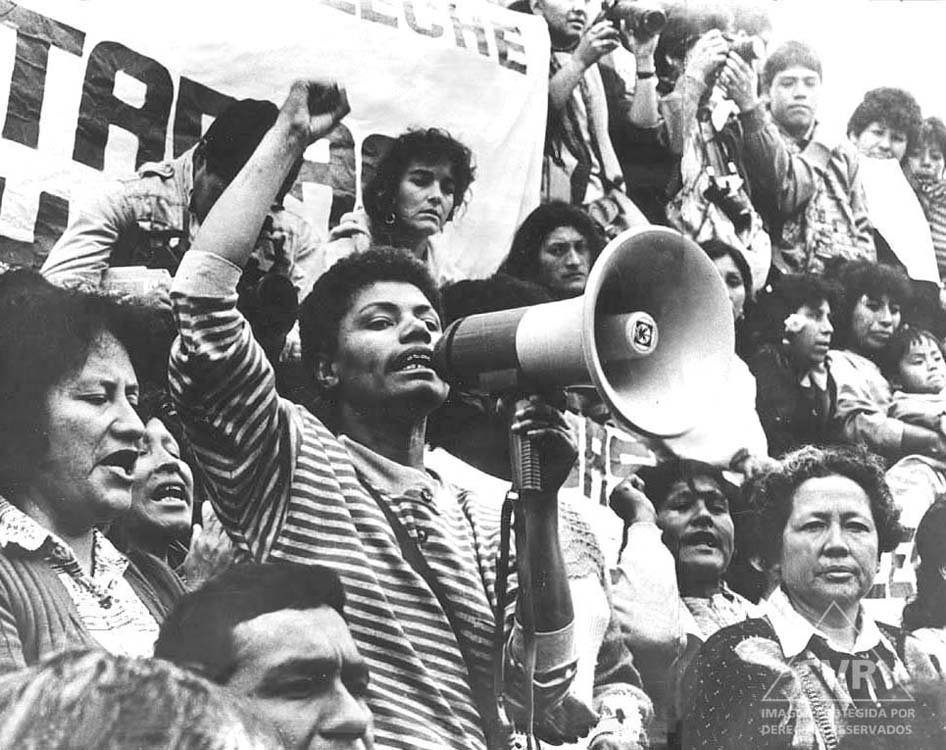
María Elena Moyano during a demonstration in February 1992. The female lieutenant, who was also mayor of Villa El Salvador and president of the local People’s Women’s Federation, had the valor and courage to stand up to Sendero Luminoso, publicly decrying their maneuvers to control local social organizations. She defended her people’s right to fight for social improvements in democracy and freedom. On February 14, 1992, Sendero Luminoso called an armed strike. María Elena Moyano, alongside other officials from Villa El Salvador, held a rally, challenging the group. On February 15, an annihilation commando from the Sendero shot her down at a social gathering and blew up her body with dynamite.
Photographer Gilmar Pérez (Revista Caretas, 1992)
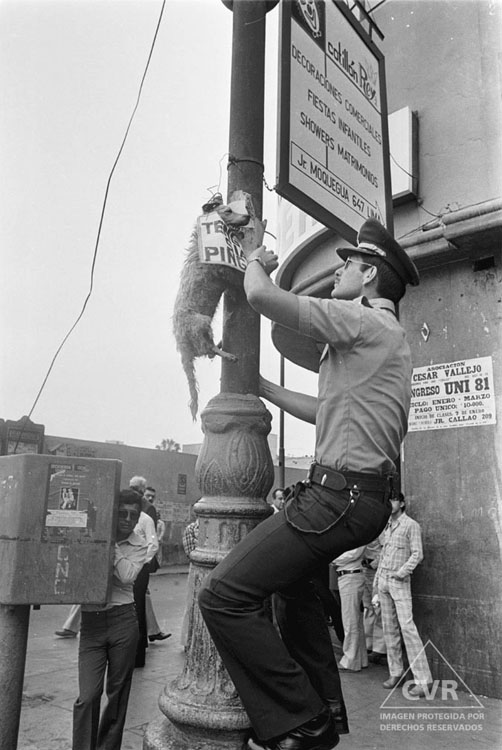
On December 26, 1980, several dead dogs appear hanging from lighting posts in Downtown Lima. The dogs had signs with the inscription “Teng Hsiao Ping, son of a bitch.” Many newspapers spoke of Chinese mob threats, but in reality it was the first message from Sendero Luminoso (a Peruvian guerrilla group of Maoist insipration created in the 60s) in the capital. Teng Hsiao Ping had been an enemy of Mao Tse-Tung’s, and the Peruvian subversive outfit considered him responsible for China’s shift from Maoism to capitalism. Photographer Carlos Bendezú (Revista Caretas, 26/12/1980)
“I believe La huella (The footprint) can be somewhat political, but it operates in a different way. The film travels through things, moving the insides of minor details, gestures or sounds. It moves from the smallest bits in order to generate something.
The way it was shot, with fairly slow camera movements, is not meant to highlight the pain; that was never my intention, but perhaps it is the exact length of time it takes to develop empathy towards the drama that unfolds; the time needed for the spectator to incorporate the drama of the victims and produce an impression that is part of a change or a track.
In making the film, I repeatedly referred to the Image Bank recompiled by the Commission of Truth and Reconciliation. The Bank features roughly 1700 photographs from widely varied sources such as the press, church and military archives, family albums, or albums by independent photographers.
The Commission of Truth and Reconciliation was a joint effort of the Peruvian government, alongside various civil society organizations and members, to grasp the conflict we were experiencing, an extremely painful conflict. Its creation became possible only after Alberto Fujimori stepped down, a transitional government was set up, and people started trying to make sense of the domestic war that haunted Peru for the past 20 years. The war claimed more than 69 000 lives, mostly of Quechua peasants who were murdered or forcibly disappeared.
For La huella, I also heard statements from victims’ families at the Public Hearings in Ayacucho. The statements were very painful and I felt I couldn’t use them directly as raw material. Considering the testimonies, I feel I couldn’t have filmed anything, so I decided to keep only the photographs: although they were also graphic, the images afforded me some margin of movement, or at least of appropriation.
There is a very important ethical stance when it comes to approaching and filming these photographs. I didn’t want to do it from a perspective of historical analysis, nor in an informative way; I wanted to be closer to the vibration these photos elicit in me, a vibration I think is connected to the traumatic, to recognizing what is human in them, the drama of the victims.
For the voiceover, I invited José Pablo Baraybar, a forensic anthropologist who was considerably involved with the exhumation and returning of remains to the victims’ families. He seemed to provide a good counterpoint to the photos, since his voice was also a statement — not from the victims’ perspective, but as another very close and crucial eyewitness for the families.
José Pablo had the views of someone who had seen everything, or almost everything, since he had been deplyoyed on similar missions to several locations, like Sarajevo, Rwanda, Haiti, and Somalia. I think his statement helped reveal, in the photographs, the sensation of seeing them for the first time, of being very deeply marked by them.
And since José Pablo’s voice was speaking in first person, I decided I would do the same. People tend to think my voice is also a statement, but that is not the case. I did not directly experience the loss of family and friends during those years. Nevertheless, it seemed to me that first-person was the way to go; first-person is the tense of the present and of the self as utterer; it’s the tense of one who experiences. And the text narrated by me was written to convey the impressions I had in looking at the photographs.”
Tatiana Fuentes Sadowski in a statement to PLATFORM:VB (July 2015)
La huella, 2012 | Video, 18’
Tatiana Fuentes Sadowski
90 Segundos (20/11/2000) - Renuncia de Alberto Fujimori
Story about the resignation of the Peru president Alberto Fujimori in 2000