Study for Duel
2013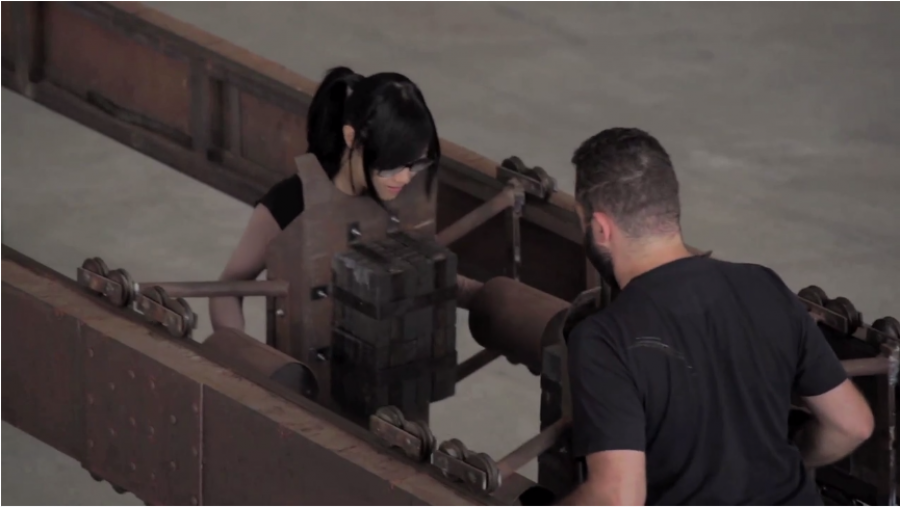
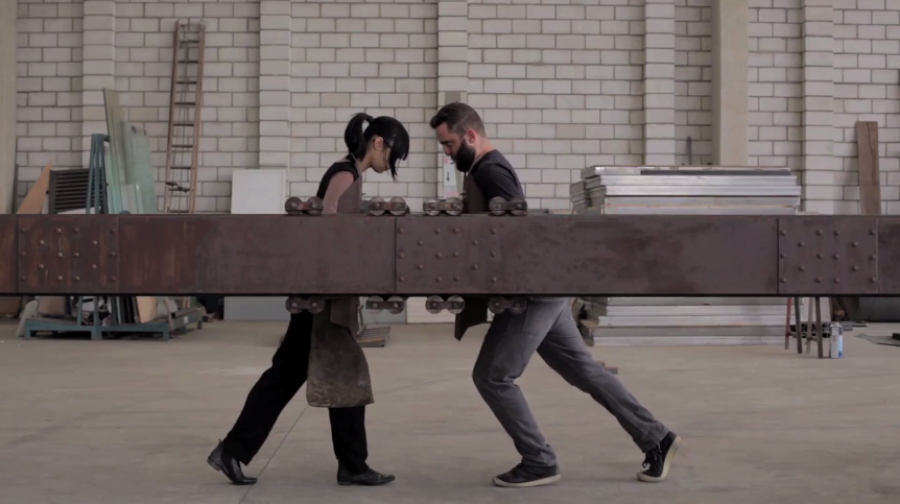
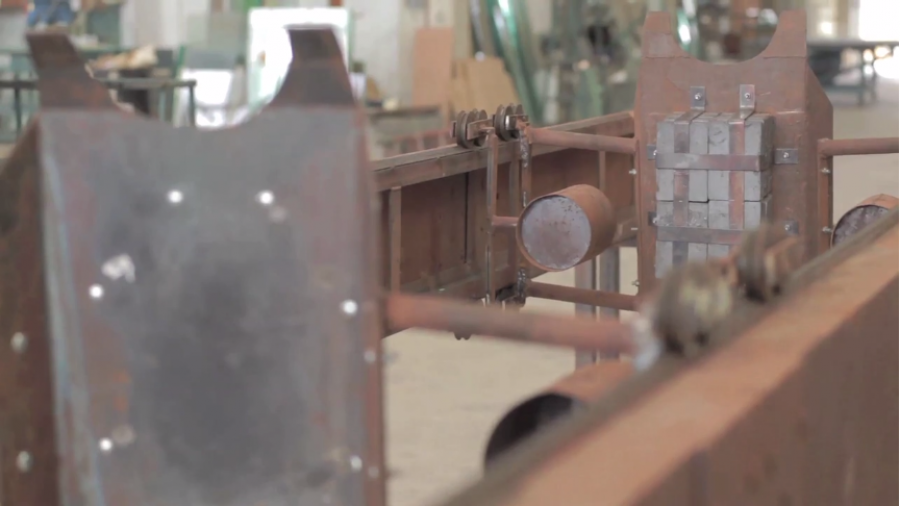
"I was selected for the 2012 Videobrasil in Context award, and from September to December of that year, I underwent a residency at the Delfina Foundation, in London, and Casa Tomada, in São Paulo. The award’s initial proposal was for me to explore Videobrasil’s collection. I immediately set myself to observe the artworks presented at Videobrasil’s 15th Festival, entirely dedicated to performance art — that edition, which took place at Sesc Pompeia in 2005, strongly contributed to my education in the visual arts. The sum of my research, the exchanges established with the artist Paula Garcia and my relationship with the pieces from the collection allowed me to define key concepts to reflect on the proposed installation. These concepts convey the notion of a body controlled by invisible forces, such as power, the spectacle of subjecton (highlighted by Coco Fusco in Bare Life Study #1) and a metallic burial (present in the performance #4, from Paula Garcia’s series Corpo Ruído [Noise Body]). These artworks point to the deletion of a subjectivity derived from the control of the body and its movements. During that period, I also studied other pieces, such as M3x3 by Analívia Cordeiro, who took part in the show Made In Brasil at Itaú Cultural, in 2003. This artwork, which utilizes means of transmission and a coreography for a dance carried out with/for television cameras, allowed me to think about the body’s traverse through information. Other important references were music groups that explore a freer body, the queer aesthetics, such as Solange, Tô Aberta! and Deize Tigrona, among others — in this sense, the developed piece reveals the opposte of the freedom experienced by these artists, highlighting the visible and invisible control mecanisms of the body, like the physical machine that was created and the magnetic field that mediates this relationship.
The partnership with Paula Garcia is the fruit of a long conversation, initiated in 2007. She was doing her Master’s at the Santa Marcelina College, in São Paulo, with the guidance of professor, critic and curator Christine Mello. Back then, we used to attend the same study group, called Technological Arts and Media, also coordinated by Christine. On the occasion, we studied several historical and contemporary artists togheter, and we read several texts, such as Maurice Merleau-Ponty’s Phenomenology of Perception — an important reference for our researches. It was at that time that Paula intensified her work with magnets on the body — and, a few years later, she started to collaborate with the artist Marina Abramovic, in New York, which was also a reference for us, especially the piece Relation in Space, 1976, performed with her former partner, Ulay.
For me, the path toward Estudo para Duelo [Study for a Duel] was paved by Redes Vestíveis [Wearable Nets], 2010. At that moment, I was reading about Lygia Clark’s piece Rede de Elástico [Elastic Nets], from 1974, in which people construct and utilize an elastic net together. By looking at this collective performance, it became clear to me that the notion of network people had in the seventies is not the same anymore. Nowadays, we talk a lot about the perspective of communication networks, as well as an invisble traverse through these networks within people’s bodies, like diagrammatic lines that explode and multiply in spaces. I always try to excercise the way I look at art history by attempting to realize what we are able to grasp and transform within our current practice, minimizing the pieces’ historical fetish. In Redes Vestíveis, I thus created a phone app that turned people into knots in an elastic net, which they could tension through the movement of other people, who were visible on their phones’ interface.
Thereafter, based on this artwork, I began to reflect on the way (intangible) information affects and mobilizes the body. The act of surfacing this concrete dimension from an accelerated affected body, tensioned by technology, made me realize and shift issues brought about by previous generations of artist, who looked at the digital and cybernetic from a perspective that was detached from concrete reality — that is, based on simulation, virtuality and the fabrication of other worlds. I have always desired to understand the spaces of networks like the spaces of cities, which consequently produce direct effects on the lives and bodies contained in them. A circumstance that drew my attention, for instance, was a demonstration at Largo da Batata, in São Paulo, in 2013, when 3G outages took place while all protesters were communicating to organize the event and meet on the streets. The influence of the network on the mobilization and gathering of people in a space became clear, providing me with a certain wish to make the presence of this immateriality tangible in one’s own body.
My work has always been set in this place of immateriality, a spacious and collective agency, with possible physical consequences, as shown in O Transporte #1 e #2 [The Transport #1 and #2], from 2009 and 2011. However, in the beggining of my doctorate study at ECA-USP, 2011-2015, entitled Campos de Invisibilidade [Invisibility Fields], the desire to convey these invisible fields in one’s body in a tangible way was amplified.
To this end, the dialogue with Paula Garcia, who then lived in New York, was once more fundamental. Therefore, in the beginning of my residency, after receiving Videobrasil’s comission, we resumed our conversation about the possible co-creation of an installation, which we had previously initiated in a casual way, six months earlier. We thought that it would make much more sense to conceive this work together. This dialogue remained constant while I built the piece in São Paulo (side by side with our partners). Throughout this development, the presence of the artist was fundamental, as well as the technician specialized in the confection of large installations Paulo Galvão. He had already worked in Paula’s series Corpo Ruído, and he knew how to manipulate structures made of iron and magnets. He conceived the technical design of the piece, and he brought countless aesthetic and conceptual contributions to us. In the beginning, I thought of vests filled with magnets that would make people stick to each other, and repel each other, thus creating a confusing game among the participants. However, in order to make this work compelling, it needed to bear strong magnets, and ensure the safety of the audience at the same time. The most important factor was the desire to make people feel the mediatons of the aforementioned invisibility fields. And the unique confrontation between two people became increasingly powerful. In this process, the idea of a control architecture was consolidated, as it was made explicit within the sensitivity of the participants’ bodies, an invisible field that works as a mediator of the relationships among people, present in many places: in the architectural design of the spaces, in the techonologies, in the relationships, etc. At last, the work became a machine that controls the body and the proximity relation among people. At the same time, the participation of the audience is optional, for the presence alone of the installation in the space already produces speech, in spite of the other layers that come to light through interaction.
As an artist, the majority of my pieces come about in collaborations, through numerous aesthetic and conceptual negotiations, thus reducing the existence of or the desire for a style of my own. This collaborative attitude, hand in hand with other artists, is not soothing at all; on the contrary, it is a constant negotiation of aesthetic, ethical and poetic limitations. Paula and I had extensive discussions in order to reach the piece’s current format. The problem of this idea is that it falls into a kind of self-formalism. It is a problem because each work has an issue that demands specific aesthetic answers, as well as contextual dialogues, not only formal exchanges. The idea of personalization of an artistic creation does not interest me, neither the appreciation of “the artist’s body”. In the case of this piece, for instance, what interests me is giving visibility to this machine, a raw visibility that does not fit the body very well, that is not very ergonomic. This issue interests me as an aesthetic positioning. The idea of public confrontations is also very important. What I usually do is invent a few rules that start a game and bolster the creative process, which often occurs through collaboration and, consequently, negotiation."
Cláudio Bueno in a statement for Platform:VB (January 2016)
Study for Duel, 2013 | Installation
Study for Duel, 2013
Conceptual landmarks | Videobrasil Collection:
#4 (da série Corpo Ruído - Estudo para um Soterramento) | Paula Garcia
Bare Life Study #1 | Coco Fusco
Some relevant theoretical works for the artist:
BARTHES, Roland. How to Live Together. New York: Columbia University Press, 2013
CAUQUELIN, Anne. Fréquenter les Incorporels. Paris: Presses Universitaires de France, 2006
MERLEAU-PONTY, Maurice. Phenomenology of Perception. New York & London: Routledge, 2012