Wallpaper – Tangier
2001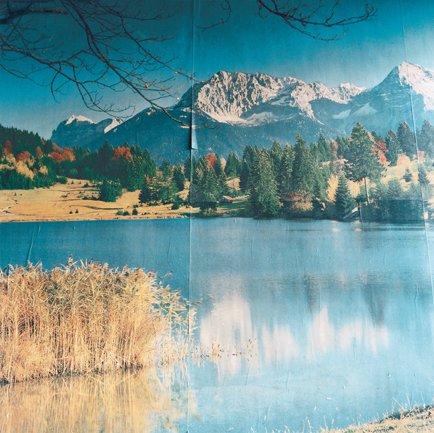
Detail of the piece
João Laia: In 2003, you cofounded Cinéma Rif – Cinémathèque de Tanger. How does your work there relate to your artistic practice? Do you consider your activity at the Cinémathèque to be part of the same line of work regarding your practice as an artist or rather a separate area of activity?
Yto Barrada: The Cinémathèque project began when the group of artists I’m part of formed a non-profit organization to take over the lease of the 1938 Cinéma Rif, on the central square of Tangier. It was going out of business, projecting exclusively scratched old Bollywood films to young men who generally used the darkened room for purposes other than watching movies. We thought it would be a good idea to bring both Moroccan and world cinema back to a local audience. We did two years of fundraising and two more of construction; the Cinémathèque finally opened ten years ago as North Africa’s first cinema and cultural center. We dreamed an ambitious program of art house films; with a series of workshops and master classes, which put world-renowned artists together with audiences, including children, women’s groups, student filmmakers, and non-profit organizations. At the heart of any cinémathèque, there is a film archive, and the CdT has presented selections from its archive of documentaries, Arab cinema, and related films from home and around the world. Something we didn’t anticipate is the way our café has been taken over by the local youth who seem to spend all of their free time there flirting, playing the guitar, singing, using the free Internet, nursing a Coca-Cola, hitting on our interns, and very occasionally going to see a movie. Everybody says a cinema today has to be a destination! At first, the two activities seemed to be engaged in an exhausting competition for my energy and time. I had two full-time jobs, with tons of management, fundraising, and administration to do, and it was really excessive. The experience taught me a lot, though, and over the past couple of years, I’ve come to realize that the CdT is part of my work, a sort of site-specific intervention, which demands a new kind of creativity from me. At the same time, what is happening in and around the cinema feeds into my work. The art world has been quite supportive of the CdT and has understood it’s more than just a movie theater. So now, my two jobs are more or less complementary. I come from a generation of artists from the Arab world for whom “home and away” matters—it’s an exciting laboratory. Three years ago, we hired a fantastic new director, Malika Chaghal, and she has launched very interesting new educational programs with local schools and also local factories.
JL: The idea of traffic seems to be critical in your practice; it can be felt both on the subject of the circulation of images, and also regarding different sorts of population movements. Traffic might relate to circulation but also to stillness, which is an interesting paradox while considering your work. I am making reference, for example, to your interest in Tangier, as a space that is both an entry / exit gate but also a stopping point. For tourists, it is a readily available entrance into the “exotic,” whereas, for Africans attempting to enter Europe, it is a waiting stage. At the same time, Tangier is also a space in motion through the pressure of economic forces related to real estate that went into a halt with the current crisis. Lastly, we can also consider traffic in light of economic dynamics bringing images and objects into and out of Tangier and Morocco. Elements such as the palm tree echo well this sort of paradoxical dynamics. Could you elaborate on these ideas and expand on your interest for the idea of traffic both as movement and waiting through your analysis of the city of Tangier?
YB: Hercules, sent on a mission beyond the end of the world, separated Europe and Africa—creating the Strait of Gibraltar—to negotiate a passage out of the Mediterranean. For decades, the coast around Tangier has been the embarkment point for an ever-growing legal and illegal traffic of merchandise and people across the Strait. The philosopher Nadia Tazi said in an interview that the Strait “is seen not so much as a place but a state of being.” The closing of Europe’s shared border to Moroccans coincided with the arrival of satellite dishes and DVDs in Tangier. So everybody was getting this rose-tinted vision of a European paradise that was forbidden to them. For some time, Tangier was a big existential waiting room. Thousands of people have died trying to cross the Strait. Now there’s a big push to develop the north, and real estate economics is driving everything in a kind of fast-forward transformation of the city. It became, ironically, isolated as a place of transit. So bringing the world to Tangier, since the borders were closed for North Africans, that’s what the Cinémathèque de Tangier was all about. We smuggled culture by showing, sharing, making, importing, and exporting moving images. So in our way we contribute to this complex story of traffic.
JL: While focusing heavily on the city of Tangier, your work has a universal appeal touching upon questions that are similar to issues faced daily in many parts of the world. You negotiate with impressive precision the local / global dynamics facing today’s globalized world. I would like to invite you to elaborate on your use of the palm tree as a local / global identity icon. In Portugal, where I come from, in a different intensity comparing to Morocco, the palm tree is also used as a sign of the South for mostly Northern European consumption, but other less expectable places also make use of this tree. I am particularly referencing cities such as Hyères, also known as Hyères-les- Palmiers, in Southern France, which also employs the palm tree as part of the creation of an image / identity of the place. Could you expand on your interest for the palm tree and illustrate how for you it becomes a tool to uncover economic and political dynamics of a location, and could you give other examples of similar images and objects?
YB: Palm trees are a tropical trope, a symbol of the South (you can find them in Paris, in Gare de Lyon, where trains head South; in Las Vegas where they evoke oases; in restaurants where they suggest dancing girls in grass skirts), and a symbol of colonial empire. The main street palm trees on Tangier’s Avenue d’Espagne were a gift from the Spanish dictator Franco. Tangier is Morocco’s northernmost city, and palm trees are native to the South. So transplanted palm trees are symbols of the centralized power of our administrators: the former colonial Spanish and French occupations, and after independence the Government, the Palace, the Governors, the Technocrats, the Ministries, the Agencies, the Industries… (Until recently, the Agency in charge of developing the northern economy and infrastructures was based in the capital to the south. They just recently moved to Tangier.) Now, any new administrator plants a massive alley of palm trees and lampposts along an avenue in Tangier, on which they also build a dozen geranium-studded roundabouts. We have countless tales about palm trees being moved from one city to another to decorate main avenues before official visits. This absurdist Potemkin-village dance of power (and waste) was the subject of a book and a film I made called A Guide to Trees for Governors and Gardeners, and my table-sized motorized diorama Gran Royal Turismo (2003). In a film called Beau Geste [Literally, “beautiful gesture,” Beau Geste is also the nickname of the eponymous character of the 1924 novel by the English author P.C. Wren, adapted for cinema in 1939 with Gary Cooper in the leading role. The story tells of Michael “Beau” Geste, who joins the French Foreign Legion.—Trans.] I organized a futile gesture of trying to save a Phoenix canariensis palm tree whose owner had made a deliberately fatal notch in its trunk hoping to kill it so the city would cart it away from his future construction site. I also made sculptures of palm trees dotted with lightbulbs that look like outdoor cinema signs or Fun Fair or motel signs.
JL: Videobrasil focuses on the socalled global South as a privileged site of activity and reflection. The global South is considered a geopolitical territory which does not correspond to a geographical area south of the Equator, rather mapping a symbolical area where the impacts of past and present dynamics related to globalization might be looked at from a different vantage point regarding the ever-present narratives originating in the North / West. How would you read your work in the framework of the global South?
YB: Actually, what I am really unearthing, discovering , and learning to read are the strategies of resistance, the “hidden transcripts” of people who are faced with superior power [Allusion to the subtitle of the book by the North American political scientist and anthropologist James C. Scott, Domination and the Arts of Resistance: Hidden Transcripts (1990). For Scott, the domination the oppressed seem to accept in public is always questioned in private, and when that questioning becomes public, the oppressed assume the discourse as their own and become aware of their shared condition. Hidden transcripts are free discourse that flourishes under the radar.— Trans.]. The lady in my film The Smuggler; my illiterate grandmother with her coded telephone books; the illiterate kids who figure out a bus logo route-identification system to escape to Europe, these are all characters of the Tangier I know. So are the sellers of illegal cigarettes, the stowaways and would-be émigrés from a dozen countries further South (who get a foretaste of the reception awaiting them if they ever get to Europe from our Moroccan powers that be).
Interview conducted via e-mail by João Laia on occasion of the 19th Festival (July 2015)
Wallpaper – Tangier, 2001 | photograph
Yto Barrada
Yto Barrada on the ways the Strait of Gibraltar shapes life in Tangier (2012) | San Francisco Museum of Modern Art
Artist discusses the complex realities of life in Tangier, a city poised on the northern coast of Morocco, along the Strait of Gibraltar. [eng]
Artist´s web site
Yto Barrada engana-nos com a arte popular de Marrocos, by Sérgio C. Andrade (Jornal Público, Jun. 2015). [pt]
A Tangier-based photographer and video artist who charts the struggles going on behind the scenes in tourist mecca Morocco, by Skye Sherwin (The Guardian, Dec. 2011). [eng]
Artist Project / A Life Full of Holes. Yto Barrada. (Cabinet Magazine, 2004/05). [eng]
Talking Pictures. Yto Barrada is interviewed by Jennifer Higgie. (Frieze Magazine, Oct. 2011). [eng]
Yto Barrada at Fotomuseum Winterthur, by Olga Stefan. (Art in America Magazine, Mar. 2013). [eng]