Wenzu
2011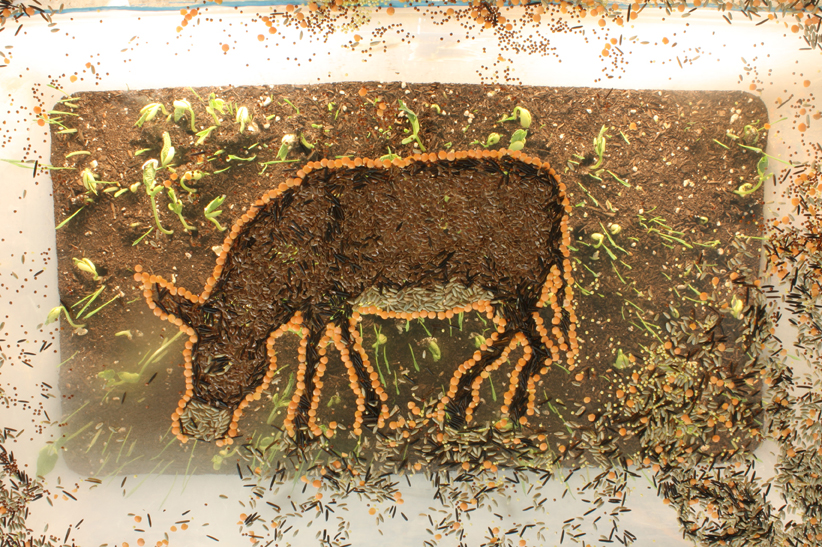
Wenzu (2011), video still
"In 2004, I was working on a collaboration with Jolie Ruelle, a research project about Ethiopian folklore. We spent four months traveling throughout the country. We documented over 100 stories on video camera and sound recorder. Once the journey was completed, we returned to Addis Abeba, to the house were I grew up in. I wanted to hear a story from my grandmother, Tafesech Zeleke, who raised me. She told us the story Wenzu. When she passed away, I decided to make this piece to honor her, to retell the story through the medium of animation.
The initial purpose of the story collection project was to document the oral traditions that were vanishing due to an increased presence of television. Many storytellers had forgotten how the stories went, since they hadn’t been telling them often.
For this project, I built a greenhouse and planted a crop of beans. On a piece of glass suspended over the greenhouse, I used salt, tomatoes, onions, teff and lentil (common ingredients in the Ethiopian cuisine) to animate the story while the beans grew in the background. This piece is an effort to re-experience the story, to bring my grandmother back to life through the growing of beans and the preparation of the traditional food she raised me with.
While working on it, I enjoyed the cool fresh air of the plants. A still camera, connected to a computer and mounted above the greenhouse, captured each frame. This project is the most performative project I have ever done. Since I was documenting the growth of the plants, I could only work forward.
I was regularly visited by insects, especially spiders, and I really enjoyed the company of these unexpected visitors. I also built a strong bond with the planted beans, watching them grow, spiraling up from the dirt into sprouts and then adult plants. After the project was completed, I felt too attached to the beans to take them out of my studio, but I found a place in a park for them.
What could be more aesthetically appealing than food? I find the growing of plants and the act of preparing, serving, and eating food to be poetic. The process is as experiential as the telling of the story, existing only for the moment, celebratory and temporal. Merging the personal dimension with the political one, this piece is perhaps a portrait of my grandmother and her sympathy for the poor (she housed those who were homeless and orphans). The dialogue between the donkey (from the low stream) and the hyena (from up stream) directly refers to class tensions.The two characters in the story are the most common residents in Ethiopia (the country has the second highest population of donkeys in the world).
Today, in Ethiopia, many people know this story, but no one knows its origin, history or author. The story is also insignificant. It is always told as a form of humor, usually a minor complaint about getting pushed around. When someone demands something, this story can be told as a way to acknowledge their manipulative actions.
The making of the piece was unrepeatable, it was a one time authentic experience, but the final outcome of the work is digital. Animation becomes a way to integrate the story back into the changing cultural psyche by putting it on the television monitor itself, keeping the past while moving forward."
Ezra Wube in a statement to PLATFORM:VB (October 2013)
Wenzu (2011) | Ezra Wube
Video | Stop-motion animation, 3’09”, stereo, color, 16: 9, loop
Excerpt from Wenzu (2011)
Testimony Ezra Wube | 18th Festival
The artist discusses his animated film. The story is the outcome of eight months’ collecting popular folklore in Ethiopia, his country of origin, which are passed on through oral tradition
Link to watch Wenzu (2011)
Vik Muniz’s use of materials (especially food) in his photographs interests Erza Wube.
The performance Writing Time with Water (2000), by Song Dong, is also among the artist's references.