Kaleta/Kaleta + Vodunaut #009-#010-#011 (Hyperfielder)
2017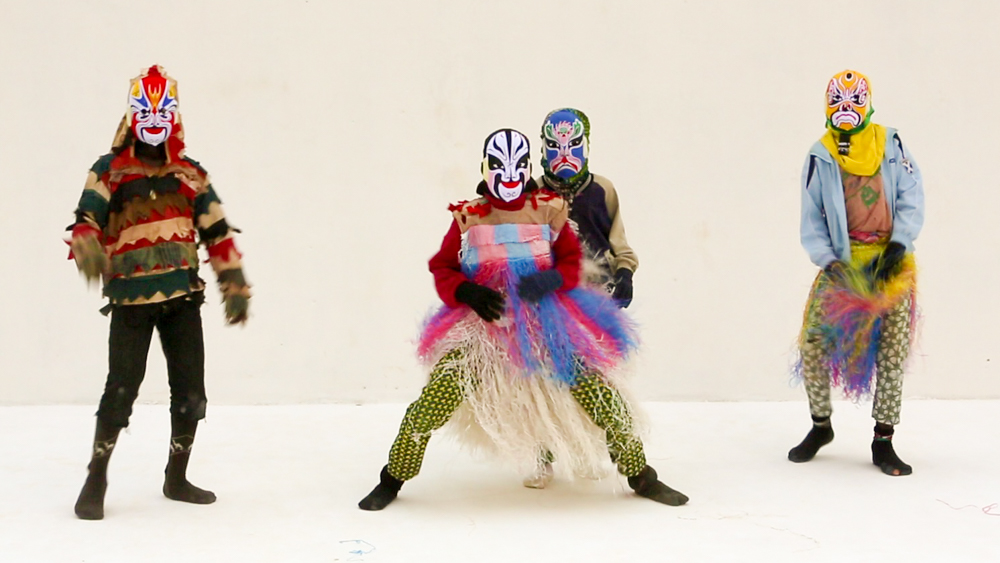
Kaleta/Kaleta
The word ”kaleta” refers to a tradition invented in Benin by Afro-Brazilians returned to Ouidah during the 19th century, possibly after the Malê revolt of 1835. The kaleta tradition is a unique mix of Brazilian carnival, American halloween, and local mask traditions, such as the Zangbeto (guardians of the night). Born from the slave trade, kaleta is anything but a lament: it is a tribute to human resilience and resistance, but also to cultural resilience, since the tradition is passed on by children. kaleta is performed by young boys gathered in small bands during the Christmas and New Year holidays. They go from house to house, dancing and playing makeshift instruments in exchange of small tips. The musicians never wear masks, and their percussive instruments are generally made out of reused material (cans, bottles, pieces of metal, etc.). The dancers are always masked and never talk. They communicate only through gestures and only respond individually and collectively to the name “kaleta”. Kaleta/Kaleta was first shown in Paris at the Palais de Tokyo in 2014 as a performative and monumental video installation, and incorporates hundreds of audio and video bits that can be infinitely recombined, each time producing different pieces and performances, at a tempo of 133 bpm. Its music mixes traditional percussions of Benin, Brazil and Cuba, Jamaican dub, Chicago house music and Nigerian afrobeat. The film piece/instantiation was also shown at the 2016 Marrakech Biennale.
Kaleta/Kaleta is a multidimensional performative installation comprising video, music, and photography. It is called a performative installation because it includes performance in three ways:
Firstly, beyond a "simple" video and sound installation, it entices the participation of the public;
Secondly, like a digital kaleta band, it constantly and autonomously generates performances: never identical recombinations of semantic elements—visual, auditory, and gestural;
Thirdly, it becomes a giant instrument for an artist performance where the artist improvises and plays music and video in real time.
It forms an immersive environment that turns the public inside the installation into visual elements and actors of a performance. Visitors, as soon as they are in the installation, either play the role of Persona, wearing what the analytic psychologist C.G. Jung defined as the "social mask," or can proceed further, "deeper" into the installation and play the role of kaleta by wearing masks that are provided as part of the installation. Some screens are visible only to the kaleta (or masked visitors) thus making the installation a place of initiation, where people learn about this unique African "aguda" (as descendants of Afro-Brazilians and Portuguese are called in Benin) tradition from Ouidah, but also discover its mysteries, creating an intense experience.
Vodunaut
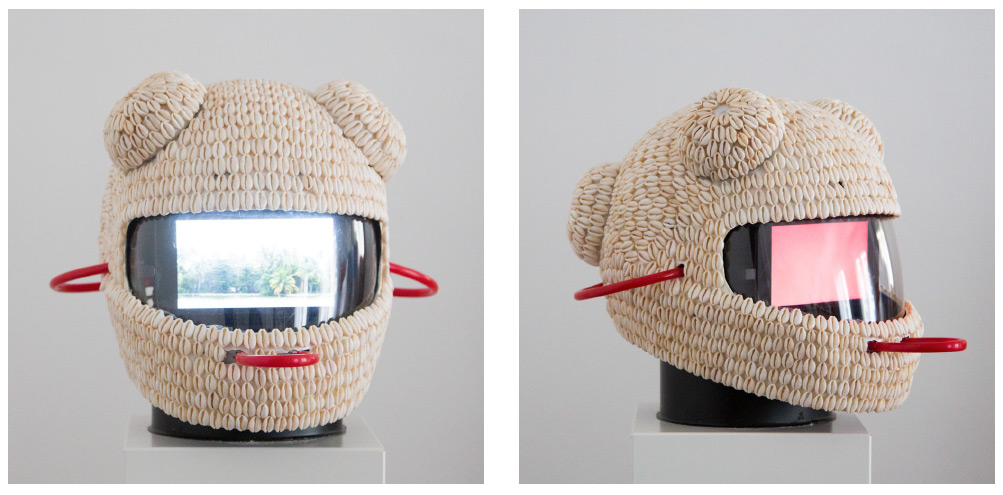
The helmets of the Vodunaut series were born from a fascination for cowries, space navigation, the times to come, and this question: what if a future futurology was based on the fa divination? Fa is a divination system, somewhat similar to the Chinese I-Ching. It is widely used in Benin and Nigeria, and not only describes possible futures, but also how one should react to it, and makes use, among other things, cowries. In the vodun religion in Benin, cowries (because they come from the Indian Ocean) are associated with the symbolism of the voyage, bring protection and good fortune, but also wealth, since they served as currency during the early 20th century. Made of these mysterious and evocative shells, merging industrial design and organic material, Vodunaut incorporates video works displayed on smartphones that firmly connect this series to the codes and semes of their time, emulating electronic brains’ premonitory dreams, travelling between the past and the future, showing video pieces filmed in Africa, America, Asia, and Europe. They invite contemplation and charge the mind with imagination and curiosity.
Kaleta/Kaleta, 2013-2017 | Video installation
Emo de Medeiros
Vodunaut #009, #010, #011 (Hyperfielder), 2016-2017 | Installation
Emo de Medeiros