Varela na Copa
1986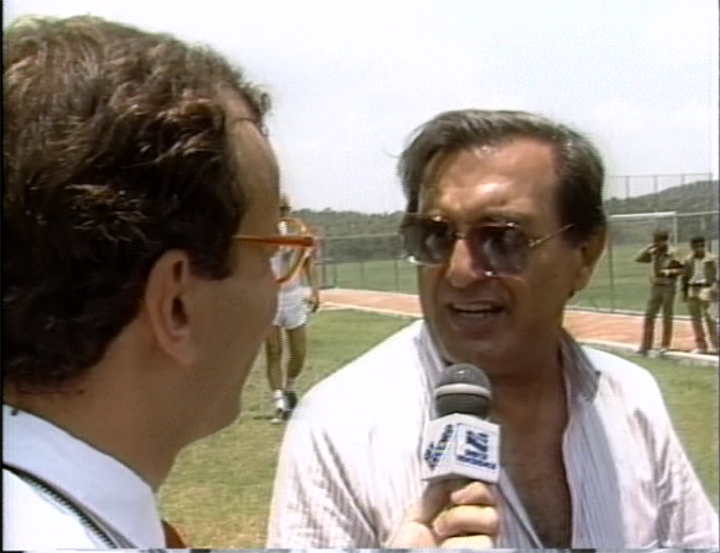
Varela na Copa (1986) video still
"We [at production company Olhar Eletrônico] would switch jobs constantly. Each of us experienced every step in the production process: from driving the van to directing the TV show. And that includes camera work, photography, editing, text, set design, and hosting the show. Oddly enough, the latter was the least pleasant task for most of the group. Hence, when time came to go on camera, we would take turns. Much like when you play soccer and no one wants to play goalkeeper.
In one of my turns playing “goalkeeper,” the rough draft for the Ernesto Varela character came about. It began with a different tone of voice, a nonsense situation, a clumsy way of looking at the camera to mask embarrassment… and voilà! The person that showed in the video was very unlike me. Everyone laughed, and that to me was a big relief. Playing a character felt much better than being myself at that unbearable moment when you have to be in front of that spontaneity-destroying weapon called the TV camera.
We were in the city of Santos and didn’t know what to do with a rainy afternoon. We went down to the coast on a kombi van with two missions to accomplish: recording a concert by Itamar Assumpção at night, and coming up with something to do during the day. We were already feeling the pressure and the voracity of television. It only sank in after our debut. We had two hours’ time to fill each week on TV. And that requires a lot of stamina and ideas galore.
In front of a broken digital clock on the beach, I recorded a news bulletin by the as-yet-nameless reporter. “Surprising change in weather in Santos, 85 degrees Celsius on Gonzaga Beach!” We went back to São Paulo and that naïve joke became a comedy skit for the show. We slapped on a vignette saying 'Santos Urgente' (Breaking News from Santos), the lettering appearing nervously upon a blank paper sheet in a typewriter. To that we added a vibrant soundtrack a la ' CNN Breaking News.' That gave it TV news-like credibility and made the absurdity quite funny. The author of the vignette and cameraman-in-the-rain was Toniko Melo, who is now one of the most creative and active directors in the Brazilian advertising industry.
But my partner on birthing the character that would accompany me for years in my travels throughout Brazil was someone else. As soon as Fernando Meirelles laid his eyes upon the material, it set his mind on fire. Together, we started coming up with a thousand different situations for that embryo of a reporter. We decided he would discuss economics, politics, sports, and interview actual people.
We began with a news report explaining the Brazilian external debt at an abandoned plot on Paulista Avenue. We calculated the price of each banana bunch planted there, on the most expensive square meter in Brazil. And thus we advised the authorities on how to solve the national crisis: by tearing down all of the banks’ buildings on Paulista Ave. and farming bananas instead. The military government did not implement our suggestion, and the external debt remains until this day. But television got a new character: the reporter Ernesto Varela.
An important detail: the famed red spectacles – which became the character’s trademark trait – were an improvised prop, lent by audio operator Fernando Rozo when the time came to record. Now a respected DJ on the São Paulo party scene, Fernandinho used to be a kid full of swagger from the Vila Madalena neighborhood who showed up wearing different color glasses each day. On that day, it just so happened he wore red.
Thanks to Varela, I have had encounters with wildly diverse beings. From Indian chief Raoni to politician Paulo Maluf, from race car driver Nelson Piquet to the Red Army Guard in the Soviet Union, from gold miners in Serra Pelada to singer Chico Buarque on top of the Diretas-Já stage (a demonstration for direct elections in Brazil). Much of the next few years of my life were spent travelling Brazil and the world. [...]
With Varela, we took the camera’s participation to the extreme, which has to do with 'Olhar Eletrônico' (the Electronic Gaze). Unlike traditional journalism, we were not at all afraid to combine fiction, reality, and even the cameraman himself on editing the narrative. Varela began thinking out loud and speaking directly to his cameraman. Thus, there emerged another fictional character, providing the ideal counterpoint to the reporter’s antics: Valdeci, the cameraman.
In the 80s, aside from Fernando, there were two other Valdecis, who were equally partners in creating, editing and directing. Each in their own way, they helped perfect and expand the character. The first one was Toniko Melo, with whom I created the broken clock episode in Santos early on. Toniko was extremely creative and skillful with images, and we had a true professional “marriage.” And this is the exact word to describe it, since we spent most of the time together twenty-four hours a day while covering the 1986 FIFA World Cup. And we also took a historical trip to Cuba, in summer 1985, when we became the first Brazilian TV professionals to film freely on Castro’s island.
Toniko’s talent for cinematography endowed Varela with surprising boldness and beauty in picture. During the Cup we scored two widely commented goals. One was a famous and controversial interview with CBF chairman and congressman Nabi Abi Chedid. The other was a segment featuring exclusive footage we managed to take from the field during Brazilian national team matches. Dressed as a VT operator, I would narrate the game’s backstory, showing scenes the official broadcast cameras did not show. Toniko captured some beautiful images, which seasoned professionals at the International Press Center rated as the best in all of the World Cup."
Excerpt from the testimony of Marcelo Tas, A minha história da Olhar Eletrônico, published in the book Made in Brasil: três décadas do vídeo brasileiro, by Arlindo Machado (Ed. Iluminuras, 2007)
Varela na Copa (1986) | Marcelo Tas, Olhar Eletrônico, Toniko Melo
Video | 60’00”, U-Matic, NTSC, color
Excerpt from Varela na Copa (1986)
30 YEARS VIDEOBRASIL | INTERVIEW WITH MARCELO TAS
Marcelo Tas comments the creation process and the approaches of the caracter Ernesto Varela
30 YEARS VIDEOBRASIL | INTERVIEW WITH GOULART DE ANDRADE
Goulart de Andrade, central figure of Brazilian television, tells how he met the boys of the producer Olhar Eletrônico (Electronic Looking) in 1983, during the 1st Festival, and he also comments the character Ernesto Varela