Uyuni
2005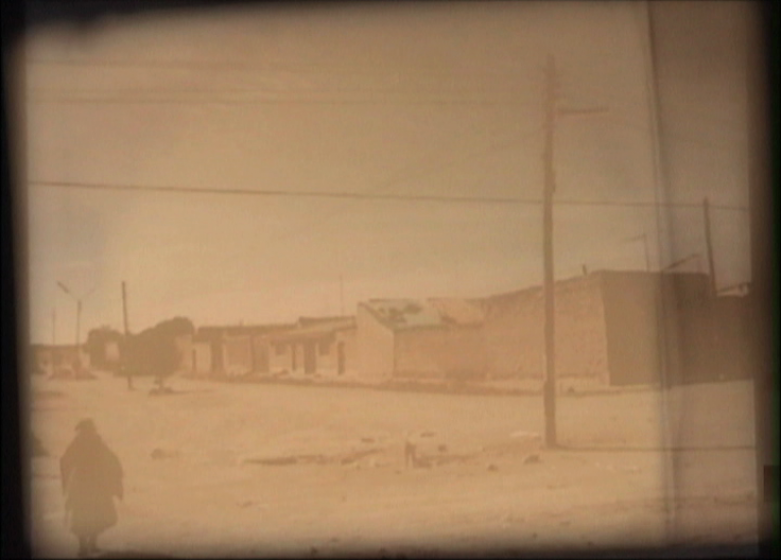
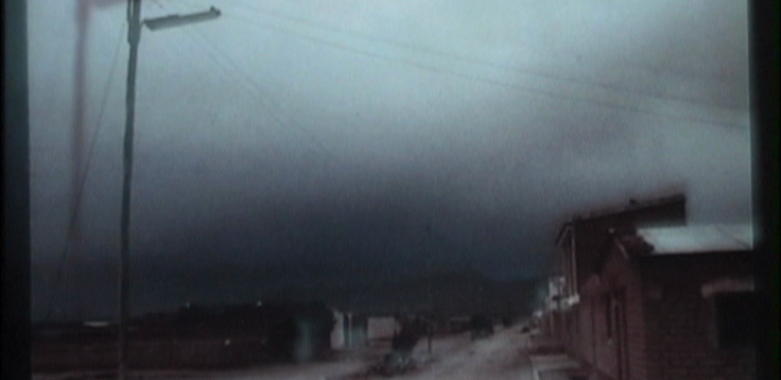
Uyuni did not stem from any research, but from a spontaneous gesture. I enjoy filming, and I relish it. From the exercise of this pleasure came the images that soon turned into this video. They were captured at the end of a two-month trip through the northwestern Argentina and several cities in Bolivia. I carried three cameras in my backpack: a Canon A1, a 35 mm film camera—which I loved and was quickly stolen in Bogotá— a Sony Hi-8, and a Super 8 camera, probably a simple Canon one, I don’t remember the model. During the trip I took only a few photos, the film and video cameras remained in their covers. I wasn’t worried about coming back without having filmed. Arriving in the town of Uyuni to take the train that would take me to the Argentinian border, I come across the exits closed, miners had blocked the roads in protest for decent working conditions, what forced me to extend my stay in Uyuni. It was complete uncertainty, I kept going back to the station for a week and the promise was always the same: the train would leave the following day. The train never left. I had no money to take the tour to the famous salar nearby, a destination where you can only take the train or visit the salar. The only thing I could do was film, record the broad and barren Uyuni streets, which I did with two cameras, and both arms and eyes—all at the same time. I tried to keep the same frame with the video and the Super 8 camera, attempting to capture the same view, at the same time, in two different formats. I understood that the result was to be both similar and different. Arriving in Buenos Aires, I put the images away—the roll of film and the video tape—in a drawer, where they lay for two or three years. In 2004 I was granted a scholarship for a residency at the Wexner Center for the Arts. The project presented for this scholarship was a result of a long research on old Catholic churches, part of Buenos Aires’s architectural heritage. It was ideal for the application, but very dull, an undertaking I honestly wasn’t interested in. Arriving in Wexner, I confessed my complete indifference concerning the 19th-century religious buildings, and proposed to work with the images I had filmed in Bolivia—I had written a dialogue for them, which I recorded in a hurry one day before I left Buenos Aires. A few weeks later, I received Uyuni’s tape in a superb Betacam SP.
Uyuni was an instance of disruption in my production. It is always a well-received video, which was appraised in its time and got me many doors opened. It is a work I love and for which I’m very thankful. But the fact is that its major impact in my production was when I thought that, to me, it was too simple to make hundreds of videos like this, I could do one a week without much effort. The formula is very simple: beautiful images, a nice dialogue—accessible, but not idiotic—, and a general tone lovingly inviting to the contemplation and enjoyment, without leaving aside any trace of progressive thinking, which the intellectualized middle class enjoys so much to see in every work. I had already taken a first step in this direction five or six years ago, when I made Cuando vuelvas vamos a ir a comer a Cantón [When you come back, we’ll go eat in Cantón]. I decided not to repeat myself, I thought art should be blunter, conceptually categorical, away from any form of entertainment. Surely I was mistaken, I could have taken a path to deepen these elements, which didn’t seem enough to me, but I made use of them in some sense. I didn’t want to, I couldn’t. In any way, this led me to a small crisis, which encouraged me to seek alternatives. This is how I started to play with Super 8 projectors and took the necessary step toward the installations I produce since 2006 with different film formats. Thinking this way, Uyuni was important in the negative sense. But it is a work which will always be present, every year someone comments on it, a curator wants to exhibit it, a young artist discovers it and decides to write something to me. In this coming and going, I think, is the basis of a new project, a series of videos that I will start this year with the temporary title of Imágenes conversadas [Talked Images].
I had said previously that I enjoy filming. This may seem very simple, but it is important for me to point out that it implies something meaningful—that my enjoyment of filming means that I hate shootings. It’s not common to address the difference between these two activities. In film schools, the pleasure that filming may create is displaced by the model of industrial production—they teach you how to manufacture a film. At the basis of this gesture lies a solid and subtle ideological element—functionality (solely of appreciation of the capital invested) is at the basis of all capitalist thinking. I am passionate about filming, but I hate shootings. I think I could compare it with the difference between the pleasure of dancing—in a party, with friends, alone in the bedroom with the speakers blasting—and dance as a discipline and career. Dance bores me, it appears to be grotesque, I prefer partying. And nothing seems so boring to me than a shooting, I prefer dance.
I think that is why, when I started studying cinema, I quickly related to video (in that moment there was a substantial difference between cinema and video). Video gave me complete me independence, allowed me to film anywhere with very little crew and minimal pre-production. In the 1990s, I always carried a video camera in my backpack, the smaller the better (that’s how Uyuni was born). I still follow this line of work in my Diarios cuadro a cuadro [Frame by Frame Diaries]—a series of films in Super 8—and in the collective project This is Just to Say. I’ve never written a script, in my work image always comes first—I’m talking about the monochannel works, installations follow a different logic—an image that arises from the pleasure of filming.
I don’t condemn large shootings, or small ones for that matter—the independent cinema is industrial—they simply don’t interest me, don’t give me pleasure. It seems valuable to me to put this poetic difference on the table, which necessarily gathers aesthetic and ideological elements between the two instances of image production—that of the shooting and that of filming.
Uyuni, 2005 | Video, 8’8"
Andrés Denegri
Cuando vuelvas vamos a ir a comer a Cantón (2001) | Andrés Denegri
The whispered text of a small love letter scrolls through the image of four photographs.
I feel embarrassed to admit, the list is made up of an endless string of commonplaces. When I filmed Uyuni, I was submerged in Sam Shepard’s literature, the voiceover text has unquestionably a strong influence of Motel Chronicles or Cruising Paradise, of course shaped by the porteño Spanish from Buenos Aires. I also read a lot of Roberto Bolaño and Juan José Saér, La mayor split my head in half, but its influence would appear later on, in a different video. And from the cinema of Chris Marker, Win Wenders’s documentaries—not his fictions, even less those produced after 1986—, Harum Farocki, Agnés Varda, James Benning . . . the list is quite long and known, nothing exceptional. Perhaps the only singular influence is a video I saw soon after I went to film school, by a visual artist who made three videos, tops: Tango: el narrador (1991), by Luz Zorraquín.