Tomo
2012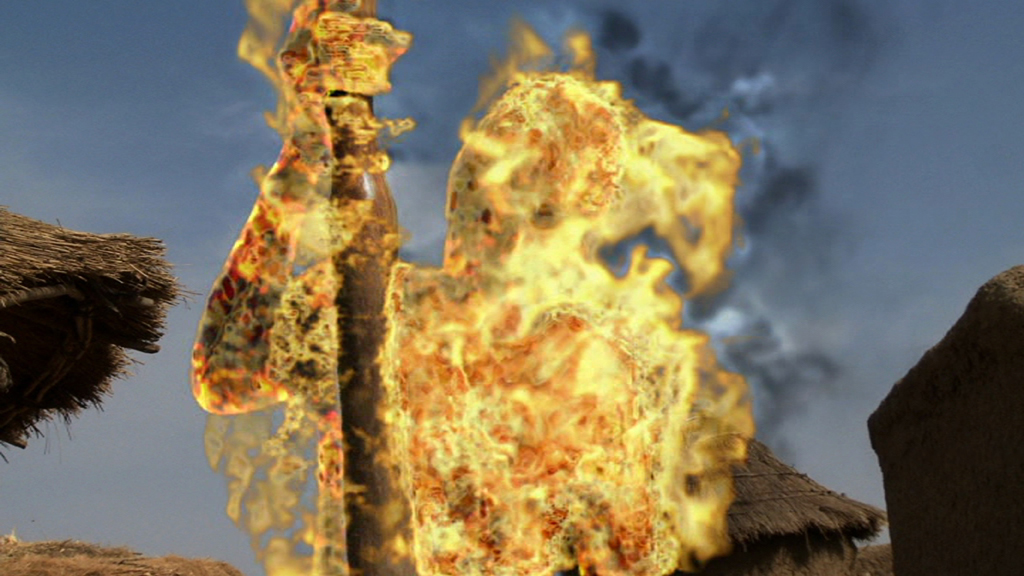
Tomo (2012), video still
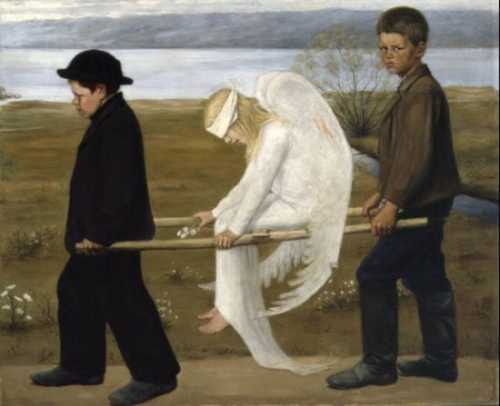
Artist's reference: L'Ange blessé (1903), Hugo Simberg
"Due to political and geostrategic challenges, the dictatorship, fratricidal wars and all sorts of senseless actions by a few ruling elites, Africa was and still is home to agitations of different sorts, like war, genocide and other violent forms of oppression.
Still, it must be known that, in any situation of war and instability in which we either are submitted to or submit the other, no one is spared, notwithstanding their position. And this is so because we are simply human beings.
Tomo literally evokes the Bambara Language, spoken in Mali: an abandoned territory, marked by war. Armed and mental conflicts. He who comes and guides the viewer through the film is reduced to an arm, which presents a troubled gaze. He moves with the frantic steps of a cornered animal, crossing empty spaces and finding only ghosts and signs of abandonment. This film symbolizes the 'tout blessé' [all wounded], that is, the wounds of the body and the wounds of the mind.
In Tomo, the action is unraveled in a universe where the living have vanished, replaced by ectoplasms in a simulacrum of life. Tomo deals with war in general, using Mali’s rurality as a neutral backdrop to the disturbance that war causes to all the psyches in the world. Violence, as it passes, destroys everything around it, in both the physical and mental planes. It is a deserted, hopeless path.
In order to highlight this complex violence, I use objects, cuts, thundering sounds, gasps for air, life’s little sounds, wind noises, percussion sounds, chanting and the crackling of fire and the sun. Phantoms of flame and smoke perform commonplace actions, instead of living beings, close to reality.
The film makes a plea for non-violence; it doesn’t contain graphic images, and it unfolds in an essentially expressive narrative without resorting to psycho-babble or moral issues. Tomo opens itself to mental stress, to the vain and desperate escape, and to collective alienation. Its force and power to disturb are due to a construct in which three levels of space-time perpetually conspire: the past, hallucination and reality. The viewer is at once placed side by side with burning spectra, their own interiority and invisible worlds."
Bakary Diallo in a statement to PLATFORM:VB (October 2013)
Tomo (2012) | Bakary Diallo
Video | 6’53”, stereo, color, 16 : 9
Excerpt from Tomo (2012)
Testimony Bakary Diallo | 18th Festival
The artist discusses his work through the prism of war and instability in his native country, Mali. He claims his video is a denouncement of the violence that plagues and divides his people and causes them to become lost from their own selves, both physically and psychologically
Tomo - La violence vue d'un œil contemporain (2013)
Interview with Baraky Diallo (Alqara TV, Apr. 2013) [fr]
Hotel Rwanda (2004) | Terry George
Reference for the development of Tomo (2012).
Uncle Boonmee Who Can Recall His Past Lives (2010) | Apichatpong Weerasethakul
"Tomo was inspired by this film as it assigned ghosts another function besides scaring people" explains Bakary Diallo. [eng]
Link to watch Tomo (2012)
"This project is based on the work of photojournalists like Eugene Richards, the acclaimed author of the book War is personal (2010), and on films such as Hotel Rwanda (2004), by Terry George. But it is mostly a result of my participation, in April 2006, in the international interdisciplinary conference Les mots du génocide au Rwanda: lire écrire et comprendre (The words of genocide in Rwanda: read write and understand), held in Kigali, Rwanda," Bakary Diallo explains.
"In Tomo, the main character and sole survivor reminds us of the natural catastrophe that occurred in Ancient Italy as Pompeii succumbed to the Vesuvius’ eruption, which left piles of sculpted, phantasmagorical bodies behind."
A report on psychic disturbances caused by wars, organized by Serge Bornstein (Neuropsychiatrie, n. 34, Sep. 1986) [fr]
Carnages. Les guerres secrètes des grandes puissances en Afrique (2010), by Pierre Péan. According to Bakary Diallo, this is a book that "features a poll about the roles of the USA, Great Britain and Israel in African wars, including theories regarding genocides in Rwanda and Darfur."
République démocratique du Congo, la plus grande guerre d'Afrique, a translation of the original Africa's Great War, by Sven Torfinn (The Economist, Jan. 2003) [fr]