Todas as vozes
2011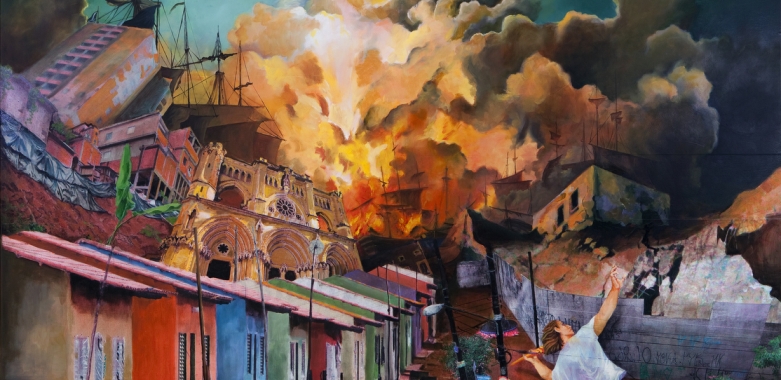
Todas as vozes (2011). Painting/collage made by Carolina Caliento on the occasion of the 1st Ateliê Aberto Prize, displayed at the 17th International Festival of Contemporary Art SESC_Videobrasil.
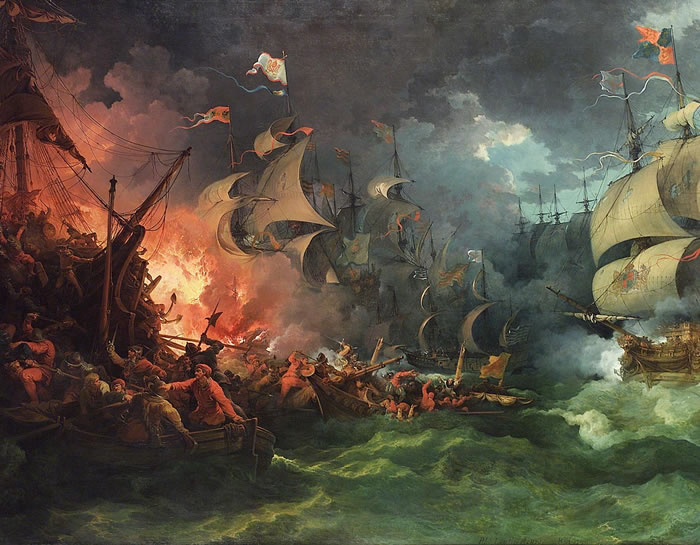
Referência da artista: Defeat of the Spanish Armada (1796), de Philip James de Loutherbourg.
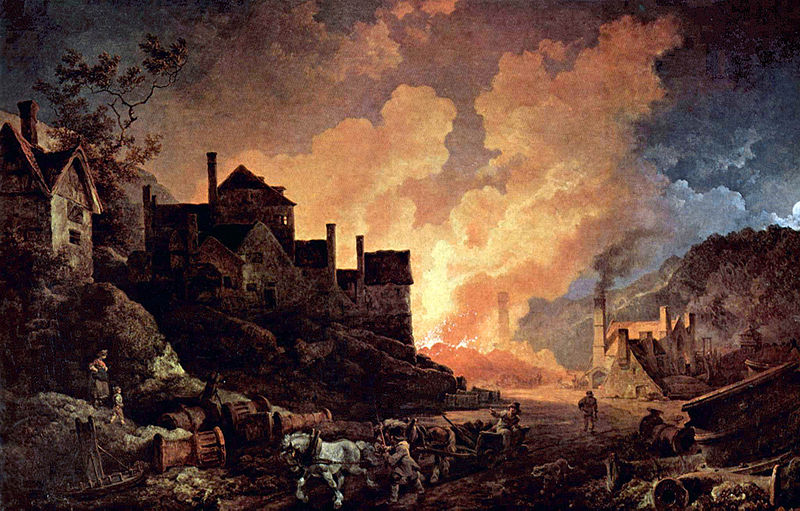
Referência da artista: Coalbrookdale at night (1801), de Philip James de Loutherbourg.
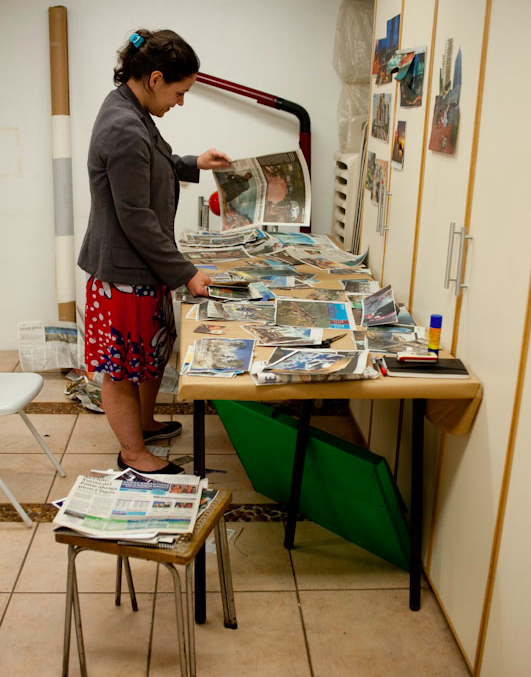
In residency.
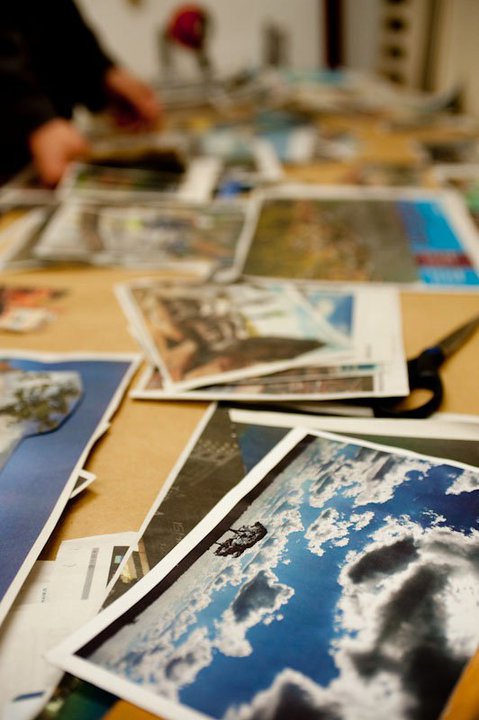
In residency.
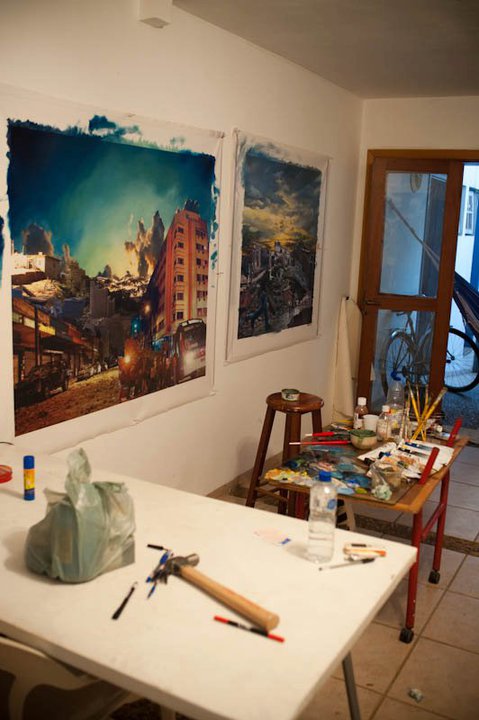
In residency.
I would like for our conversation to address the changes that have taken place with regard to some of the issues featured in your work. At our first meeting, I remember you discussed the negation of an autobiographical language, and a concern with context. Other issues included a return to painting, to references from historical paintings, the materiality of photography, and the use of picture archives. I cannot forget that you mentioned the “undeniable recording of what is real;” that the sky is sublime to you; and that these aspects combined are what provides the dramatic charge in your work.
Gal, first I would like to discuss these highly personal poetics. Maybe I haven’t expressed myself properly, because it’s obvious that I also work based on personal poetics. This is not merely a negation of autobiographical poetics. What moves me is the fact that I want to discuss the city, the perception of pictures in language planes, and how I articulate elements to transform a work of art. When I mention this negation, I am defining what I don’t want to do, which is to work in highly autobiographical contexts that do not interest me. I’m not even sure whether this is noteworthy. Because, of course, I also see things and I work from my own perspective, from a very personal perspective and a very personal poetics. This must be made clear.
I guess this had become quite clear to me in the past. Your gaze was not inbound, it was not diary-like, it was not meant to reestablish intimacies, even though these things may exist; but I have always noticed a concern with the surroundings, a dialogue with what is on the outside; a concern with retaining these relationships with the external. No matter how relationships may be subjectively and particularly driven. I believe that what you are saying does not deny this.
This is a hard field to discuss because I believe it involves other aspects. Negating everything is not productive. I have a desire to tackle the world and to tackle other things that concern other people than just me. This has to do with social context. I work based on something I believe is common to everyone. These are printed media pictures from major outlets.
Lately I have been thinking that my work comprises many fragments which come together and create tension amongst themselves. And also that our experiences are fragmented. The way things circulate and the speed at which we come into contact with information also dilutes the experience a lot and increases this fragmentation. And then, all of a sudden, a sequence of different things passes before our eyes, and we end up taking them in as a whole: scenes of the world, of life, from the most absurd soap opera to war and advertising. And it is surreal. I brought one of these newspapers that get handed out in the subway with me. And on the cover is there is a Dorflex (painkiller) ad. The entire cover is an ad.
It is a fake advertisement cover.
I’ve brought the newspaper; I need to show it to you so you can understand. “The world where no one feels pain” is the title of this ad, which is a fake cover. And it seems very real, but it’s an advertisement. After reading this cover that says no one feels pain, we see the actual newspaper with a headline about some bicycle rider who died after being run over. I believe these regular language data are what moves me to work with this type of material. I am still doing guesswork to a great extent, considering hypotheses, but I think the dimension of the impossible doesn’t exist today. Any and all absurd event can happen; desire can always be fulfilled. I believe a certain measure of the worldly experience has gotten lost. There are other tensions brought about by advertising. The physical space has become a scenario of accommodation. It is a materially palpable dimension: a space on which I act, dominate, and modify. But the space is a given, whereas the actions are mediated by a certain idea.
Interview conducted by the researcher Galciani Neves with the artist Carolina Caliento during the residency program Ateliê Aberto #4, a partnership among SESC, Videobrasil and Casa Tomada.
[download the whole interview below]
Read the whole interview published at Convivências #4, launched on the occasion of the residency program Ateliê Aberto #4. [pt]
In residency.
In residency.
In residency - week 3.
Galciani Neves blog on the project.
Carolina Caliento blog on the project.
About Historical Painting.