Tocaia
2013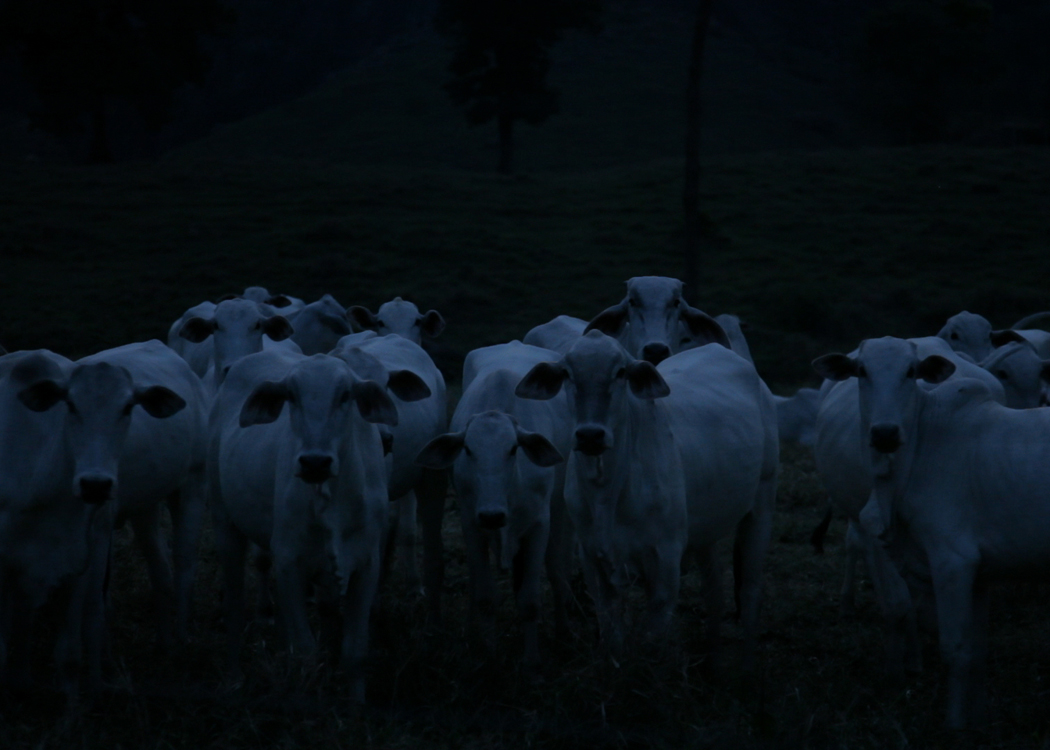
Tocaia video still
"They say the tocaia (ambush) is an invention of the Tupi Indians; it means a small house in which one waits for game while hunting. In the north of the state of Minas Gerais, near the border with Bahia, is where the seminal image for this video installation was discovered. It was the pasture in a farm, by a dirt road. A film crew, a camera and direct sound in position next to a fence, facing a herd of oxen on the other side. It was late in the afternoon, and with every second that passed, the comings and goings of those beings grew more and more mysterious. The hypnotic motion, the natural repetition, a loop loaded with suspense, difference and absurdity. This ambush spawned Tocaia, a recording of that one-of-a-kind moment.
The research leading to this piece arose from an imaginary hunt between the camera and the animal, a method we adopted during the filming for O Bagre Africano de Ataléia, a medium-length film made between 2009 and 2014. The film guided us into a dimension of parity between fiction and nature; it pointed to the act of hunting something as an open mirror, between the reflection and the animal/other, based on local experiences and accounts from the residents of that small town.
In relating to the animal that sees us, we cannot help but remember Jacques Derrida in The animal I chase is the animal that therefore I am. Nature encircles us and lures us with the magnetism of a black hole for which we know no explanation. There’s something that places us in the center of a mystique that sucks us in physically, no matter how we try. We share the belief that making a movie has to do with experiencing an imagetic hypothesis of the world. We are subjected to the mysterious ellipses that feed the creative spirit, preparing the gaze for what was never imagined, experiencing the risk of a free, experimentation-oriented approach.
While filming in the north of Minas, we were enchanted by oral accounts from the residents of Ataléia and by the natural flamboyance of the region. We would travel adrift with our team, conquering the useless, the intangible, to quote Werner Herzog, a landmark when it comes to expedition movies. There was a script of initial intentions containing scenes with the Potoo bird, which is widespread in the region and known as mãe da lua (mother of the moon), or with a snake that would face us squarely. Captured snakes are collected in bars in the Minas backcountry, and they are also part of the narratives of some indigenous peoples in the state’s countryside, such as the Maxakali, who fall ill when they are unwittingly spied on by the vipers.
The event portrayed in the piece was not scripted or pre-produced; it was discovered as it happened. The camera is present as a mediator of the trance between man and nature, the long shot sublimely presenting the relationship between the observer and the observed. In order to share the experience of this moment when man and animal meet, of the mysterious and unspeakable that take place between the film apparatus and the reality it confronts, we opted for an installation-based format for this piece."
Aline X and Gustavo Jardim in a statement to PLATFORM:VB (July 2015)
Tocaia, 2014 | Video, 3’
Aline X | Gustavo Jardim
Uncle Boonmee Who Can Recall His Past Lives (2010) | Apichatpong Weerasethakul
Reference to the artists
O Bagre Africano de Ataléia (2009-2014) | Aline X e Gustavo Jardim
Reference for Tocaia
"Tocaia is a follow-up to art concepts seen in other works of ours, such as the interest in experimenting with the documentary film genre, the fraying of the boundaries of image/reality and its screening contexts, aiming at participation, at the sensory, at heightening audiovisual enjoyment.
The animal is a problematizing element present in several literary works that were used as references. This piece directly or indirectly relates to Jorge Luis Borges’ imagined animal, to Herman Melville’s lyrical scientific animal, Derrida’s philosophical animal, Graciliano Ramos’ political animal, Saramago’s human animal, the Brazilian mythical Macunaímical animal, and the nightmarish animal of Uruguay’s Comte de Lautréamont.
We are also interested in video art, expanded cinema and audiovisual installations: the cinema of Herzog, Kubelka, Pelechian, Béla Tarr, Apichatpong, Peixoto, Tonacci, and Sganzerla. The quasi-cinema of Oiticica, the video experiments of Paik, Fluxus and Gutai, the installations of Bruce Naumann, Bill Viola, Anthony McCall. These were authors who were purposely not paying attention to boundaries, who experiment with the social functions of the artist, the public, the critic and the cultural agent. All of these references from theoretical and practical fields add up to the fuel that propels our work forward.
As for our method, we strove for collaboration, for horizontal, interdisciplinary practices. Since the research stage, we tried to establish a conversation with everyone who helped create the film. An experimental film in the sense of the practice employed during its creation, Tocaia is the direct outcome of the involvement of the artists that made it: the direction of photography by Lucas Barbi, the image colorization by Lucas Campolina, and the soundtrack by O Grivo.
We worked in a duo, individually, and in collaboration with other transdisciplinary art groups and processes that intersect with education and research projects, such as REPIA (Advanced Interdisciplinary Research Residency) and MarginaliaLAB (Art and Technology Laboratory). In Belo Horizonte, Aline is the director of OITOOITO, audiovisual and art research and production, and Gustavo is the founder of DuRolo Filmes.”