The Atlas of Places Do Not Exist
2015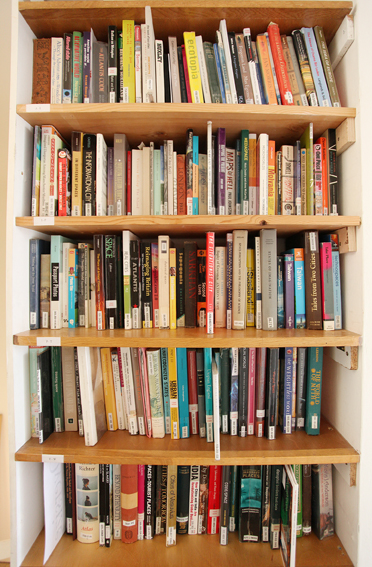
References for the development of the piece
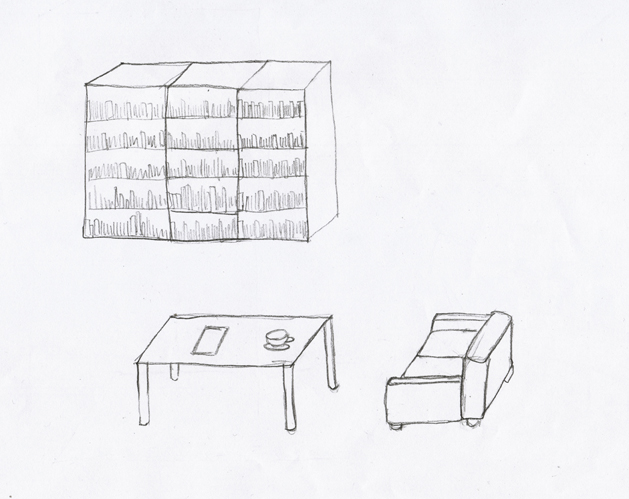
Study for the work
João Laia: Among other questions, your practice has been exploring the relationship between language and identity. The Atlas of Places Do Not Exist, consisting of a library that collects books, works around these ideas through the lens of literature and writing. Could you elaborate on how this idea developed?
Ting-Ting Cheng: I am interested in communication, symbols, interpretation, coding, decoding and their hidden connotations. Language, for me, is not only a means to communicate with others, but also the badge of our identity. That is the reason several of my works are either text-based, or include text or verbal language. And I wouldn’t see The Atlas of Places Do Not Exist out of this context. The project started as my experience of being detained at Gatwick Airport for one night. In the detention room, there was a bookshelf filled with books. There was not a consistent theme in the selection. There were romance novels, crime, science fiction, and of course the Bible and the Koran. After I was released (luckily), I wanted to reconstruct that bookshelf. I contacted every airport in UK, asking if I could visit the detention room to get the booklist, and of course I was rejected. However, the experience made me think about the physical space and location of the detention rooms. I was on the physical territory of Great Britain, but at the same time, in a symbolical way, I was not. I hadn’t yet entered the country. Somehow, I was in an in-between place. So, where was I? And as an immigrant myself, migration is another constant theme in my work. I am fascinated by the in-between status. Does this grey area "exist"? Who’s responsible for the people there? "Existence" became the key word. What is visible/invisible, reachable or unreachable? To tangibly exist or to exist virtually? So, I’ve decided to build this library as a physically existing space, filled with concepts of non-existence. I am hoping to explore and discuss the definition of existence with the audiences through the books I chose.
JL: How did this specific commission influences the development of the project, and how did you go around in selecting the books?
TTC: The original concept of the project is to build a real library containing books about places that do not exist. By real library, I meant hundreds of books, a proper cataloguing system for audiences to search for and browse through the books, and a comfortable, quiet sitting area where they can read the books. I experimented with it for the first time at a curatorial residency in London, invited by curator Oona Doyle. The exhibition was held at the residency itself, the domestic space where the curators lived at the time. It was a very unusual space for an art exhibition, being more of an everyday environment we encounter daily, which was/is perfect for my project. I intended to construct this library as if it would be there all the time, inviting audiences to interact with it comfortably. I used the bookshelf, which on this occasion was next to the kitchen, and the kitchen table and chairs were used/reframed as the reading area. With the help of Goldsmiths College, I managed to borrow 200 books from their library for the exhibition. Despite the fascinating context of this first experience, Videbrasil’s commission is the first time I have the chance to properly realize the project in its ideal scale. The library contains 250 English books and 250 Portuguese books, covering all areas regarding places that do not exist, such as politics, philosophy, religion, sociology, fictions, health, environment…etc., with a catalogue that does not only play its functional role for audiences to navigate the library, but also opens up discussion about the essence of places and existence. The research process was also a very interesting experience. It was the first time I included books in languages other than English, so the work can be closer to local audiences. And trying to understand a language I cannot understand (Portuguese) somehow became part of the concept, which can be traced back to my other projects, in which I tried to learn a language I cannot understand in order to fit in a new society.
JL: Videobrasil has been progressively inquiring the idea of the so called Global South, which is an imaginary geo-political location, embedded in a number of complex symbols and histories. How do you think the interest in this symbolical location might contextualize your project?
TTC: I found the concept of Global South fascinating. And yes, it’s very related to The Atlas of Places Do Not Exist. The Global South is a place that does not physically exist. It’s a concept of south. It’s relative. Using Taiwan as an example, I had the need to confirm with the organization to make sure whether I am from the Global South or not. Is it defined politically, economically or historically? It’s a power relation between nations. I am very happy to have the chance to present the project in this context. It’s like an atlas within a bigger atlas. The matters of geopolitics, economic, and art history raised through the events weave the atlas I mapped together with the wider context of the festival. I imagine the factor of unbalanced power relations in my project would emerge further here. In the other way around, I hope the atlas I am presenting can be a good footnote for the festival, focusing on the relativity of geographical locations such as South or North. The atlas is subjectively mapped by my own selection and definition of places that do not exist, hoping to raise questions around the concept with others about alternative mapping systems and the possibility of changing current relations.
Ting-Ting Cheng in a interview to curator João Laia, member of the Curatorial Committee for the 19th Festival (July 2015)
The Atlas of Places Do Not Exist, 2015 | Installation
Ting-Ting Cheng