Teque-teque
2010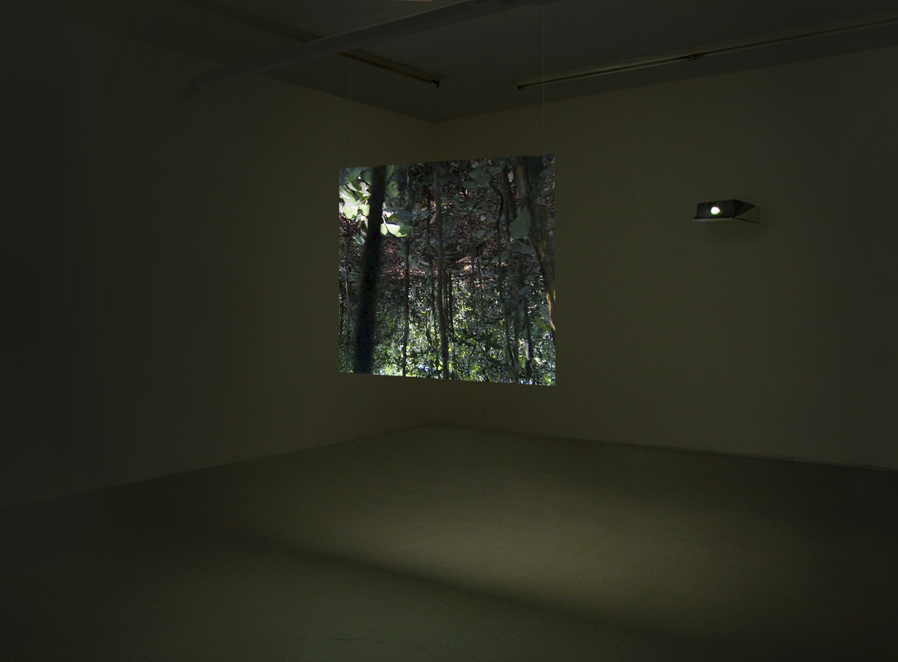
Teque-teque (2010)
"Teque-teque arose from a parallax test I made using an old 16 mm camera. Before a film is made, several tests are carried out, mostly to check whether what is seen in the display is what has actually been recorded on the negative. I also made engine tests, in which I filmed forward and backwards, using different focuses and speeds.
On seeing the results in the lab, I had the idea of cutting the film in the unsteady pace of the call of the teque-teque bird, a small bird endemic to the Atlantic Forest now threatened with extinction, as its habitat disappears in the hands of men. Over the course of 38 seconds, the image spins, inverts, turns upside down, changes focus, making all possible combinations, like an exercise in minimalistic art.
Teque-teque is my first piece with image in motion, and it foreshadows many of the features of my later films, like the ‘nature-culture’ relationship, combined with a structuralist approach to the medium. The goal was to allow for video to be apprehended as a physical and sculptural medium, in relation to the spectator’s body and its movement through space. The phenomenological experience is very important in this piece. Its brevity leaves the viewer in a cycle of light-darkness and movement-stillness, which repeats itself, continuously altering one’s perception of the work.
I always try to set forth reflections about a specific medium, be it sculpture, film, photography or drawing. However, it was through making movies that I began to work with teams. I really enjoy these collaborations, especially when they are made with people from other fields, such as filmmakers, engineers, architects, scientists, philosophers… In this sense, my work is becoming more and more complex (this may become apparent only two years from now, perhaps). Learning different ways to face problems fascinates me, and the contact with other disciplines never fails to surprise me. The question is: how do we stay creative?
Anyone who thinks about the tropical rainforest is bound to end up reflecting on issues of colonial appropriation, cultural domination, ecology, sustainability, development… All these issues converge in the dense mesh that crosses the forest. Still, there is also a sociopolitical narrative that manifests itself only in the nature of the forms or materials used in this piece.
The work of art is always the product of frictions present in the context in which it is born, and it tries to influence such frictions, although it may not tackle them directly or explicitly."
Daniel Steegmann--Mangrané in a statement to PLATFORM:VB (October 2013)
Teque-teque (2010) | Daniel Steegmann-Mangrané
Video installation | Video. 0’38”, suspended Vikuiti screen, 115 × 92 cm, surround sound (4 channels), color, 4 : 3, loop
Teque-teque (2010)
Teque-teque (2010) details and setup at the exhibition space of the 18th Contemporary Art Festival SESC_Videobrasil
Learn more about Teque-teque on Daniel Steegmann's website.