Teoria das Bordas
2007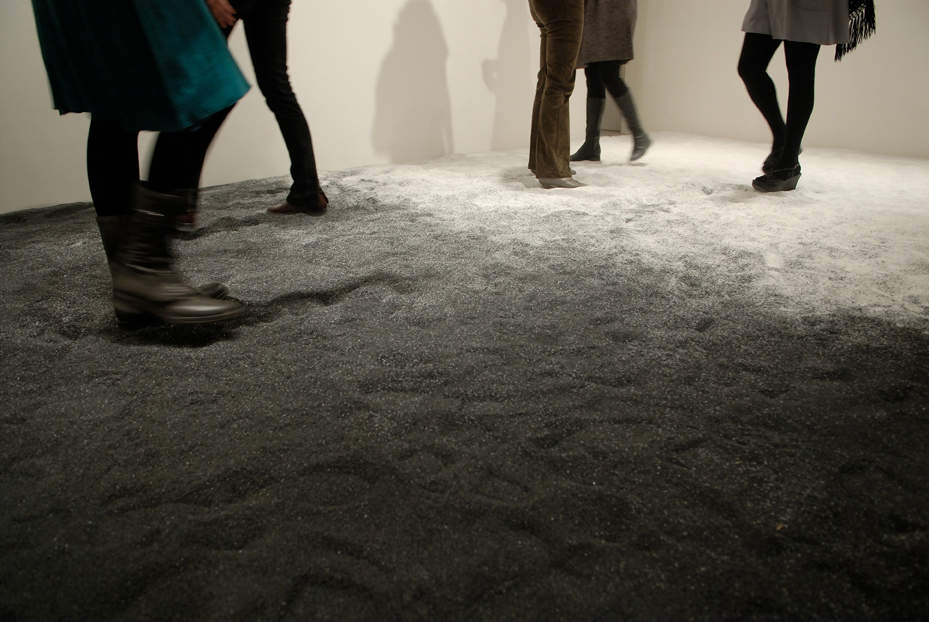
Teoria das Bordas (2007)
"The piece Teoria das Bordas (Theory of the Edges, 2007) consists of covering half of a floor with a layer of black granitine and the other half with white granitine. Its geometrical aspect is reminiscent of the concretist tradition of Brazilian art, and as one walks over it, its geometry gradually comes apart as the outer edges dilute into dark grey.
We may wonder what edges the piece refers to. Is it about a merely geometrical construct, or does it point to other instances? Could it be regarded as a metaphor? For what? On setting forth a theory, what would be its nature, its scope? What moments, situations and works is it reminiscent of? Because it is a piece with a simple constructive principle, Teoria das Bordas becomes a sort of mental scheme, a framework capable of feeding various conjectures.
I chose to use granitine — a type of rock dust similar to sand, made from leftover ground rocks – to indicate a moment of crisis in my work. Both symbolically and effectively, the installation was made from the ruins of other works of mine that used rocks.
Teoria das Bordas dates from the same year in which I completed my master’s thesis in Visual Arts, Sobre as possibilidades da impermanência: Fotografia e Monumento (On the possibilities of impermanence: Photography and Monument). While I was preparing to defend my dissertation, a couple of months after having shown the piece at the Novembro gallery, in Rio de Janeiro, I stumbled upon an experiment proposed by Robert Smithson, in his text A Tour of the Monuments of Passaic, New Jersey, which the artist describes:
'I should now like to prove the irreversibility of eternity by using a jejune experiment for proving entropy. Picture in your mind's eye the sandbox divided in half, with black sand on one side and white sand on the other. We take a child and have him run clockwise in the box, hundreds of times, until the sand gets mixed and begins to turn grey; after that, we have him run anti-clockwise, and the result will not be a restoration of the original division, but a greater degree of greyness and an increase of entropy. Of course, if we filmed such an experiment, we could prove the reversibility of eternity by showing the film backwards, but then, sooner or later, the film itself would crumble or get lost and enter the state of irreversibility. Somehow, this suggests that the cinema offers an illusive or temporary escape from physical dissolution. The false immortality of the film gives the viewer an illusion of control over eternity — but 'the 'superstars' are fading.'
Although this is a widely known text, no one mentioned it upon viewing Teoria das Bordas. Because I was not familiar with it either (or, at least, I had not recalled this excerpt), I cannot list it as a reference.
This is a rather interesting fact regarding the very notion of references: even though my work is chronologically posterior to the experiment proposed by Smithson, the experiment is, to me, posterior to my work.
I arrived at a very similar proposition through a distinct path, independent from Smithson, an artist in whom I became more interested after reading Hélio Oiticica. At that particular time, I was rather interested in artists like Félix González Torres, On Kawara, Christian Boltanski, Rosângela Rennó and Nan Goldin. I also read texts by Walter Benjamin and Roland Barthes. I was working on issues of temporality and its forms of representation, as well as anything that might point to the notion of impermanence, finitude and erasure. Hence, my interest in photography, monuments and historiography.
There is one particular piece which made quite a big impression on me (and still does), although I have never seen it up close: the piece presented by Laura Vinci at Arte/cidade 3 – A cidade e suas histórias, held in São Paulo in 1997. She drilled a hole on the roof of a building, and, in that hole, she laid a bunch of sand, building a sort of giant, irreversible hourglass. I can say that this piece inhabits my imagination; it takes part in a set of things that make me think and keep producing."
Lais Myrrha in a statement to PLATFORM:VB (October 2013)
Teoria das bordas (2007) | Lais Myrrha
Installation | Black-and-white rock dust, variable dimensions
Teoria das bordas (2007) details and setup at the exhibition space of the 18th Contemporary Art Festival SESC_Videobrasil
Testimony Lais Myrrha | 18th Festival
The artist highlights temporality as a key element her the piece, which transforms as the exhibit goes on. According to her, each time the piece is shown, her own understanding of it is enriched by what she calls the “ruins” of past works
On the Concept of History (1940), by Walter Benjamin, one of the artist’s references.
Other works made by the artist, with rocks: Sem titulo (Beije a mão da sua imagem) (2001), Deslocável (2001), 4 coordenadas topocêntricas e a construção de um possível horizonte breve (de I a XI) (2005), Dicionário do impossível (2005)
Lais Myrrha’s website