Suara Putra Brahma
2010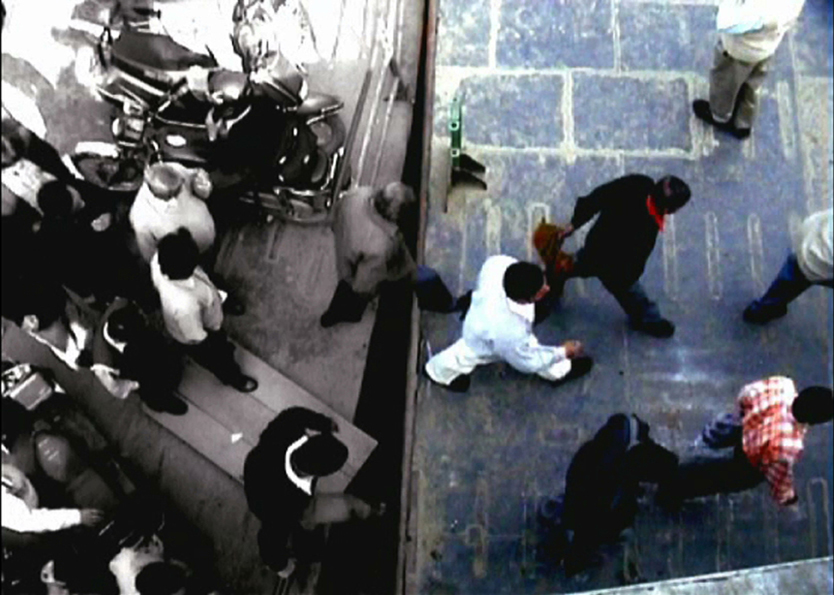
Suara Putra Brahma (2010), video still
"I made this work in three steps. Initially, I did a research on the history of the little Sukreswar Port, in Guwahati, India. I tried to understand the socio-political situation in North East India through the newspapers, which are always filled with news of the conflict between the Indian Government soldiers and militant groups, like the United Liberation Front of Assam (ULFA). I also researched books, maps and fictional novels.
The second step was to go deeper, to 'plunge into' my field of study. The meaning of 'plunge' here is: to live with my subjects, to eliminate 'the distance' between us (me and the people from Sukreswar). So I hung out, chatted, drunk with them, slept in their houses. I wanted to experience being a citizen in that little port. And, when the people of the Sukreswar port accepted me, I started to record their daily activities with my camera.
When I came back to Indonesia, the third step was to watch all of my recordings. Then, I decided that the footage of the people crossing the Brahmaputra River represented the most important thing I wanted to discuss, regarding Sukreswar. Brahmaputra is the only river in India that has a male name, and it splits Northeast India in two parts: North and South.
I tend to make political pieces. And the political matter here is not only about the issue or the subject that I want to address, but also about the impact the piece has on society. How is this piece able to communicate my statement or my position regarding the issue I want to discuss?
The brief narratives told by the citizens are important references to my work. I invite the audiences to reflect upon global issues through small and personal narratives. This is how my work can draw the audiences' experiences or even relate to the audience’s impressions on the issues I adress.
I think about the artist's position in the society. Especially when art imagines and creates changes for the future.
One may say I lve in a country with a messy system. Its socio-political context reflects roles which are still in disorder. But I love living this messy life, because it keeps me awake to analyze, respond to or even seek a realilty."
Mahardika Yudha in a statement to PLATFORM:VB (October 2013)
Suara Putra Brahma (2010) | Mahardika Yudha
Video | 3’49”, stereo, color / B&W, 4 : 3, loop
Suara Putra Brahma (2010)
Testimony Mahardika Yudha | 18th Festival
The Indonesian artist discusses the experience of undertaking a residency in india, where he created Suara Putra Brahma. The piece explores the civil conflict waged by a separatist moviment in the Assam area