Deslocar
2015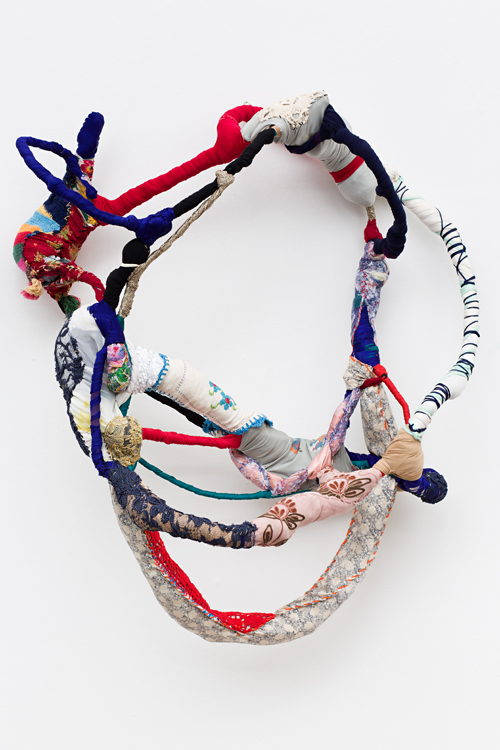
Installation detail
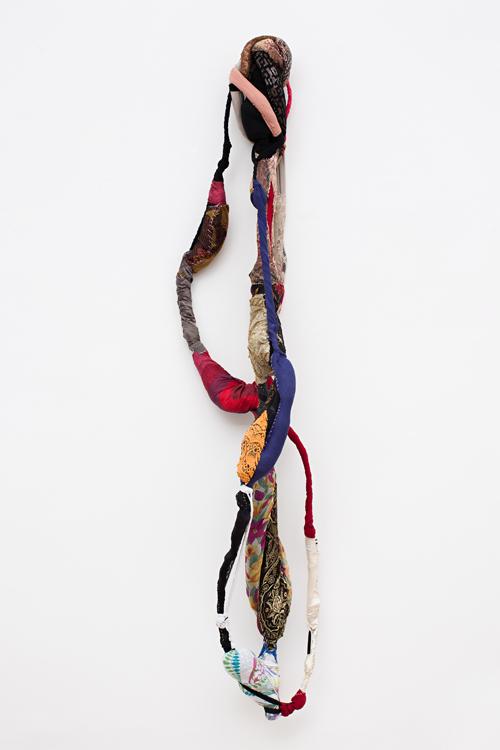
Installation detail
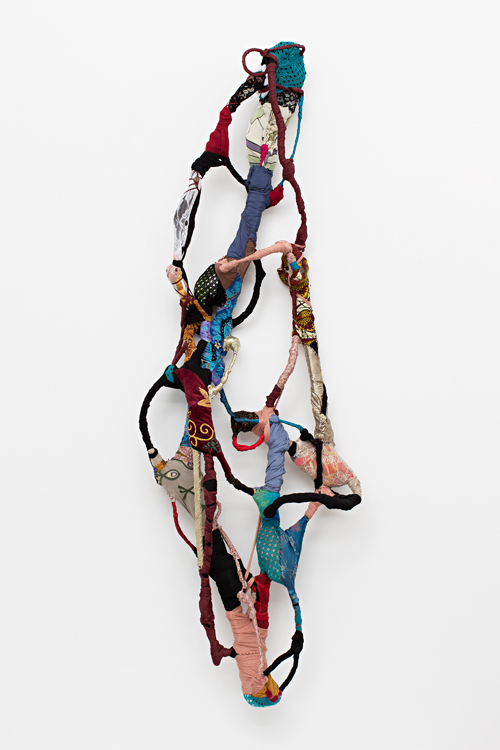
Installation detail
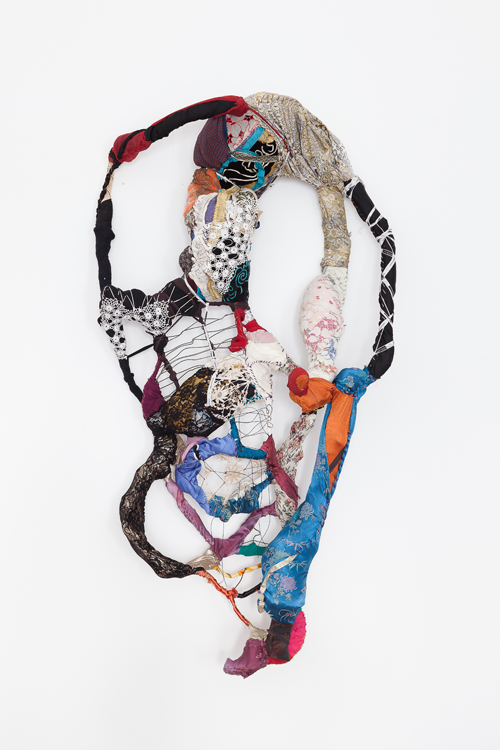
Installation detail
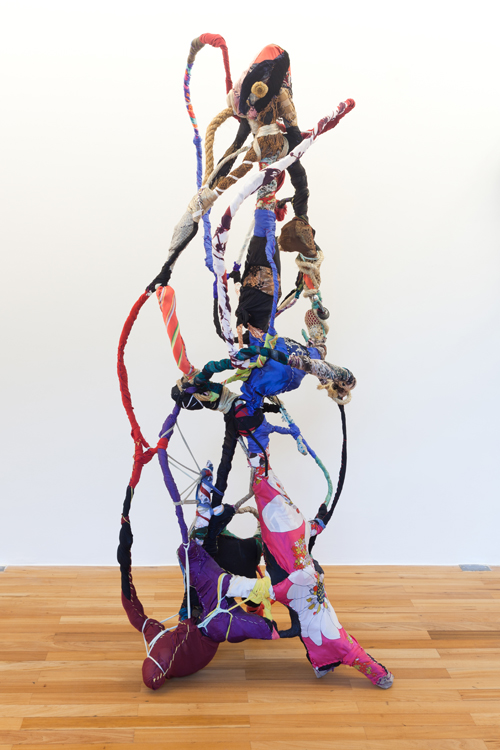
Installation detail
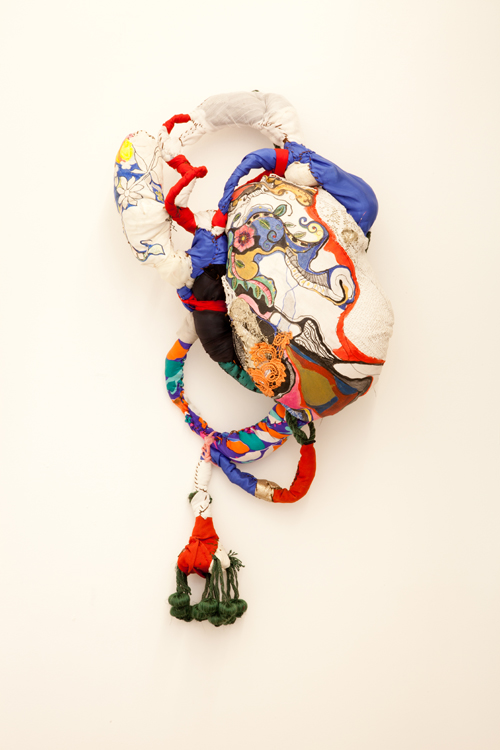
Installation detail
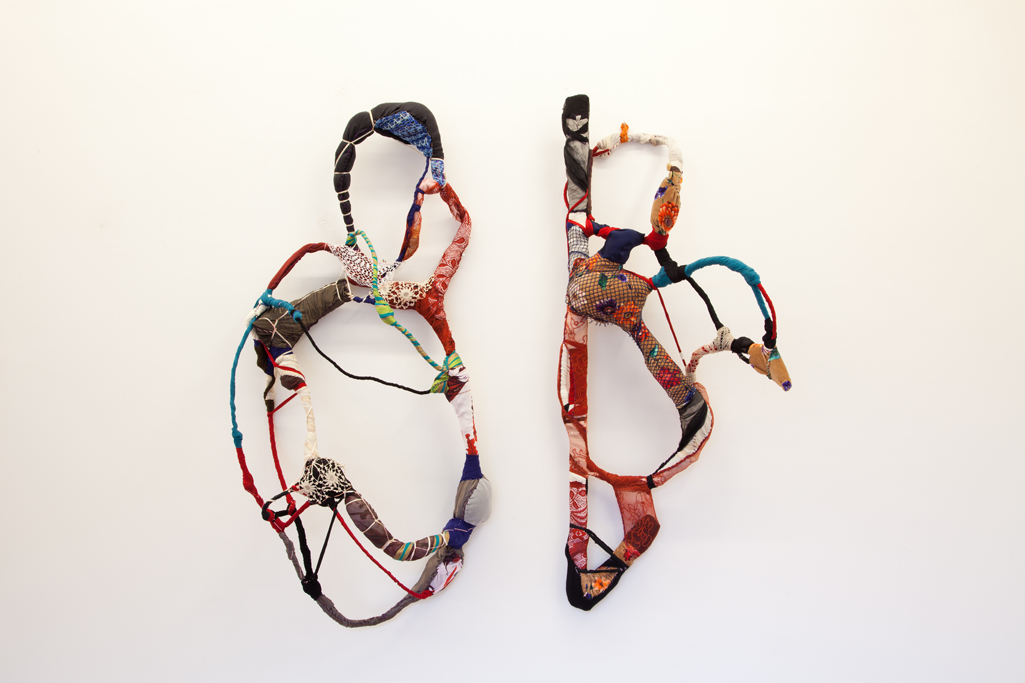
Installation detail
Júlia Rebouças: How would you define your work? How would you describe it to someone who didn’t know it?
Sônia Gomes: It’s hard for me to talk about my work, but I’d return the question. What does my work say to you? Just the other day I was with this guy who was helping me on the pieces for the Biennale [Sônia Gomes is the only Brazilian artist invited to show at the exhibition curated by Okwui Enwezor, All the World’s Futures, 2015] and he asked me what the concept was. So I asked him to “listen” to the work and tell me what it was about. He ended up telling me stuff I couldn’t have imagined, things that I hadn’t put into the pieces, but which were obviously there. That would be my answer to the concept that people expect you to have. But I could also talk about the material, the textiles and how they find their way to my door. People leave stuff here at the studio. They give me things as presents, donations, so the material arrives here with little or no planning on my part. In effect, it’s like they come with an added responsibility; I feel that in this regard. It’s like they are given to me as a sort of appeal. Everything I work with comes to me steeped in the stories of the donors because it’s not trash; it’s not something that’s just been binned. It was brought to me. So the giver is concerned with the history that thing embodies. One day I received some bird cages. I thought to myself: what am I going to do with these, I work with fabric? So I hung them up over there, and they ended up turning into works, with fabric. So I start actually by listening to the material, hearing what it has to say. Generally, I suppose I would say that I work with cloth, rags, bits of things, things to dress the body and the home with, and my work begins when these items arrive here, and I try to unlock the history in them. Then I start cutting, darning, twisting, piecing things together, creating textures, colors, filling, folding… I started out using my own clothes. I don’t sew; I don’t know how to sew in the classical sense. I just began transforming my clothes. Sometimes I’d want to take up a hem, and before I knew it, I’d changed the whole piece. I’ve always tried to buck against the established tone, to put a new twist on things. My artwork comes from craftwork.
JR: You were born in Caetanópolis, a town in Minas Gerais that is home to one of the oldest textile factories in Latin America, Companhia de Fiação e Tecidos Cedro e Cachoeira, established in 1872. You were talking about the memory of things just now, about these things that adorn the home and body. That makes me think there’s a very private sphere in your work. How does this reference to your personal history, your private world, inform your work?
SG: I don’t know whether this is an answer, but my work always stemmed from solitude. I have always been very alone, since childhood. So everything’s too much for me. That might sound a little selfish today, or very closed. If no one cared about me and I was a very solitary child, then I had to draw sustenance from somewhere. In my work today, I feel like I’m bringing out the stuff that helps me, things I nurtured over the course of a lifetime. It’s hard to explain!
My birth was registered in Paraopeba, but I’m from Caetanópolis, and that’s where all my references come from. The town grew up around a textile factory. This connection with textiles is at the heart of the town’s culture, but it also has a lot to do with the way I relate to things. Cloth samples were delivered to my father’s house, and I used to love looking at them; they were a real stimulus for me. And it was back then that I started braiding, tying, and playing with colors. My whole background is a blend of the folksy and the erudite. The folk side came from my maternal grandmother, who raised me to the age of five. She was a very simple woman, but extremely wise. She was a faith healer and midwife. She was a very influential figure. When I moved to my father’s home, still a girl, I started having contact with a more sophisticated world. There was a large library at home, so, in one way or another, I had contact with European culture. My father was the son of English and Portuguese parents. But I always carried my grandmother’s home with me. Hers was a simple house, with a dirt floor. It took ages to get used to the tile floor at my father’s place, I didn’t like it at first. I tried to run away a couple of times. My truth was in simple things. At least that was where I had experienced affection. This blend of worlds is a very Brazilian thing, isn’t it?
JR: You worked for a long time without considering yourself an artist or calling what you did art. What changed when this idea dawned on you?
SG: Probably when the references started coming in. One day a journalist said I was “Bispo in skirts.” So I looked this Bispo up and discovered Arthur Bispo do Rosário. I found his work marvelous and, of course, I was flattered by the comparison. But it had taken me so long to know that he even existed! I always worked out of myself, out of necessity. In technical terms, in terms of craft, my biggest influence was perhaps arts and crafts though I’d never really identified with anything I saw. Then there were the influences that came through my maternal grandmother: the jar cushions, talismans, and trusses. At my father’s house, there was embroidery from Madeira Island, Richelieu, that sort of thing. I loved it. I thought it was all gorgeous. That’s when I discovered that it was even more beautiful all mixed up—the simplest materials and the most sophisticated. Linen embroidery, linen and cotton. Cotton prints and patterns. Satin embroidered with plain thread. I remember my grandma used a jar cushion to carry heavy things on her head, like water pails, or trusses full of clothes. When I started giving my works these names, I guess that was when I became an artist [Rodilha (Jar cushion), Trouxa (Truss), Patuá (Talismans) are names of some of Sônia Gomes’ series, as are Torções (Torsions) and Ninhos (Nests)]. I did that consciously, as I linked one moment to the other. Art had already been calling to me for some time, but I didn’t know what it was. I thought that being an artist was way over my head, sort of overambitious for me. I felt more like a craftswoman. But my work didn’t fit in that category either, as people said it lacked finish or had no function. I made some trinkets for a while, but nobody was brave enough to wear them. They thought they were too bold. Stores wouldn’t stock them. People weren’t ready to understand my stuff and wear it. And I wanted to keep going further and further. I wasn’t discouraged by the rejections. Nobody understood my work or wore it, but I did, and I kept on making more.
JR: At the 19th Festival, we have a lot of artists talking about memory, using their own private, subjective histories in an attempt to rewrite the hegemonic narratives. In a sense, your work does the same, doesn’t it?
SG: Our own histories come from other people’s histories. No one has an individual, a subjective history that’s not somehow connected to others. My work has my history, sure, but other people can find their histories in there too. I think all artists address this in a way, I mean memory, time. These are recurring issues, and they’re not only in my work. As I said, my search has always been very solitary. I don’t think anyone bothered much about me. My profession was my own quest. I wanted to survive and become an independent, autonomous woman; I wanted to carve out my space, make a living out of my work. I don’t have anyone, so I always wanted a sense of security of my own. Today, thanks to everything that’s happened, I think I’ve become an international artist, and that’s a bit scary. I didn’t plan that; I just wanted to look after myself.
JR: How does the idea of a geopolitical South resonate in your work?
SG: I recently went to South Africa but felt like I hadn’t been to Africa at all. I have to go back, stay longer, do more research, experience more. I think it was like that the first time because I was in a place that was like any other wealthy environment, and also because I couldn’t get a sense of the history of the site, the culture, the identity. I think I went to Africa in search of myself, but I didn’t find anything. It saddened me to feel that there was no sense of local identity there, only a strong appeal to a global standard. I missed not seeing the local references, in the architecture, the clothing. But, when I think about the South in my work, of course it does carry this South within it. My work is Black, it’s feminine, it’s fringe. I’m a rebel [laughs]. I’ve never tried to stifle or mask anything just because it might not fit within the preestablished conceptions of what art is. It’s interesting that, even here in Brazil, here in Minas, the place my work comes from, people still have a great deal of difficulty understanding my art and identifying with it, because it carries the roots of our land. People reject our roots, they feel more comfortable with references that come from abroad. We’re prejudiced against ourselves. My art is Brazilian.
Interview given to Júlia Rebouças at the artist’s studio in Belo Horizonte, on occasion of the 19th Festival (March 2015)
Deslocar, 2015 | Installation
Sônia Gomes
Sonia Gomes 's statement for 2012 Pipa Prize
[pt]