Scanograms #1
2010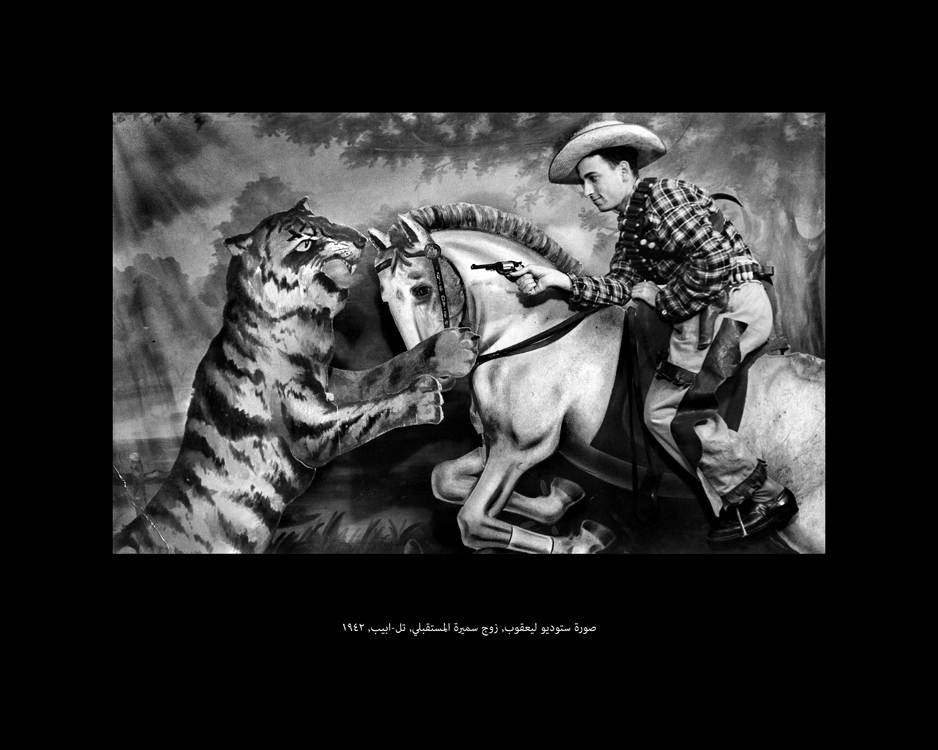
Scanograms #1 (2010)
"I started working with archives in 2006, as a part of my studies and my PhD research on Orientalist photography in the Zionist archives. Three years later, I started working with archival footage as a visual artist, not only as a writer.
In 2009, I found a suitcase under my grandparents’ bed, packed with plastic bags filled with photographs and other documents from the first half of the 20th century. I had never seen these materials before, and I remember wondering why they were not organized in family albums, as it is the habit when it comes to these types of photographs (weddings, baptisms, studio photographs for Christmas, etc.). With my grandparents’ permission, I took on the task of organizing them into albums.
I tried to build the conventional narratives of family albums and organize them accordingly. As the unofficial historian of the family, and maybe also as the eldest grandson, my grandparents let me deal with these materials. I found myself editing our stories over and over again in various versions and possibilities, but I failed the primary task of making family albums. I realized what my grandmother had understood all along: it is an impossible mission. She gave me time to reach that conclusion on my own, and fail on my own, as she had in the past.
This accidental encounter with a single suitcase was the starting point of the Christian Palestinian Archive (CPA) project, which is the only archive today dedicated to the Christian Palestinian diaspora. The CPA was also a turning point in my artistic practice, and it provides the basis for all of my installations: whether it is one picture or a series of 15 photographs dressed as a family album.
The meaning of the term 'scanogram' is, literally, 'drawing with a scanner machine'. Every scanogram is made with three layers of scanning. Each scan is programmed to feature a different aspect of the material, and then I unite the layers into one image. A scanogram is my personal interpretation of historical material from the CPA. Naturally, the process relies on a personal perspective and the outcome differs from the original photograph. This technique of multi-scanning stresses the story of the document as an object, that is, the rips and tears become very prominent in an almost abstract way, and they assume a three-dimensional format in size and scale.
The scanograms offer ways of re-presenting these documents and seeing them through sharp, high resolution prints. Scanograms are activated as contemporary ‘objects’ or, to be more accurate, as a result of their contemporary physical condition. In other words, the original photograph, as a physical object, has a story of its own, and the scanograms are trying to bring this story to the surface."
Extract from Photographs, like a sort of embodied, physical subconscious |, Mitra Abbaspour's conversation with Dor Guez, published as part of the exhibition Dor Guez—40 Days, at The Mosaic Rooms, London, April - May 2013
Scanograms #1 (2010) | Dor Guez
Photographic installation | Series of manipulated readymades, 15 appropriated inkjet images, 60 × 75 cm each
Scanograms #1 (2010) details and setup at the exhibition space of the 18th Contemporary Art Festival SESC_Videobrasil
Testimony Dor Guez | 18th Festival
Guez talks about his project, the Christian Palestinian Archive, which he founded in 2009. The institution was born from the artist’s research on his own family’s past