Samba #2
2014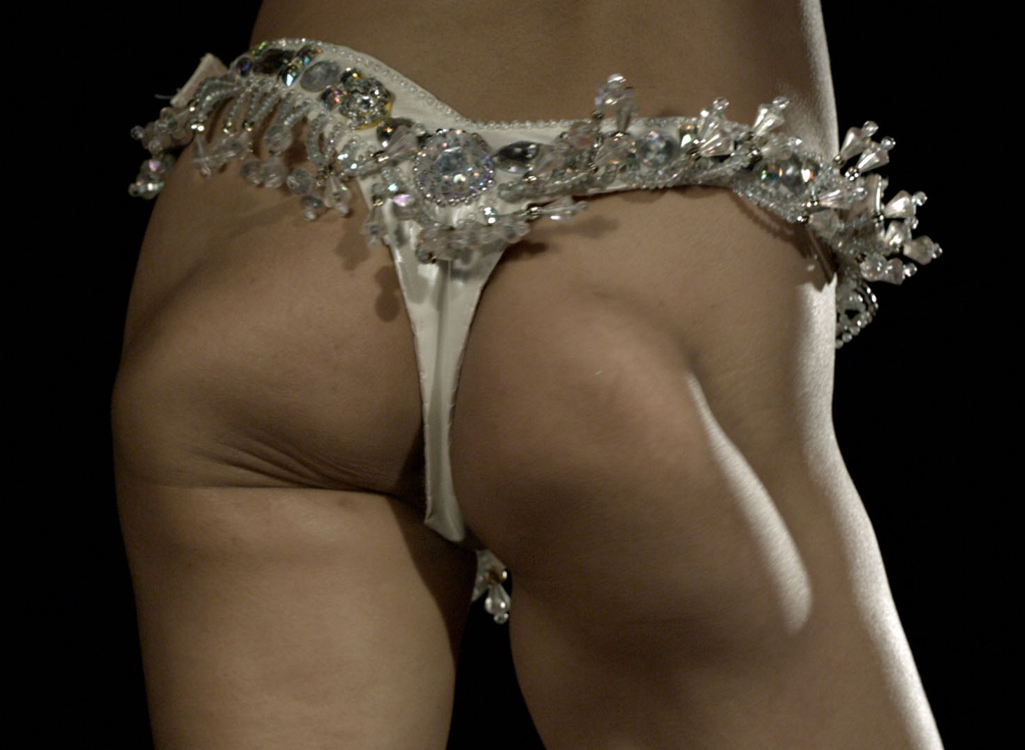
Samba #2 video still
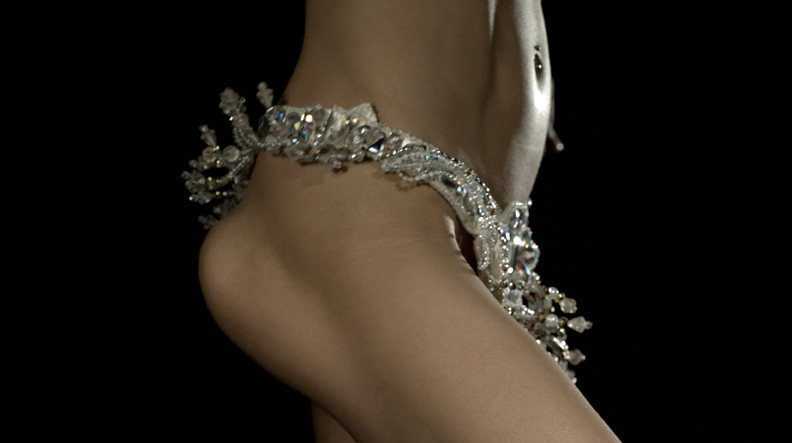
Samba #2 video still

The "Chacrinha framework", reference to the artists

The "Chacrinha framework", reference to the artists
"For Samba #2, we chose to work the cliché of samba as a social/physiological/artistic research into this physicality that’s so exclusively Brazilian. The deconstruction of motion allows a visual perception of samba’s most visceral aspect: its primitive energy. It is as if our eyes could finally see what we have always known about it — its lust and untamed physicality.
The piece works not to promote, but to subvert this cliché, enabling a new perception, a deconstruction not only of the motion, but also of the corporal materiality of the 'butt'. Once it loses the materiality we identify with and becomes such a primitive nature of the body, it overcomes the beautiful/ugly. It becomes a physical portrait, a movement of Brazilian nature with its wild, luxuriant landscapes.
Samba #2 is the second part of a project called Samba (the #1), shot as a part of the EXIT performance, which is about the artist’s mid-life crisis. During the performance, the samba dancer is used as a metaphor for the original dream of the music box ballerina — a Brazilian music box. Seven years later, when the opportunity came up for us to do a project where we’d have the conditions to film Samba using the Phantom camera — which allows for much slower footage (at 500 frames per second) —, creating a 'dance of the flesh', as we had initially envisioned, we 'jumped' at it.
In Samba #1, the camera circled around the dancer as she circled around herself. In Samba #2, the camera is stationary. The simplicity of the motionless take where only the flesh, only the skin moves, offers a perspective of study, a dissection of the body that dances samba, this cultural manifestation that is so important to Brazilians, which reveals our deepest physicality. The framing, borrowed from the TV shows we grew up on, which we nicknamed the “Chacrinha framing” (after a famous 80s TV show host), is a close-up on the hips. The body speaks for itself.
This piece cuts straight to the heart of everything that interests us: the presence it takes to improvise the movement of samba; the relationship among body parts, where the tension between hips and legs creates a visceral, unpredictable, choreography, which is deeply strange, and yet comes from a familiar place; the physical appropriation of a cliché, turning it into a physical experience that transcends its own boundaries; and our personal stories as Brazilians looking to understand what this means.
We are both from the South, from Curitiba, the descendants of Western Europeans, and we bear little to no resemblance with the stereotype of the Brazilian woman. Although we are Brazilians and dancers, neither of us can samba. Therefore, for us, samba holds a familiarity that doesn’t belong to us. It is a cultural manifestation we identify with, but not without some unfamiliarity. This inability to belong may have been the source of our fascination and of our insistence on dissecting it. Besides, we wanted to deal with the questioning of the objectification of the body of the dancer, or of women in general, and the authority she exercises by authorizing the public to watch her allegories.”
Chameckilerner in a statement to PLATFORM:VB (July 2015)
Samba #2, 2014 | Vídeo, 2’36”
Chameckilerner
Cassino do Chacrinha | Globo | Anos 80
Samba #2 borrowed the framing from the 80s TV shows