O Profundo Silêncio das Coisas Mortas
1988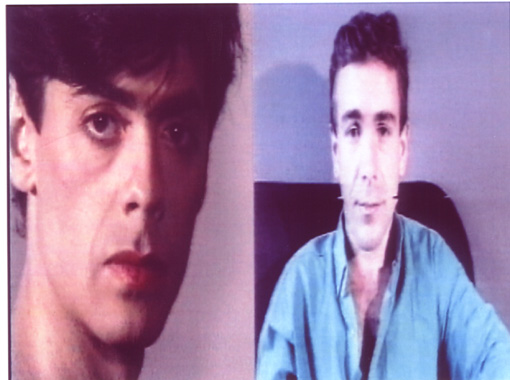
“Video-art is celebrating twenty years of existence, a short but troubled history, with distinct phases and styles. In these years, critics and art historians have attempted to interpret this history and create a critical theory to analyze it. Retrospective shows were recently organized aimed at making a survey of what these years of activity consisted of. Publications of critical and historical texts proliferated, making video-art one of the phenomena of modern art that most defies interpretation and assimilation.
During long periods of history, the mode of human sense perception changes with humanity’s entire mode of existence. The manner in which human sense perception is organized, the medium in which it is accomplished, is determined not only by nature but by historical circumstances as well.[1]
It is to modernism that video-art owes the parameters that directed its development in the early years, having gone through moments of rebellion, social and political engagement, and a deep concern about discourse in regard to itself.
As an art form allied to technological development, video-art experienced a faster and more radical development than any other 20th century art form due to the speed of the technological revolution. As an art form related to the plastic arts, it passed through abstractionism, structuralism, pop…
However, it was as the bastard child of television that video-art showed itself most amazingly. Its revolution, still being processed, is increasingly more inevitable.
It is unwise to despise an enemy, especially a more powerful, older enemy, who happens also to be your frightful parent. So it is with television that we have to begin to consider video, because if anything has defined the formal and technical properties of the video medium, it is the television industry.[2]
At a time when video-artists are reacting violently to commercial television, Antin realizes that this struggle will probably be in vain, and that video-art may come to join up with its most powerful enemy, which is also its parent.
From the modernist viewpoint, revolutionary by nature, this prospect would be simply unacceptable. Antin writes for the artist of the ‘80s with the perspicacity of the unprejudiced observer.
In the ‘80s, modernism becomes an institutionalized movement, and its artists, who in the beginning were representatives of a resistant class, immediately become the 20th century classics. Once again, the radical movements of this century are absorbed and assimilated. Dadaism, surrealism, cubism, expressionism, all are duly assimilated by the mechanisms of the dominant class that most fought against them.
In the modernist context, video-art developed within a dynamics influenced partly by the artistic circles, and partly by the mass communication media.
Technological development takes place parallel to the social and political transformations, and more than any other, it is responsible for the radical changes in the development of the style of video-art.
The evolution of analogic and digital equipment, the 15 and 10 second commercials, resources for processing black and white images into color, and the processes of recording on one-inch tapes brought changes in the types of production and in the style of video-art. Beginning as a typically modernist phenomenon, video-art now undergoes transformations of post-modernist characteristics in its relationship with the mass communication media, with the spectacle, and with the types of narrative.
The return to narrative occurs, among other factors, due to the exhaustion of the structuralist aesthetics and to a change in the controlling of artistic production. This change also contributes to a greater approximation between video-art and commercial television.
On commercial television, video-artists perceived a source for inspiration and intervention of an aesthetic and technological nature. We have come to a point at which two media begin an intense exchange of values, and at which video-art begins one of its deepest transformations, from the values of resistance to modernism, to the values of assimilation of post-modernism.
Television needs fresh, creative minds to improve its content. Video artists, who have been waiting for more than twenty years to access broadcast quality equipment, have had to focus on content, even if this content is primarily artistic. Now, in this decade, video artists are in a position to produce broadcast quality programs with a content that is both needed and desired.[3]
Today’s video-artists are interested in reaching an audience accustomed to a television language which, instead of being vigorously opposed, is being used to transmit theoretically revolutionary concepts. Artists concern themselves with a professional finishing for their work, with special interest for the use of new technologies aimed at improving the presentation of their ideas. Artists produce their work in commercial television studios with the latest in production and post-production equipment. It is art living with technology. And commercial television is aware of this transformation and explosion of creativity; it is aware of the development of professionals coming from the field of video-art, hiring them to participate in their work teams. Artists leave the solitude of their studios to return to team-work.
Today’s video-artists need a vocabulary that combines an aesthetic experience with knowledge of electronics, computer graphics and editing, a vocabulary capable of communicating their ideas to the whole team, from lighting specialists to electronic engineers. Their work, when produced for commercial television, is not signed, but if an artist’s style is outstanding, by means of this style, he will once again have the power to transform the audience’s visual standard.
At this moment of the 20th century artistic development, artists’ social position, unchanged since the 16th century, begins to be questioned. ‘Who are our artists?’ and ‘What is their social function?’ are the questions truly pertinent to those who work with video-art.
We can legitimately speak of cinematic and visual art, although they are not the same. But the term ‘video’, which we will certainly continue to use, refers only to craft, not to the object of cinematic desire that actually claims our attention. What we really mean by ‘video-art’ is personal cinema practiced electronically.[4]
With digital technology, video-art begins a phase of its development as important as the access to editing systems was in the ‘70s. Artificial realities invade the thoughts of video-artists, who begin to manipulate this additional factor in their work. Special effects proliferate and make it possible for artists to manipulate the visual codes after recording. Digital technology offers artists the possibility of producing and transforming a videotape by means of insertion of a frame that was not recorded based on the reality presented to the video camera. Now, more than ever, the idea that television reflects the world as we see it is increasingly false. We have entered the age of production of digital realities.
This technological development reflects the current cultural and social moment, in which the idea of spectacle invades daily life, increasingly moving common citizens away from their reality, in which information transmitted by television increasingly fails to portray reality as it is, in which the electronic image is invariably ‘better’ than the real, in which the spectacle permeates all daily routine acts, and in which viewers increasingly want to feel surrounded by something that actually does not exist.
And it is thus that we witness one of the most controversial moments that video-art has experienced since its birth, with producers divided into two radically different factions. On one side are those who want to continue to be associated with the plastic art production media, working as modernist artists, solitary, and repudiating the values of commercial television with a conservative attitude, interested in showing their work in art galleries, to an audience accustomed to the values of Fine Art. On the other side are those who, by means of a revolutionary and experimental attitude, are interested in producing their works allied to commercial television, placing video-art on the air with top billing; they are interested in revolutionizing and transforming the language of television, seeking to reach a larger audience, and, mainly, in changing the static position that visual artists have occupied in the social hierarchy over the last four centuries.”
[1] Walter Benjamin, ‘The Work of Art in the Age of Mechanical Reproduction’
[2] David Antin, ‘Video: The Distinctive Features of the Medium’
[3] Lorne Folk, ‘The Second Link & The Habit of TV’
[4] Gene Youngblood, ‘A Medium Matures: Video and the Cinematic Enterprise’
Rafael França's text extracted from the general catalog of the 19th São Paulo International Biennial, 1987, pp 359-361
O Profundo Silêncio das Coisas Mortas, 1988 | Video, 7’15”
Rafael França