¿Por qué disparan?
2016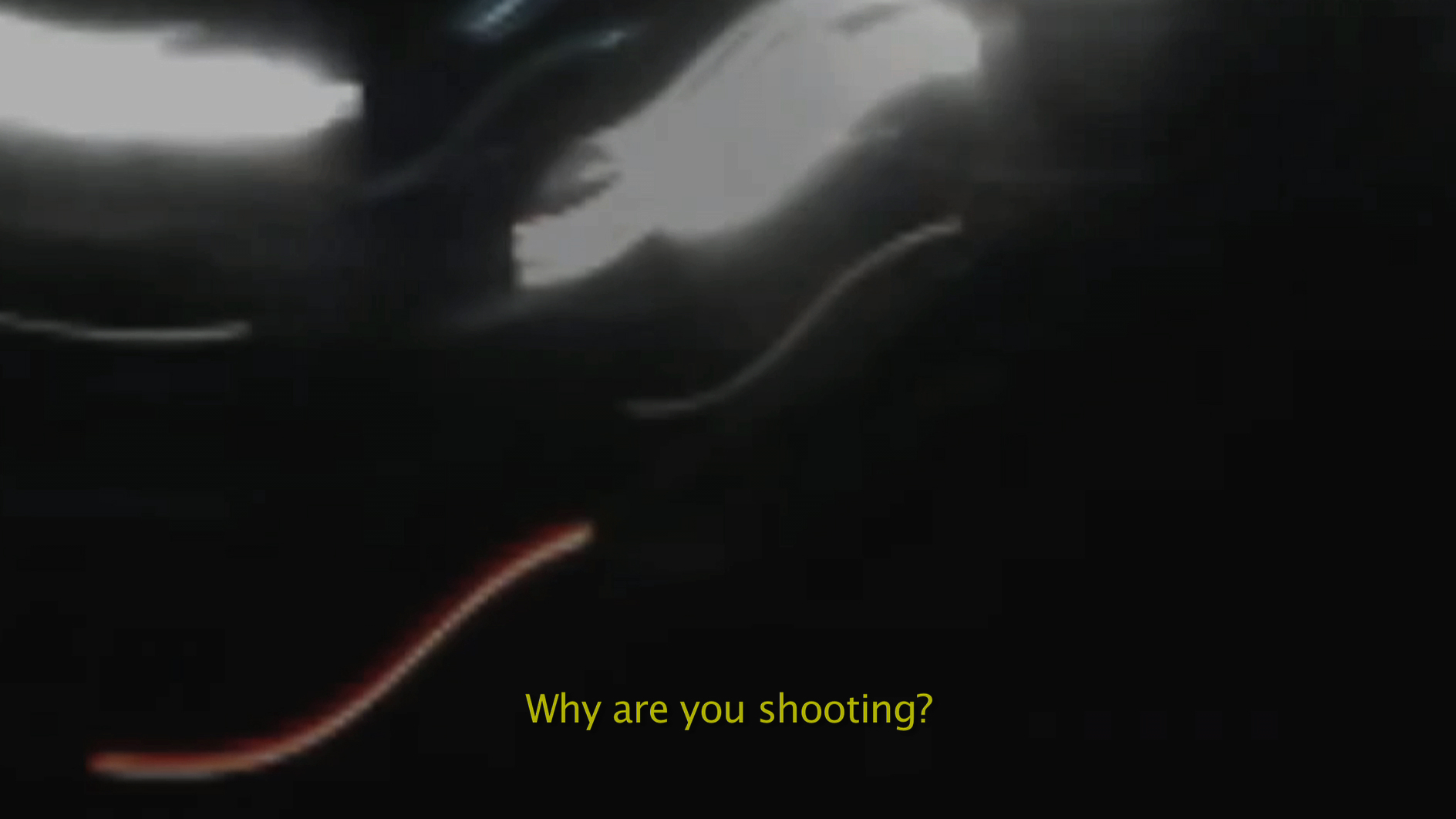
On September 25, 2014, forty-three students disappeared in Iguala, a municipality of Guerrero, in a country called Mexico. It was an event that shook the whole world. Some time later, Amnesty International Mexico invited several artists to individually make an audiovisual piece on the theme of the #43. I then began to think of different possibilities, collected testimonies, established contacts with local people, read a multitude of newspaper articles. It was difficult, and still is, to explain why the massacre had happened. Why did the state and federal police, the army, and the organized police participate in the disappearance of the #43 students? It was very difficult to explain why government discourse played down such an ominous fact. We asked several questions that led to many answers, but no assurance. I then decided to reinterpret the generated file—this was going to be my raw material. With this material I intended to confront this tragedy with different voices. The government was relentlessly denying the gravity of the events, which was not strange, but terrifying: in power, again, the speech was false, unsustainable, and culpable. So this piece began to assemble itself, one that has no answers, a piece that is composed of questions.
In this archive I gathered, there was a very powerful material: the testimony of the students registered on their cell phones when they were ambushed by the police. It was the only first-person record to which I had access about the events of this eternal night, an archive with the victims’ point of view, and this is what led me to scrutinize the rest of the material I was working on, trying to build this story from the students’ point of view. In one of those videos I found online, we hear the voice of a young man screaming in despair to an invisible enemy: why are you shooting? The question we all ask ourselves.
My job, that is, what puts food on my family’s table, is image editing, or montage, call it what you will. I marvel daily at what lies behind the narrative possibility offered by individual images, with infinite possibilities of being watched and organized to generate multiple narratives. We can combine and link images and sounds to elaborate a discourse with elements that generate a new being, and for this reason I thought that the most sincere thing I could do in this occasion, in the invitation for others to think about this tragedy without solid answers, was to play with what I play daily: combine fragments, and combine them to tell a story. I propose a piece that wants the viewer to become one of the students, to become the camera, the eye, the heart from which the fragment of the beginning of an unanswered nightmare is told. On the other hand, I have always enjoyed working with archives and giving order, direction, and form. My previous work consists mostly of this, and this piece turned out to be part of a way of looking at existing materials to unravel a story.
I was born in Argentina in 1970. In 1976, my country witnessed a coup d’état that lasted ten long years. My family, like many others, had to go into exile and my uncle, my father's brother, is one of the thirty thousand missing. All this marked me, and I have always been very susceptible to reflect and try to oppose the arbitrariness of power.
I think that today we are saturated with information, images, sounds, and we often must pause to observe what lies before us, to reframe things. After a bombardment of recompilation videos of files from the Internet, one day I stopped to watch and listen, with horror, the 12 minutes recorded with the various cell phones of the students who were present at the beginning of this dark night. This material was part of the narrative of the information, it was a file that was lying around, like so many others, but that had not been interpreted. As I watched it carefully I realized that it was a jewel, which I often look for so I can accurately narrate a “point of view.” In this material, there was a perspective charged with disconcert and fear that somehow had Little Red Riding Hood’s innocence facing The Big Bad Wolf, and held the true facts from an actual and terrifying perspective.
These files were charged with unanswered unknowns, and they spoke of the arbitrariness of a system that we do not know what it is made of and how much it can devour between its tentacles, if it so deems necessary. My goal was to build, by manipulating this file, the feeling of being in the place of these young people. This is why, even if blurred, I have reframed and distorted the images and changed time to build what appears to be a long take, but in reality is not, since it is composed by joining several different fragments of image and sound. There was no need to seek out a character or even give voice to the nightmare: the voices were already there. What it lacked was a structure so that they united in one voice and that, through a new order, it gave the sensation of the actual time of an event that in reality lasted very little, almost nothing, but that essentially has not yet ended. Thus, the many voices and the few seconds have become the fiction of something closer to the anguish that does not give us respite, to the question that still has no answer: why are they shooting?
Mariana Rodríguez in a statement to PLATFORM:VB (August 2017)
¿Por qué disparan?, 2016 | Video, 2' 26"
Mariana Rodríguez
Robert Bresson said that the camera, at the time of recording, had no idea of what it captured, but that somehow poetry, speech, or meaning could be later observed.