Pipe Dreams
2012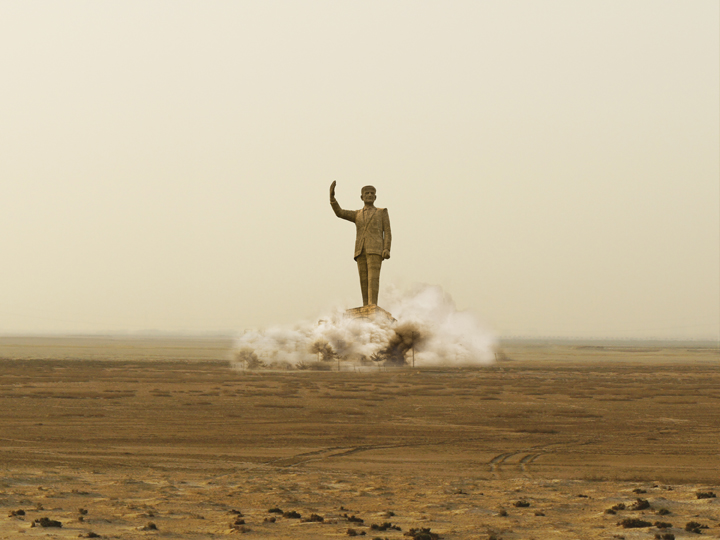
Pipe Dreams (2012), video still
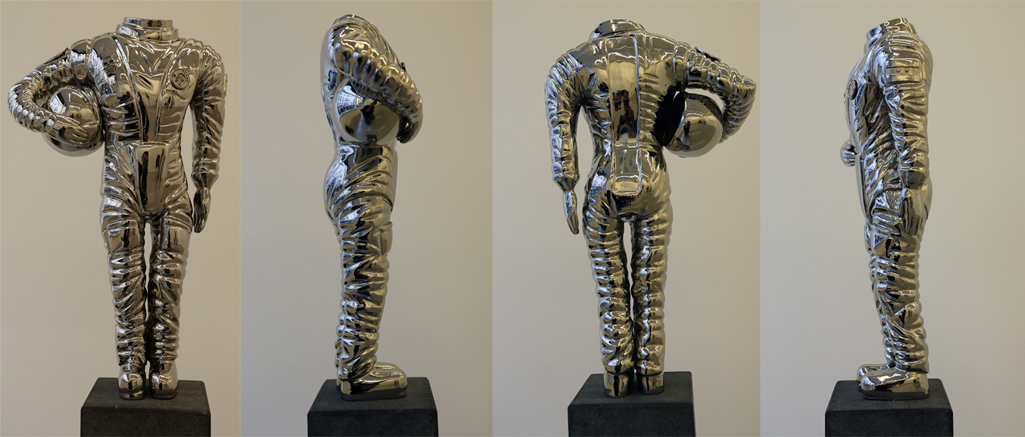
"My scultpure is inspired by the Syrian cosmonaut Mohammad Faris, from Pipe Dreams. Its medals are the same given to him: "Soviet Union Hero", "Lenin's Order". On his right arm, he has the same logotype of the Syrian/Russian space mission", explains Ali Cherri.
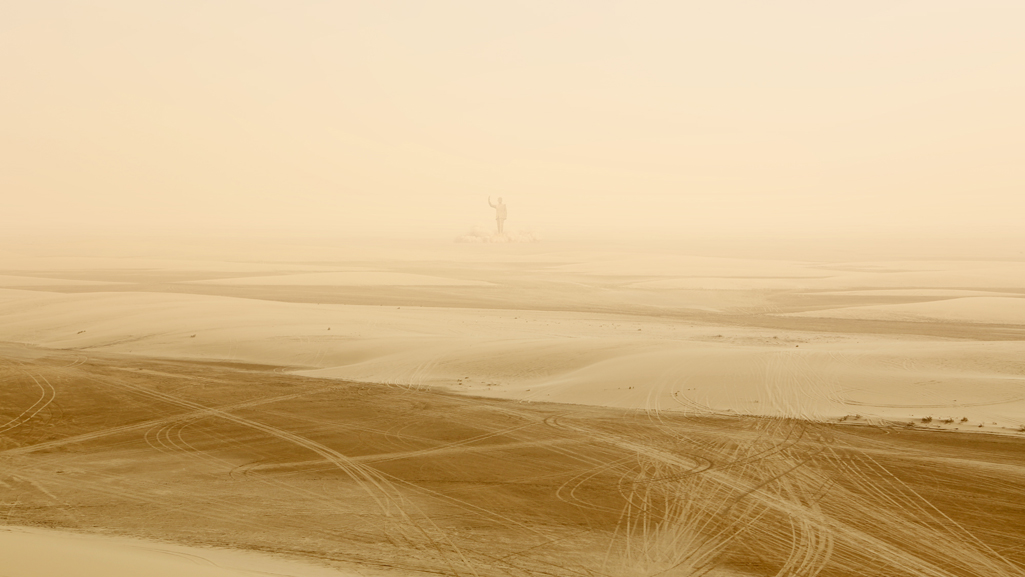
"By zooming in the image, it is possible to see Hafez al-Assad's statue, present at the beginning of Pipe Drems", explains Ali Cherri.
"The first time I heard about the Syrian cosmonaut Mohammad Faris was in a newspaper article, back in 2010. I was surprised that I had never heard about Faris before. While doing some research about the Russian mission in which Syria participated, I found archive footage of a phone call between the former Syrian president Hafez al-Assad and Mohammad Faris. This phone call happened in Hafez al-Assad’s office and was broadcasted live on national televisions in 1987.
In this historic phone call between Hafez al-Assad and Mohammad Faris, we witness the ‘father of the nation’ questioning the ‘hero’ about his impressions as he looks down on the Syrian lands. A conversation that features the eternal leader, who, from the comforts of his office, casts a watchful eye on the children of the nation, even as they are thousands of miles away, up in space.
On the break of the uprisal in Syria, in 2011, I started collecting Youtube footage that the protestors were uploading. I was interested in the images of the protestors versus the images produced by the regime. With Pipe Dreams, I put an official archival face to face with Youtube footage: this interface questions the authority of archival versus amateur images.
By the end of the 1980s, young revolutionaries of the recent past, from Libya (Muammar Al-Gaddafi), Iraq (Saddam Hussein), Egypt (Hosni Mubarak) and Syria (Hafez al-Assad) had made their grabs for power and asserted themselves as the sole and eternal leaders of their countries. Countries where power is fed by symbols: statues of the founding father, larger-than-life photos, the leader’s orations and, of course, heroes. This archive footage holds a great intensity due to the current political context of Syria and the Middle East region. It’s a glorious moment for the Arab nation, that, not long ago, was charmed by the glory of the communist space race.
Twenty-five years later, at the beginning of the upheavals in Syria, in 2011, the authorities, fearing vandalism, dismantled the statues of Hafez al-Assad in the protesting towns. When power begins to lose its Monuments, it is the beginning of the end; the countdown has started and ‘lift-off’ is imminent. Haunted by the image of destroyed statues, from Stalin to Saddam Hussein, the regime tried to avoid the inevitable, to sacrifice the Symbol in order to safeguard the Image.
This interface between two moments in recent Syrian history encapsulates the history of the entire region: the mechanisms of the construction and deconstruction of totalitarian power, the dreams and disillusions of an entire people. By taking this perspective on the events that are currently shaking up this territory, Pipe Dreams seeks to bring the poetic dimension into the political one. It is art’s ceaseless attempt to place the personal narrative into the larger narrative of political history."
Ali Cherri in a statement to PLATFORM:VB (October 2013)
Pipe Dreams (2012) | Ali Cherri
Video installation | 2 channels (projection and TV monitor), 5’08”, stereo, color, 4 : 3, loop
Excerpt from Pipe Dreams (2012)
Testimony Ali Cherri | 18th Festival
The Lebanese artist discusses the use of archival footage in his video installation, composed of two screens
Richard Nixon's Phone Call to the Moon (1969)
The U.S. President, Richard Nixon, talks with astronauts on the moon in 1969.
Ali Cherri about Pipe Dreams | Mapping Subjectivity, MoMA (2012)
Postcards from Beirut: Part 2, by Chad Elias (Frieze Blog, Jun. 2013) [eng]