Parallel
2017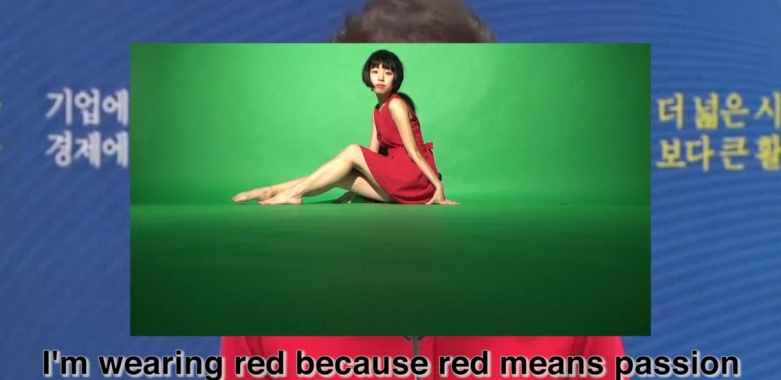
I was working for directors who shot Korean Pop (K-Pop) stars in New York, so I had a chance to see them up close, and I got familiar with their music. After quite a long period of denial, I fell into K-Pop and was interested in its contrast, the reality and representation, the symbols and underlying messages of pop music. In 2015, I was in Seoul, in the city where you can surround yourself with K-Pop. During my stay in Seoul, in August, there was an incident at DMZ (demilitarized zone), in which two South Korean soldiers were injured by landmine explosions. South Korea set up loudspeakers at the border and blasted high decibel K-Pop songs at the border, along with propaganda broadcast. The use of loudspeakers caused severe response from the North, resulting in an exchange of artillery fire and the threat to trigger military action in combat of “anti-north psychological warfare.” I was astonished by the fact that this popular culture has become strong propaganda for the country, and the more I experienced that culture in Seoul, the more my curiosity grew.
As a kid who was born in the 90s, my relationship with North Korea remains a vague education from my elementary school, and visiting my grandfather’s North Korean refugee gathering events. My grandparents are refugees from North Korea, from where they fled during the Korean War. I’ve wanted to interview my grandfather for a while, but never dared to ask him about his past. After the 2015 conflict between North and South, I finally came up to him and interviewed him. What he told me was mind-blowing and heartbreaking—I was emotionally overwhelmed. I felt a strong connection with him through his vivid memory, and now his past is not a far history to me.
After I came back to New York City to finish my graduate school, I wanted to analyze what South Korea represented, specifically its relationship with the Korean War and K-Pop as both of which are involved in the construction of the contemporary Korean society. These two mediated representations seem to extend beyond their own subjectivity, becoming blind mechanisms for propaganda and an opaque authority in and of itself. I wanted to provoke a discussion by using ideologies that are equivalent to both narratives, such as idolatry, uniformity, dictatorship, and illusion.
Parallel was a process of weaving together elements that were scattered in my work. Feminism, popular culture, spectacle, modern myth, costume play, performance art, Korean culture, reality television shows, video collage, and so on. I tried to develop as many layers as possible, as there were many discussions I wanted to provoke, especially to audiences who are not familiar with the culture. Also, considering my entire body of work, Parallel took the longest time to make, and is the longest video piece.
To me, Parallel is a political message, aesthetics built on poetic expressions, ethics explained by sarcasm.
Jiwon Choi in a statement to PLATFORM:VB (August 2017)
Parallel, 2017 | Video, 29' 55"
Jiwon Choi
Parallel's trailer
References that contributed to this work are Guy Debord, Walter Benjamin, Theodor Adorno, Samuel Beckett, Zeitgeist, 1960s video art, feminism, popular culture, modern myths, costume play, performance art, Korean culture, Seoul, reality television show and everyday life.
Artist's website