Pacifico
2014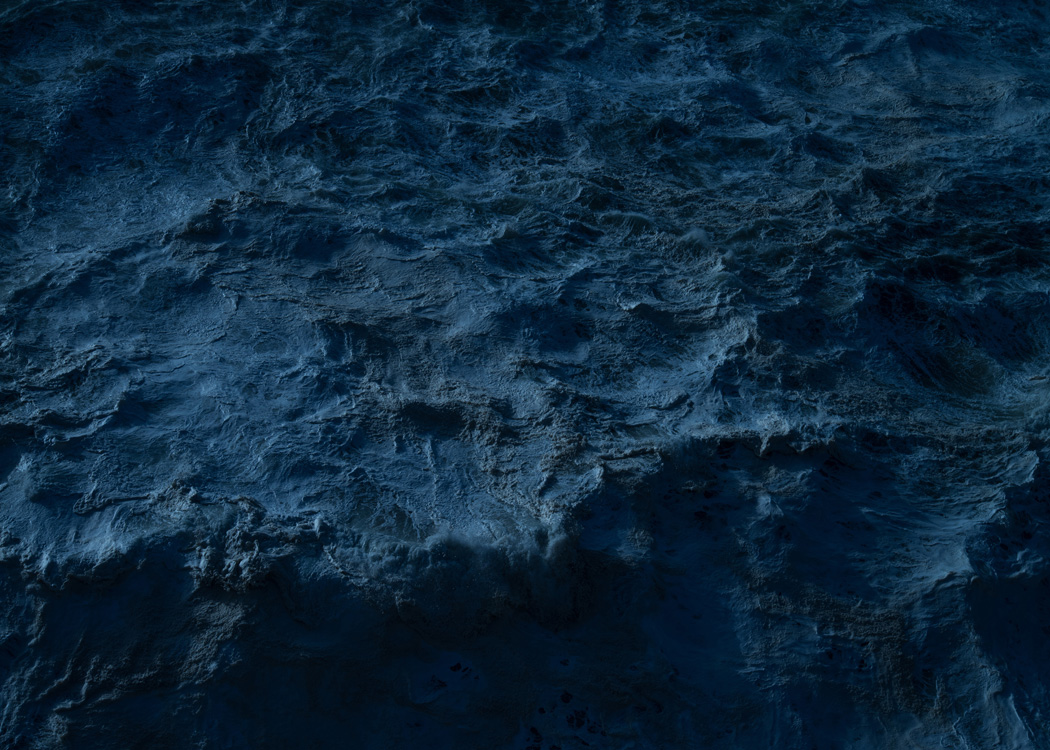
Video still
"My investigative work was mostly about exploring how our poetics and our politics as Chileans and inhabitants in a world relate to the landscape, the geography and, in particular, to the Pacific Ocean. The most important aspects of my work are poetical and political, the relationship between these two aspects, and how viewers relate to these two places…
We are suffocated by reality: in this sense, I am interested in arriving at a sort of compromise between reality and fiction, like cinema and/or documentary do. However, I don’t make films; I just use them as another way to express thousands of elements that interest me — elements that are narrative, aesthetical, political, formal, etc. I am interested in finding freer narrative forms, which allow me to work with imagery and space as primary elements, since making films for galleries or museums entails being fully aware that you, as the viewer, are not sitting still in a chair looking at something, that the body is part of the moment one confronts an artwork, and this creates a completely different relationship between you, as the viewer, and the image.
I was born during the dictatorship regime and I lived through the transition back into democracy, and it was a major change in my life and in the lives of many from my generation. For me, the dictatorship was normal, there was nothing bad about it… because it was the place where I learned to walk, to climb trees, to live my childhood. It was dark and grey, but it was my reality. And when you live in a grey country since the day you are born and you don’t know anything else, in reality you see these two different shades of grey. The change happened when democracy came back and many of us realized there was something wrong about it all. Something obscure and filled with silence, and until this day it is part of the greyness of Santiago and of the reality of Chile, of its scenic mountains and dry desert, of the Pacific Ocean, although for many there is nothing pacific about it. Our geography and our politics, and our way of forgetting too… Chile and many other places in the world replace culture with something like 'turning the page and starting from scratch', but history must not be erased, it is too dangerous.
A decade after the Commission of Truth and Reconciliation, a 'Dialogue Panel' was established in Chile, whereby Chilean democratic state resumed an active participation in the collective bargaining process of our recent political history.
The Panel had two (relatively) explicit missions. The first was to try an understanding in between different interpretations of history: Was the military coup a 'rescue' of the Chilean society as the Armed Forces like to spin it, or a violent destruction of democratic institutional order? Was it a 'war against an internal enemy', justifying the violent action, or rather the institution of a state of terrorism that violated our human rights?
The second objective was to obtain information about the fate of the arrested missing people (officially around a thousand cases). These disappearances have clouded the national collective imagination. The army took over the brutality of the past: first, there was a real admission of guilt, but the most striking thing about this confession is the fact that the Army insisted on the inevitability of the disappearance of the bodies. The sentence 'thrown into the sea' is written along most of the names in the list (which was incomplete). This is the most recent image that the Army offers to the nation to settle a common vision of the history: the Chilean sea — the Pacific Ocean.
I guess we artists are like ants: although we are almost 'invisible' within the social structure, we have the virtue of being like small insects that can introduce important cultural, political, economic, aesthetical, and other problematics and questionings into very high strata of social, political and economic power. We can influence our own medium and other media, like television, which in one way or another is going through a crisis and constitutes a precarious, under-tapped medium in terms of content and programming quality, for example."
Enrique Ramírez in a statement to PLATFORM:VB (July 2015)
Pacifico, 2014 | Video, 2’42”
Enrique Ramírez
Landscape in the Mist (1988) | Theo Angelopoulos
Excerpts from one of Theo Angelopoulos' films, reference to the artist
La recta provincia (2007) | Raul Ruiz
One of Raul Ruiz's films, reference to the artist
"I generally feel very inspired by the work of Chilean poets, by Raul Zurita, whom I have great admiration for, but also by the world of cinema, like Theo Angelopoulos, the old cinema of Wim Wenders, Terrence Malick, and certainly Raoul Ruiz and Alfredo Jaar. This piece in particular could be likened to painting. After all, it is a visual piece that has no sound; the viewer is the one who gives it sound in their unconscious mind."