O samba do crioulo doido
2004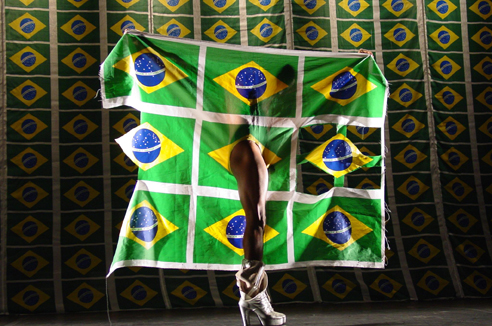
O samba do crioulo doido (2004). Photo © Gil Grossi
"This work was born out of a pressing need to discuss racial issues in a personal way. It is an outcry, something I had to get off my chest at that time. I was under a lot of pressure for being black, it was affecting me badly, and I had to reflect about it through dancing, which is my communication tool. I was not overly concerned with aesthetics, I just wanted to find the most effective way to express what I was living. At first, I thought it would flop, because it employed a structure I had not seen in other works in my medium.
There was not a single situation that led me to want to create this piece, it is part of a process that took several years. Being stopped at the door to the bank, being followed by security guards at drugstores. I felt uncomfortable in the world. I wanted to understand: what is it about this body that bothers so? The spectacle questions this discomfort.
My work is closely connected to my identity. Through my work, I question my sexuality, my self, in regard to social status and society. I have developed my awareness of the color issue since I was a child. We blacks carry this historical issue of being a 'minority' with us, but in fact it is History that labels us a minority; it places us at the bottom of the social scale. Little by little, this concern grew. I would ask myself: what is this color? What is my role in society? And my art follows the situations I experience in the world. It’s my life, the combination of life and art.
I have been a dancer with a company and dance groups, and from a certain time onward, dancing did not correspond to what I was living in the world. My artistic work addressed the issues of others, and I lived in a chasm, between myself in life and myself on stage. Once I moved to Belo Horizonte, the identity issues got even stronger. I started developing my own work, apart from the dance companies. Gradually, I began to understand the color issue and to organize my discourse about what it means to be black in Brazil. From then on, I introduced this thinking into my spectacle, and my issues were converted into form. I stopped using the dancing codes, the arabesques, grand jetes and pliés, and started to materially seek movements that were in accordance with this thinking. Identity and dancing walk hand in hand. My dancing is the moment I question myself as an individual, it is also being constructed as a language.
Samba is a synthesis of ideas, gestures and movements from other works. I try to portray dancing beyond form, in a bid to build a bridge, to cause the dance to explode, to cause it to intervene in my life, and to cause myself to intervene in the stage. It is not ready and complete, and the stage surpasses the four walls. It is part of my own life, and my life intervenes in it. Samba contains much of the contemporary dance thinking. I have developed my own language without depending on a school or a name. I was able to give it my own accent. This is a contemporary thing; you can be it, you don’t have to follow a pattern. It is a personal form of dancing, an instrument of freedom; everyone can create their own movement, as long as they contextualize and communicate; dancing is a communication tool.
In classical ballet, you have the frappé, a stomping movement; in Samba, I wiggle my butt and call it frappé de fesse. It is the same thing with the ronde bitte: I spin my penis around, while in classical dancing the move is called the ronde jambe. Why not? The penis is part of the body... I do not invent anything. No one is a genius, no one invents anything. Out of a school, the classical school, I build my own language, where I can do a ronde penis and a frappé de fesse. I don’t want to make a school out of it either, this concerns me, it’s my way of speaking. Let everyone create their own frappé and ronde, whatever that is.
I looked for a costume for Samba and couldn’t find it, so I understood that it had to be done naked, because the skin itself is the costume. It is not only the theme, it is the very texture of the piece, it creates the layers within. As the historian Lilia Schwartz puts it, the issue of racism in Brazil is an issue of branding, of skin. I discuss this skin, these black people who arrived here as slaves and had everything torn away from them, family, food, their gods, their culture, their language. All that was left is this body that has resisted until this day, which contains our entire memory.
I work with clichés, I don’t accept them as the truth, but I do affirm their existence and I reflect on them. Sexuality, humor and the exotic are in discussion. I am built through the other’s gaze, and I either accept this construct or I don’t. This reflection enters the spectacle in the guise of texture. For instance, I wear a plastic mouth that thickens my lips even more, and a boot that represents the mulata (black female dancer). The shoe is the symbol of liberation for slaves, but I wear a boot that represents sensual dancing. I speak of this contradictory element, that is at once liberating and enslaving, it puts you in this place of the exotic.
In the spectacle, I use the Brazilian flag, the symbol of our nation, as the setting for this story, and also as part of the costume. Because the flag is cut up, it represents a fluid, liquid, dynamic place, and it symbolizes the nation. To me, the nation only exists through the citizen, the individual; it is made out of people, of culture, of geography. That is why I can wear the flag - because I am Brazil, it travels through me, and I travel through it too. I am immersed in it and it is immersed in me. I have my culture, and in that sense, I am its transformative agent. The act of introducing the flag into the anus has stirred up great controversy. People interpret it as though I was telling the country to go “fuck itself”, but other readings are possible: my anus is also my spot of pleasure, and I can put my country into my spot of pleasure. The flag, then, functions as an adornment, an extension of my body, and through this action, I demonstrate the relationship I sustain with the country, which is one of passion, love and hate. Wearing it is a way of retrieving the subject that was taken from me, taken from us in our black history. A subject whose body was seen as an object, almost as an agricultural implement, a knife, a hoe; and, yet, he is a subject, he is the nation itself."
Luiz de Abreu in a statement to PLATFORM:VB
O samba do crioulo doido (2004) | Luiz de Abreu
Performance | Approximately 20'
O samba do crioulo doido (2004)
Testimony Luiz de Abreu | 18th Festival
“We cannot control anything else, so at least we control our body,” says the artist. Using Stanislaw Ponte Preta’s song Samba do Crioulo Doido as a starting point, the dancer discusses how his piece attempts to show how black people are capable of shaping themselves and the History of which they are a part
A carne (2003) | Elza Soares
“On song Elza Soares sings, 'the cheapest meat in the world is black meat', and that provides the text to the spectacle. She speaks of a meat on sale, as it were sung by a butcher calling out to customers.”
O Guarani (1870) | Antônio Carlos Gomes
“As I parade with the cut-up flag, like in a fashion catwalk, plays the overture to an opera by the Brazilian composer Antônio Carlos Gomes. During the dictatorship regime in Brazil, the song played at seven o’clock, at the opening of A hora do Brasil, a governmental radio show.”
Ave Maria (1999) | Jorge Aragão
Ave Maria, by Jorge Aragão, is not profane, it is a black Ave Maria. The choice arose from a childhood memory, looking at the crevices between tiles, which would let the light through and create images like a cinema. These images looked like people dancing and resembled the final scene in the spectacle.”
O signo do Caos (2003) | Rogério Sganzerla
“The scene where actress Camila Pitanga dances while wielding a Brazilian flag was a reference to O samba do crioulo doido”, explains the artist.
“The Samba soundtrack includes the recipe for feijoada (a traditional Brazilian black bean dish) in French. It is set to the rhythm of samba, and I put myself in that recipe, as a body-thing that can be consumed, easily consumed. A body that is not whole, it is cut up, segmented, fragmented, headless. I present myself as a prostitute, dancing at a nightclub. Or as a body that is on display.”
“While developing the piece, I found a book that really impressed me, O negro na fotografia do século XIX (The black man in 19th century photography), by George Ermakoff.”
“While developing Samba, I read a lot of Stuart Hall.“
The question of cultural identity (1992), by Stuart Hall. [eng]
Thinking the Diaspora: Home-Thoughts from Abroad (1999), by Stuart Hall. [eng]