Objetos Específicos 1 y 2
2016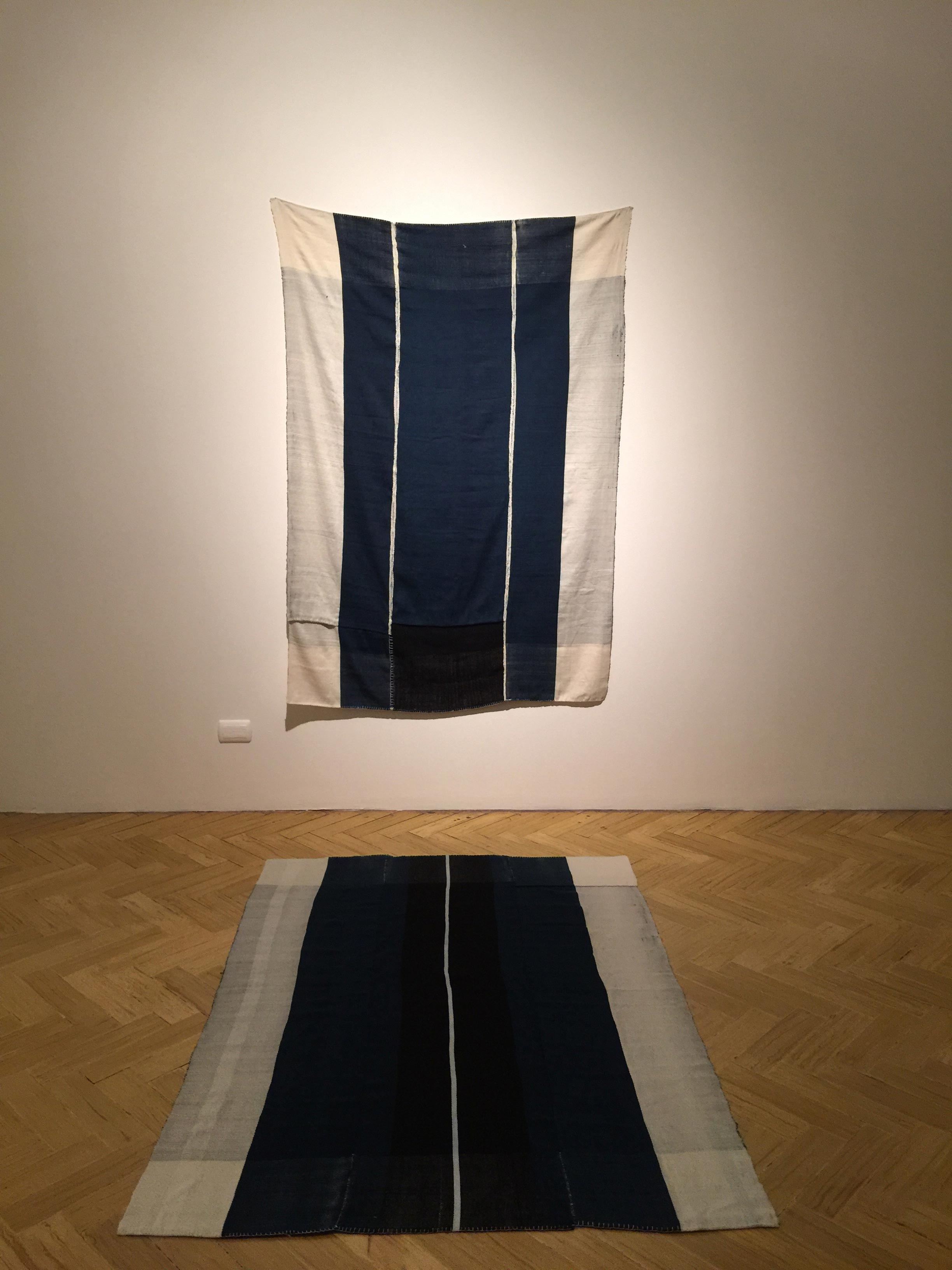
My work for the past couple of years has centered on the body, its extensions and relationships to the things that surround it (the landscape, objects and other bodies) as a way of understanding identity and place. Because of this, I have always been attracted to processes that involve the body. So, when I started weaving on a backstrap loom it felt as if for the first time I had found a medium that suited me perfectly. Of course, learning how to use a backstrap loom is not an easy process, but one I can see myself immersed in for life.
This work came from an exhibit titled The Loom Made me a Weaver, in which I explored how tools are teachers and body extensions. My background is in sculpture and I was taught so much about minimalism, and in particular Donald Judd. However, even though I admire his sculpture and writing, as a woman interested in craft, I never felt I could enter it completely. One day, when I was in the process of learning how to weave, I saw a series of prints by him, dividing the rectangle into one, two or three panels. Immediately I thought, “Judd must have been looking at huipiles!” This to me was funny initially, given his own politics, but in fact he was looking at huipiles, or at least it is certain that he was looking at pre-Hispanic art—both ceramics and textiles. So, this piece served as a transition, as a way for me to engage Judd, but on my own terms (learning from him, but also perhaps critiquing him) and a practical source to give myself instructions to learn how to weave.
Hellen Ascoli in a statement to PLATFORM:VB (August 2017)
SCALE:
One of the important characteristics that I borrowed from Judd in this work is scale. As I mentioned before, my interest in the backstrap loom comes from the body. So, for this work, I took Judd’s prints and scaled the proportions to my body. Each piece forms three panels, and each panel is exactly my size (1.60 × 0.40 meters). The smaller divisions between white and blue warps and wefts use Judd’s prints as instructions, but understanding that the backstrap loom also has material limitations.
MATERIAL:
It is important to mention that I believe that tools contribute to how we engage with the world. Materials “speak back” and teach us their limitations and uses. In making this piece, the most important thing was to learn how to weave on a backstrap loom, how to set it up and feel comfortable responding to the frustrations it presented me.
CRITIQUE:
Although I said it is “funny” that Judd could have been looking at huipiles, I actually look quite a bit at the divisions between art and craft. In this particular case, it is frustrating to see how these binaries contribute both to a social and bodily divide (Donald Judd, a Western white man who makes “art”; and anonymous indigenous women weavers who make “craft”).
Objetos Específicos 1 y 2, 2016 | Objects
Hellen Ascoli
This piece is strongly related to Judd in terms of the critique and design, but also with my readings of Tim Ingold, who writes on material culture. For this exhibition, I was particularly influenced by two of his texts: “Making Culture and Weaving the World” and a paper co-written with Mike Anusas, “Designing Enviromental Relations: From Opacity to Textility.”
Artist's website