Nascente
2012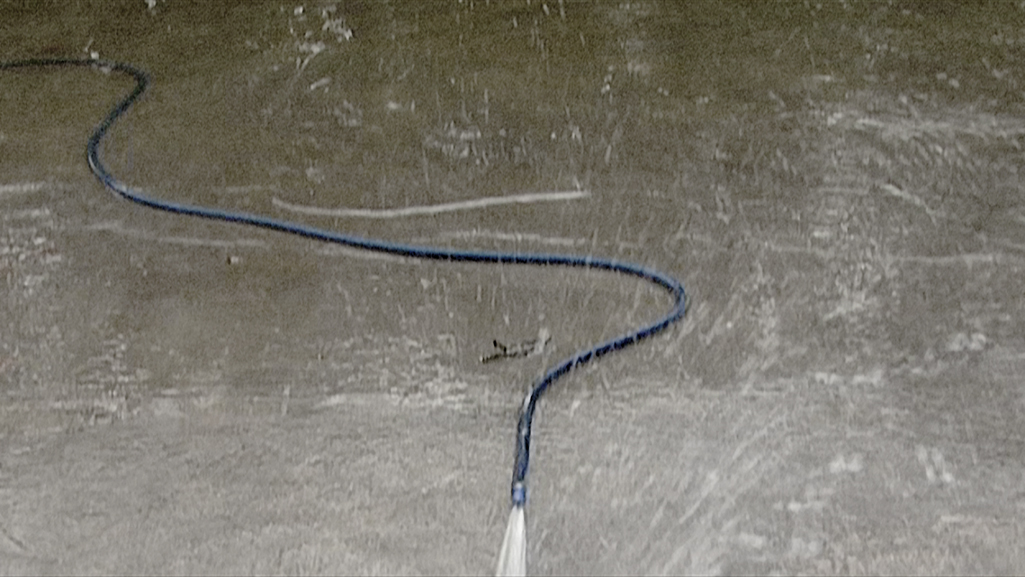
Nascente (2012)
“The footage in Nascente was shot in 2008 and the piece was completed in 2012. I was in a garden with my camera and the movement of the hose captured my attention. I moved the pad on which the camera stood until I obtained the angle I wanted, and then I recorded a long take. At that moment, I was interested in the way the hose responded to the power of the water. I was captured by the material until I realized what it had to offer.
My work results from meetings more than it does from searches. I seek to receive what comes to me and, before these gifts go back out into the world, even if only minimally modified, I must find a consistency and a formal synthesis that always demand time. My pieces are responses to these often accidental encounters. Each response is guided by the senses which the material at hand informs, like an incision into what is given. Without seeking to master a language or possess highly technical skills, my involvement is focused on potential relationships between language and life, on the effort to listen to the nature of the thing I am relating to. The longest time is that of hearing, an action that ultimately doesn’t leave many traces behind.
I feel that the experiences of early childhood bear a heavy influence on the way we create, more than the current cultural context. I do not attempt to analyze this past, but I always notice that the spaces of childhood were and still are special in this regard. The backyard with its trees and animals, the street with its friends, the grandfather’s farm and the ranch by the São Francisco River. Either consciously or otherwise, sensations from those moments accompany us. By exercising a floating, less-selective attention, I stand more of a chance of working with given forces that bring the freshness of early experiences.
After the image arrives, another process begins, because each material will call for a specific treatment.
In Nascente, the sequence shot and the static camera establish a type of silence which displays this ordinary agreement that I so like between floor, hose and water.
We have the floor exercising its gravity, the water squirting ceaselessly, and the blue plastic body that coils, imprinting curved shapes onto the plane.
At a given moment, as the water keeps flowing, the hose meets more friction and rests for a few seconds, falling in the gap in the glass. An outlet is created for the movement, which does not stop and resonates through space.
The use of glass causes Nascente to take one more step towards space, raising other issues which relate to sculpture. I needed a material that could support the gap, interfering minimally with the image, and that could rest upon the surface of projection, connected to the floor like a ground wire. The weight, the stability, the transparence of the glass are qualities that activate this new zone of touch, transcending the projection.”
Pablo Lobato in a statement to PLATFORM:VB (October 2013)
Nascente (2012) | Pablo Lobato
Video installation | Video, 3’, stereo, color, 16 : 9, loop, glass pane
Nascente (2012) details and setup at the exhibition space of the 18th Contemporary Art Festival SESC_Videobrasil
Testimony Pablo Lobato | 18th Festival
The artist from Minas Gerais gives a statement on occasion of his participation in the festival and during the Festival’s 30th anniversary celebrations. Lobato has taken part in the event, on and off, since its 13th edition
Zen for TV (1963) | Nam June Paik
“The sensibility that the tree demands from the gardener for a good trimming is something that inspires me. Perceiving the plant, knowing where the sap runs, waiting for the best season, the best moon. This gesture makes me think of the notions of language and life contained in works like Nascente,” says the artist.
During the interview, Pablo Lobato commented on his taste for minimalism and for sculpture, and also said that during the production of Nascente, the concept of metastability, by the French philosopher Gilbert Simondon, was one of his references.