My Maps

Secular Dogma
Roberto Borges, Heloisa Vivanco, Liria Tamura, Gabriel Novaes
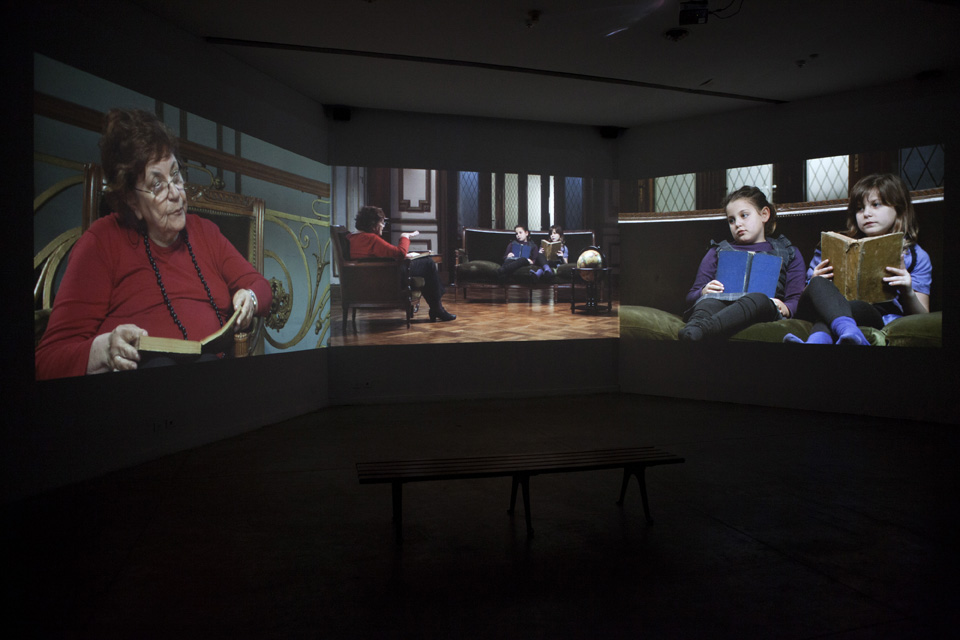
Conversation piece (2012)


Ghost Looking for its Spirit video still
The most harmful dogmas are not really those that have been explicitly declared as such, as is the case with religious dogmas, because they appeal to faith, and faith doesn't know and cannot discuss itself. What is bad is the transformation into dogma of a secular system or theory aspired to be a dogma at all.”
José Saramago, The Notebook (2009)
What are the foundations of our convictions?
In times in which new truths solidify in news feeds of social networks, in which “coxinhas” and “petralhas”[1] yawp watchwords that lack a solid source, we must reflect on the knowledge bases of the contemporary man.
The speed of information exchange in hypermodern times and the change in the way people relate to each other in an extremely digital world rekindles the issue of dogmatization of thoughts and ideologies as persuasion tools, giving way to political and religious extremism.
The search for the meaning of life is inherent to human beings, spirit and matter live, side by side, in harmony and conflict, which led to the emergence of several doctrines and sects, and the appearance of dogmas underlying the faith of the world’s leading religions.
What leads man to consider his beliefs as truths? Questioning absolute truths is no easy task. With the pieces we handpicked from the collection of Associação Cultural Videobrasil, we intend to spark a debate on the paths that lead to the transformation of an idea into dogma.
The exhibition was structured around four works: Gabriela Golder’s Conversation Piece; Köken Ergun’s Bayak (The Flag); Slinko’s Ghost Looking For Its Spirit; and Sebastián Diaz Morales’s Lucharémos Hasta Anular La Ley. The three first videos, the way we chose to install them, present a crescent narrative on the process of ideological indoctrination, departing from an innocent conversation between a grandmother and her granddaughters, passing through a populist celebration of Children’s Day in Turkey, and culminating in a humorous ideological crisis by a Russian artist based in the US. In contrast, at the end, we leave to the public the reflection of dogmatization of ideas and its direct effects in institutions and society.
José Saramago, in the text titled Dogmas, in The Notebook (2009), declares that “Marx, for example, was not dogmatic, but straightaway there was no shortage of pseudo-Marxists to convert Das Kapital into a new Bible, exchanging active thought for sterile commentary or perverse interpretation.”
Whether in philosophy, politics, sports, fashion, or pop culture, knowledge must not be disguised in blind ideology.
And Saramago ends with what he calls a fundamental question: “Why do I think the way I think?”
This is questioning we intend to arouse.
Mapping conducted by Heloisa Vivanco, Gabriel Novaes, Liria Tamura and Roberto Borges as the result of a curatorship effort by students in the Postgraduate Specialization in Art: History, Criticism, and Curatorship at PUC-SP from works in the Videobrasil Historical Collection, under Professor Cauê Alves’s guidance. (April 2016)
[1] Derogatory monikers given to supporters of conservative or reactionary ideologies, and supporters of the Workers Party (PT), respectively.
A psique de coxinhas e petralhas, Folha de S.Paulo (2017) [port]
Os Tempos Hipermodernos, by Gilles Lipovetsky
O Evangelho Segundo Jesus Cristo, by José Saramago
A Estetização do Mundo, by Gilles Lipovetsky
O Caderno, by José Saramago (2009)