My Maps

Paths of Submission
Juliana Oliveira , Laís Mayumi, Paula Toledo , Sophia Toledo , Thais Doro , Thiago Franco
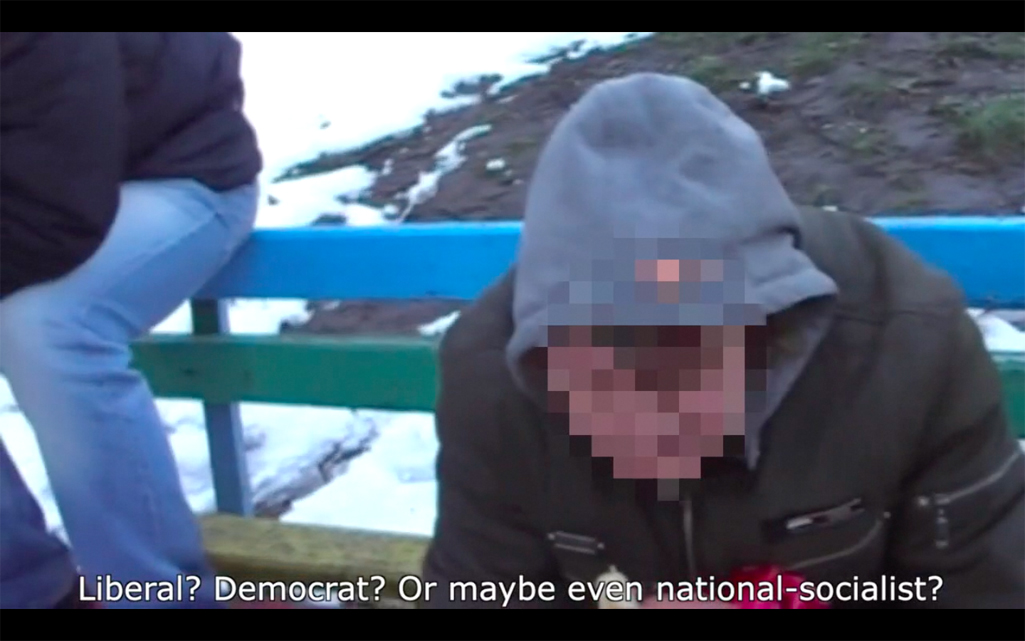
Video still
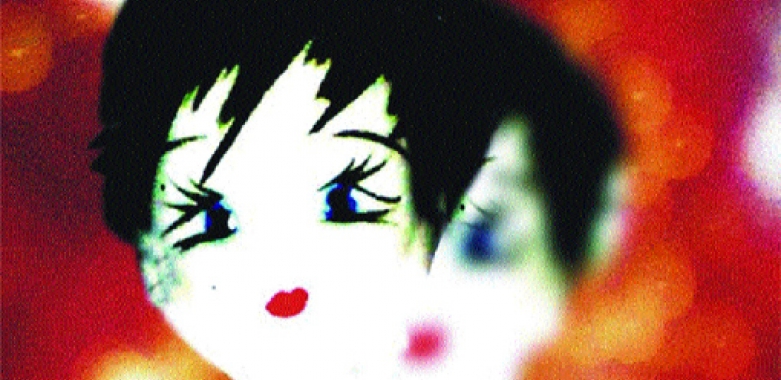
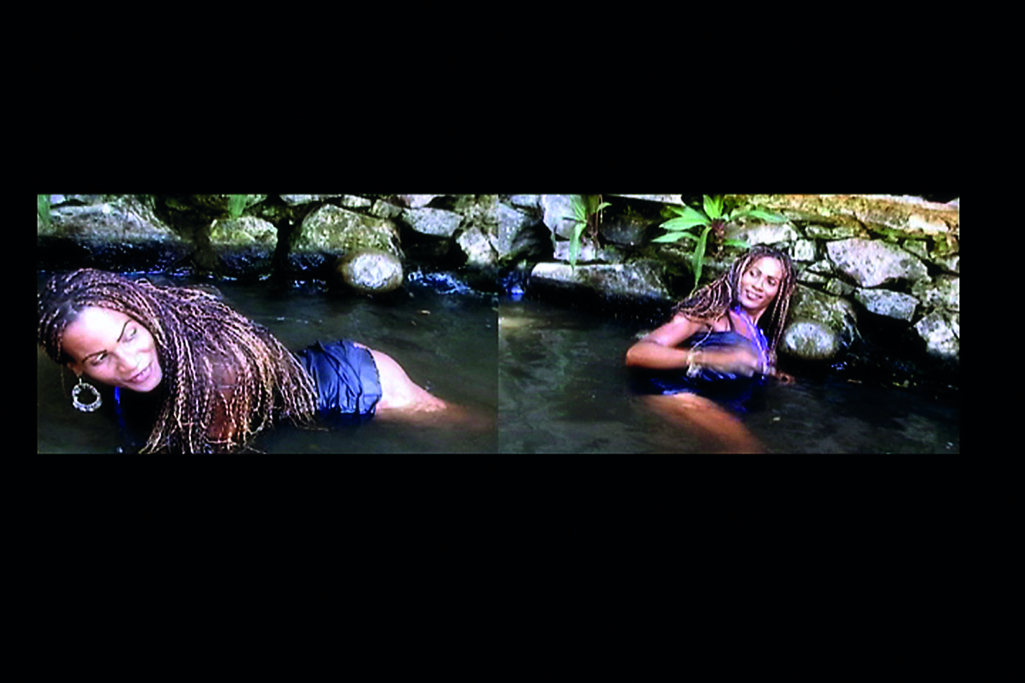
Sergio e Simone (2010), video still
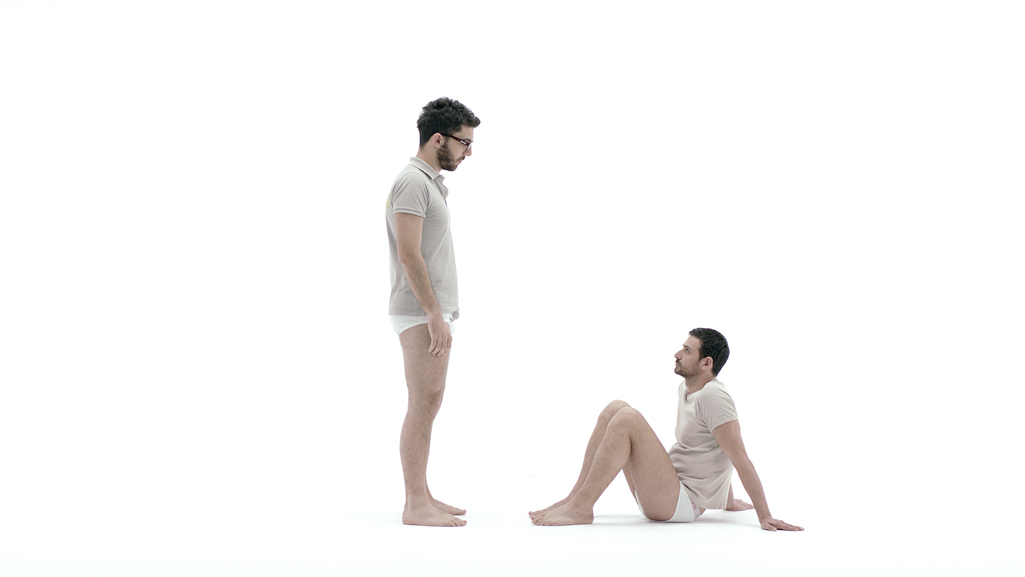
The End of Time (2013) video still

Video still (Temporada de caça)
“A passive involvement is not possible. Invoking a word, an image, or a past gesture means to enter a field of dispute for their meanings, and with our current needs and hastiness. We must manipulate, betray, distort, and twist those heteronormative stories they attempt to force upon us as legacies of truth established from the pathologization of omission and the silencing of sexual dissent.”[1]
Society and politics must break free from the supremacy of dominant discourse, dictating normative stances with repressive effects, silencing stories and struggles of individuals who are not free to simply be who they are. For years these stances have been interfering in the life and personal choice of each individual outside the standard imposed by the supremacy of the male gender, making those who do not correspond to this social construction of ideals of sexual behavior and/or gender to live submissively and shut down through times, thus hindering the rights to individual decision-making or group assimilation in society.
Paths of Submission is a curatorial exercise which gathers artworks in video developed by artists who focus on this social problem, and whose goal is to reflect on the different realities of individuals from the LGBT community who look into their social reality and who support the fight against cultural repression and violence to what they are exposed on a daily basis. By addressing the issue through the videos selected for this show, the project aims to foster a critical debate on the difficulties experienced by those who suffer heteronormative discrimination, drawing attention to how contemporary society in some countries from the geopolitical south tackle the issues of gender and sexuality, and how it has the power to shape the behavior of those who comprise it—treating whoever is different antagonistically and systematically excluding them. The geopolitical south is the setting of several displays of hate toward social minorities. Issues regarding gender identity and sexuality are often curtailed by prejudice and violence. The curatorial agenda focuses on the aspects concerning such repression, unveiling the long path toward freedom for those who don’t fit the heteronormative, sexist standard of sexuality and behavior.
In addition to considering the geopolitical framing of the Videobrasil collection, this curatorship has selected videos that present different realities of members of society outcast for their gender or sexuality. The project thus approaches not only the collection and Videobrasil’s mission, but also continues its recent program, which has regularly addressed the struggle of social and cultural movements that were erased by oppressive, authoritarian, and normative systems.
Video as medium is presented as an a critical instrument in the process of increasing the visibility of ignored narratives, for being easily accessible (ever more present, considering the widespread use of cell phones with cameras, for instance) and communicable, thus giving an opportunity for a marginalized stratum of society to speak out and be seen—people who are part of the LGBT community.
Even with the visibility these issues acquired over time through demonstrations for rights by the LGBT community, the resistance of large portions of society is palpable, manifesting negatively, through the privileges of politics and culture, applying regulations that limit the freedom of those individuals and attempt to deny rights which have already been laboriously gained throughout the years. These actions eventually influence the way through which society is led to think and act in regard to these issues. Therefore, the debate about repression is highly relevant today and we believe it is extremely important to bring these issues to the academic space, reserving some time at the end of the exhibition as a space dedicated to the freedom of expression, to discuss and debate the ideas behind the videos. The selection shows political and intellectual engagement and attitude in favor of democracy and the human rights. We believe these proposals denounce grievous social problems and reflect important topics of the struggle for the rights of the LGBT community. With this considered, we believe it is interesting to point out the political and social situation of the LGBT community in the countries present in our selection—Brazil, Lebanon, and Russia—, confirming the need to address this topic and pinpoint these countries as examples of the situation faced by many individuals.
At the same time it hosts some of the largest LGBT Pride Parades in the world, Brazil is also the stage of many displays of hate and discrimination. Despite the recent developments, such as civil marriage equality, or the right for transgender persons and transvestites to use their social names, the situation of the Brazilian population is alarming.
Constant defamation and systematic persecution of the LGBT community, often encouraged by religious fundamentalists and their political representatives, is one of the obstacles to overcome by the movement. Institutionalized homotransphobia is not a recent threat, but it has been taking frightful proportions in recent years—such as the “School Without Party” project which, under the guise of political neutrality, intends to prohibit debates of issues related to gender and sexuality in schools. In the opposite direction of non-inclusive bills, we cite Transcidadania (Transcitizenship), an initiative from the City of São Paulo whose goal is to promote social reintegration of the socially vulnerable trans population.
When the issue touches a country’s cultural and political tradition, acceptance is even rarer, such as the LGBT community in Russia. Apparently, Russian individuals have the freedom to their sexual choices provided they keep it a secret. In July 2013, president Vladimir Putin enacted the law forbidding all advertisement depicting non-traditional sexual relations, with the intention to “protect” the Russian children, attempt to keep even further distance from the “Western culture.” By adopting the law, Putin stirred up resentment and inspired demonstrations the world over in support of sexual freedom and human rights. At the same time, many Russian citizens understood the law as a way of disseminating hate and persecuting the LGBT community without suffering consequences for the crimes.
Yet another means of frequent repression is the autocracy of the religious culture. Both in the West and in the East, there are people who take advantage of religious precepts to encourage prejudice and even bills that sentence lesbians, gays, bisexuals, transsexuals, and transvestites to death. In Lebanon, for instance, homosexuality was considered an illegal and unnatural act by a law enacted in 2011, and those sentenced may face up to one year in prison. The Lebanese population is divided, in its most part, between Muslims and Christians. Both for the Quran and for the Bible, the two most widely followed sacred books, sexual relations between people of the same sex is condemned as sin and, for the holy book of the Muslims, the Quran, the sentence is death, thus regarding homosexuality as a depraved act that disturbs the standard of society’s “natural” life, and homosexuals as “slaves to their lust”, incapable of having decent taste, moral, and life.
Mapping conducted by Juliana Oliveira, Laís Mayumi, Paula Toledo, Sophia Toledo, Thais Doro and Thiago Franco, under Professor Cauê Alves’s guidance, for the project “PUC-SP’s Incursions into the Videobrasil Historical Collection”, in which students from the course Art: History, Criticism, and Curatorship at PUC-SP assemble video exhibitions from the Videobrasil Collection as an interdisciplinary exercise in the course’s final semester. (December 2016)
[1] Miguel Angel López, Alianças de Corpos Vulneráveis: feminismos, ativismo bicha e cultura visual. São Paulo: Sesc, 2015, p. 15
Rússia aprova lei que pune 'propaganda gay' e ofensa a religiosos (Folha de São Paulo, 11 de junho de 2013) [port]
A Identidade Cultural na Pós-Modernidade, por Stuart Hall (DP&A, Rio de Janeiro, 1992) [port]
Alianças de Corpos Vulneráveis: feminismos, ativismo bicha e cultura visual, por Miguel Angel López (Sesc, São Paulo, 2015) [port/eng]
O sul para além da geografia, a acepção política e econômica do termo, por Ricardo Machado (IHU Online, 2014) [port]
Os gays na sociedade russa: total liberdade, mas em sigilo, por Cristina Mestra (Sputnick News, 2014) [port]
Um sul sem norte, por Vivian Mocellin (ARTE! Brasileiros, 2016) [port]