My Maps

Let Me In
Biba Rigo, Fernando Pozetti, Maria Fagá, Priscila Fonseca, Yessica Hernandez
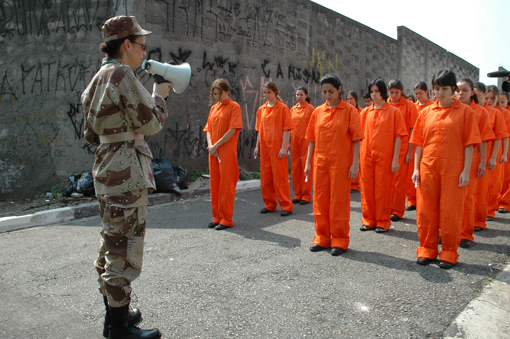
Bare Life Study #1 (2005) performance recording
Mechanisms for controlling access and permanent surveillance have become a phenomenon that surpasses private environment and institutions, seizing control of spaces of public life.
The reaction to these symbolic and real mechanisms for control of the body, which undermine the freedom of individuals and groups, convert into a principle of social surveillance in order to maintain the power of the dominating social classes. The symbolic control imposed by these technical devices at the service of social surveillance gives the artistic and curatorial research its potency of action—and why not?—a manifest for the survival of expression. It is precisely inside this universe of discomfort that the videos of the Let Me In! exhibition will be projected.
The selected works make use of a powerful language regarding its criticism to institutions and totalitarianisms of all kinds. Video art’s historical path pointed out to works structured around more open, associative and fragmentary narratives. “Video”, used as the technique to produce the artistic works presented, is also, paradoxically, the technical device ensuring permanent surveillance and alienation of individuals in relation to their environment. Some works feature the distress of the dissolving of biographies and identities; others discover, ironically, that what remains is only the stereotype of an arrangement that reduces the unique individual to a category.
Symbolic and real mechanisms for control of the body and paradoxes hovering around a permanent state of risk, but that undermine the freedom of individuals and groups, cooperate to maintain (or realize) the maintenance of powers and the dominating social classes. The mastering of technical and scientific devices—but which are always converted into ideological devices—is the principal of social surveillance. Identified by Foucault[1] as a model to preserve institutions and a basis for the theory of disciplinary societies, this systematic instrument for “docilization” surpasses walls, seizes control of spaces of public life, and underlies social relations. The issue, previously of access, now also lies on mechanisms that infiltrates bodies, gestures, behaviors.
The authority of the issue in the artistic research gives contemporary art its potency as present and action—and why not?—a manifest for the survival of expression, not mere accident, easily recognized in discourses of artists and collectives. Beyond the maintenance of social classes, the goal is to control individuals in space—so that each one is assigned their specific place—and in time—so that it is not wasted uselessly and unproductively.
By observing this phenomenon in the modern and postmodern societies, Gilles Deleuze achieved the concept of society of control, identifying as their main instruments the technologies at the service of social control[2] dominated by the emerging capitalism and imperialism.
This is about the proliferation of turnstiles, video cameras in social spaces and the use of tracking devices. Not only that, but a trend to privatize these spaces, where discipline forced by such mechanisms, at times invisible, result in the discomfort of displacement and unfitness, of alienation of individuals in relation to their environment. This voluntary submission is consolidated in the illusion of achievement of a social order only attainable through forced control.
Mapping conducted by Biba Rigo, Fernando Pozetti, Maria Fagá, Priscila Fonseca and Yessica Hernandez, under Professor Cauê Alves’s guidance, for the project “PUC-SP’s Incursions into the Videobrasil Historical Collection”, in which students from the course Art: History, Criticism, and Curatorship at PUC-SP assemble video exhibitions from the Videobrasil Collection as an interdisciplinary exercise in the course’s final semester. (December 2016)
[1] Michel Foucault, Microfísica do Poder. Rio de Janeiro: Graal, 1985, p.80
[2] Gilles Deleuze, Conversações: 1972-1990. Rio de Janeiro: Ed. 34, 1992, p.219