Letter to My Father (Standing by the Fence)
2005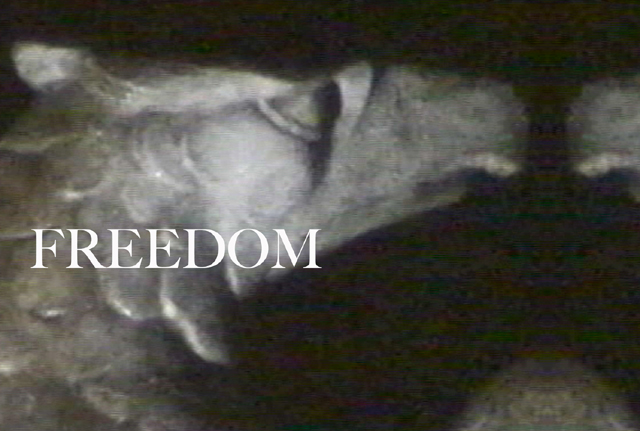
Video still
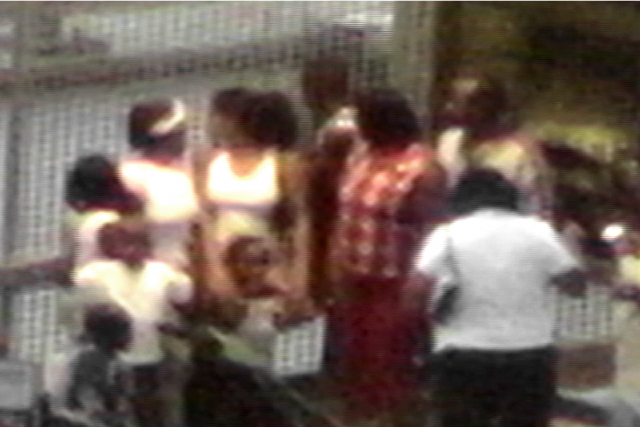
Video still
Video still
"Letter to my Father was conceived and shot during a residency at the Lower Manhattan Cultural Council that provides studio spaces to artists in this neighborhood. After 9/11, Lower Manhattan and the residency itself saw themselves hardly impacted – in fact one of the resident artists at the time (the residency was in the Twin Towers) died in the attack. In 2004 I was assigned a studio space in the Equitable Building that overlooked Ground Zero and I found that I wanted to do something about that haunted site. I wanted to acknowledge the site, as a place of a certain history, but also address the symbolic aspects of the experience of 9/11 as they related to my experience as an immigrant in New York.
I think living in New York at the time demanded a certain degree of responsibility—in terms of trying to understand what was at stake politically in the world, specially in the United States, and more specifically in New York, which had been the center of the attacks. The opportunity to make a new work within that loaded context conveyed a sense of privilege: overlooking Ground Zero from my studio window on a day-to-day basis, acted to me as a reminder of the different layers that constituted the experience of being a citizen.
Letter to my Father is one of my video works in which image and text were conceived together. I edited the images in relation to the text, but also in relationship to the way that images work with one another. The work done to the images though editing was to dissolve an image to the extent that it stops representing what is supposed to depict. For instance, the images I shot through the window, of people looking through the fence, become completely pixilated to the extent they become abstract and they start to refer to images of surveillance... In that sense Letter to my Father is a very aesthetic work. Its politics rely not only on the things that I am saying, which I believe to be more poetic, but on the way that the images may complicate those things said.
The people that talk in the video are persons I approached on the streets and asked them to take my audio recorder and walk around the site, reflecting upon their perception of the place and talking about 'what they saw.' That’s why the woman, the first person to speak, says, 'I’m gonna talk about what I see. I see an ambulance in front of the site. I see a fence...'. She was literally describing what she saw.
The title of the video directly references Kafka’s book of the same name, which is about an adolescent speaking to his father about the trouble of relating to him as an authority figure. I have some issues with my father myself, so it was an interesting idea of turning the State, the government, my experience as an immigrant in this country, into the figure of the father, into an authority figure. I was speaking about my own father but at the same time speaking about the US as a patriarchal system.
Letter to my Father is one of my first works and I think it is a very important work for me in the sense that it starts to articulate a specific kind of an intellectual positioning, in relationship to making work, but also in terms of building or shaping up a (artist’s) voice.
A bit later, I started working on a project titled The Good Life, that I did all over Latin America, where I interviewed people in the streets about their perception of democracy as a form of government. When I was working it became clear that democracy was not only a political affair; it concerned religion, sexuality, gender, issues on immigration, war, it was related to everything. And that’s when the Democracy Cycle emerged."
Carlos Motta in a statement to PLATFORM:VB (August 2014)
Letter to My Father (Standing by the Fence) (2005) | Carlos Motta
Video | 14’17”
Letter to My Father (Standing by the Fence) (2005)
Testimony Carlos Motta | 15th Festival
Testimony Octavio Zaya | Unerasable Memories, 2014
The curator Octavio Zaya comments on September 11 from the perspective of Carlos Motta
"Chris Marker is a reference, in the sense he’s very specifically articulating a set of political questions in relationship with how they are represented in those images.
My influence in terms of video essays comes also from Ursula Biemann. She has used the relationship between image and text and discussed it at length.
It would be important to talk also about the Tercer Cinema. La hora de los hornos, by Fernando Solanas and Octavio Getino, is a work that would be incredibly important for me to think about how to produce an art practice that is critical and that is speaking to our conditions."