Jardim de Aclimatação XXI
2015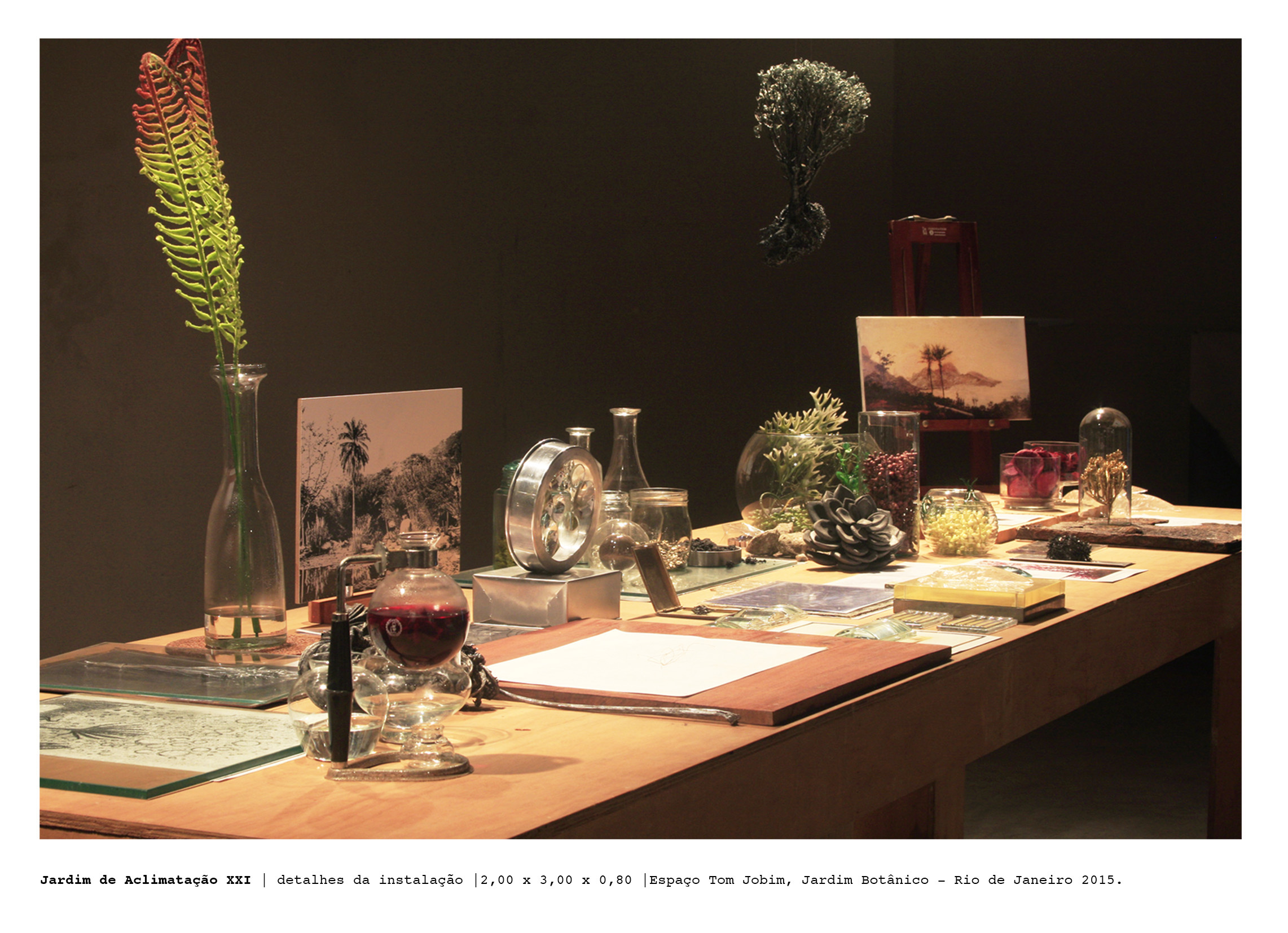
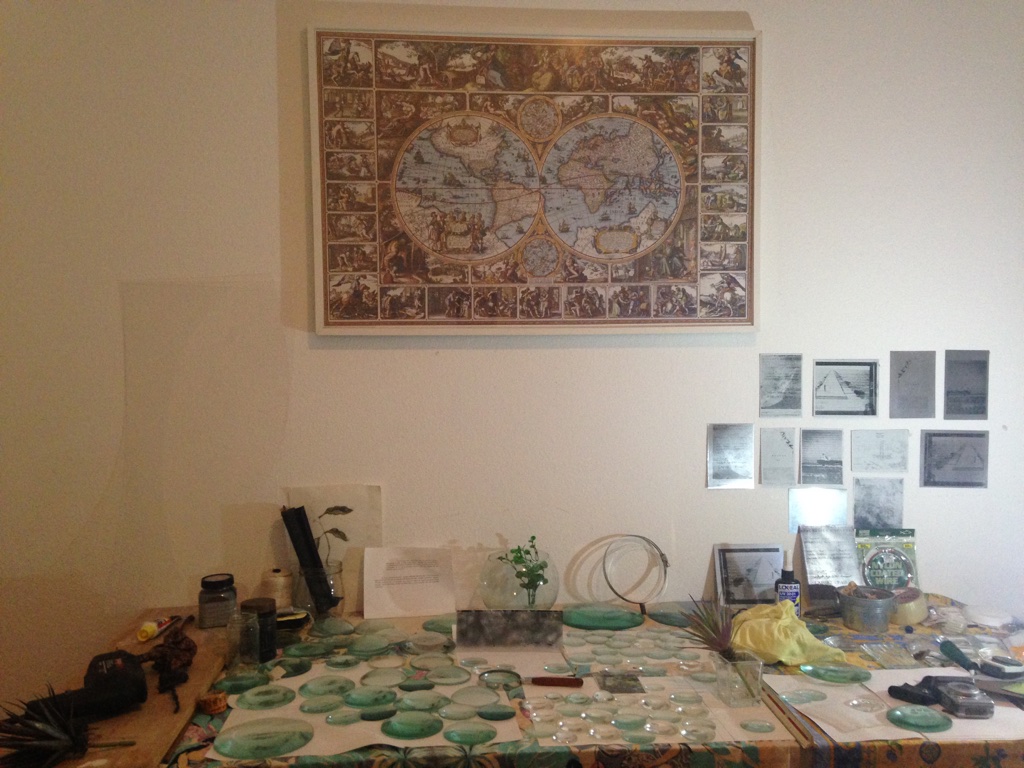
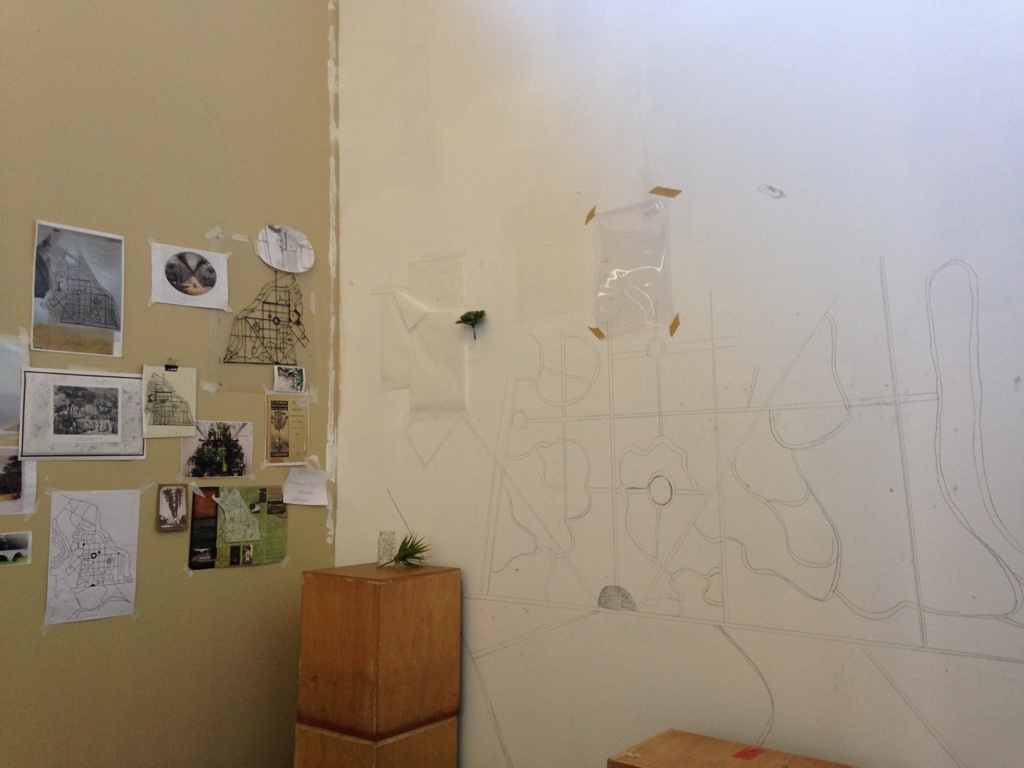
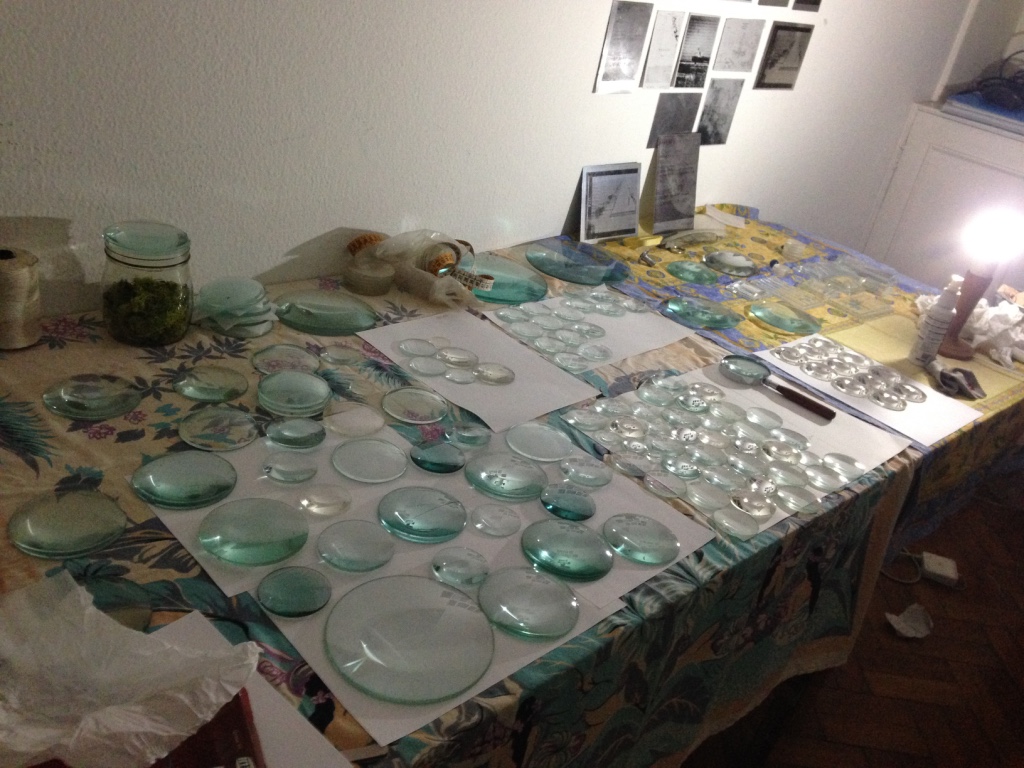
The work Jardim de Aclimatação XXI [Acclimatization Garden XXI] was produced from an artistic residency inside the Rio de Janeiro Botanical Garden. There, for a few months, I got to stay in direct contact with the Garden, its artificial structure in the sense of cleanliness, the pruning of plants, their choice and combination, and I got to be a regular visitor of the library that houses many important volumes for the history of the Botanical Garden. Being in the middle of this universe of the library and the garden was like taking a trip back in history, to the garden’s foundation. It was within this historical research that I realized the correlation of the Botanical Garden’s creation with an open-air Cabinet of Curiosities. Utopically, the garden could be the place where all the plants in the world are stored. When Dom João VI created the Botanical Garden, he created a garden for exotic plants, which was written up in a decree, without any species native to Brazil. This information is crucial to think of a certain fictional turnaround the work may come to, in terms of the structure of a hallucination.
At the library, I could read the accounts of the traveling artists who were in Rio at the time, as well as access the iconography they produced. I appropriated the several images, interfering in them so as to set them in this unreal place, where the illusions of representation are exposed, enabling fiction, especially in regards to the hegemonic historical discourse that surrounds the museums of natural history, the botanical drawings, etc. It was like taking a trip, a trip to different times—worlds stored inside shelves—, where I could notice the infinity that exists within collections. A collage spanning centuries.
The other trip I took was pure path. It was errant and collected, amidst the city, objects and materials that could give meaning to the collage of fragments. The library as a world, the city as a workshop, Saara [shopping district in Rio de Janeiro] as a continent, the workshop as home, the garden as a cabinet of curiosities. A drifting path that structured thought, that simulated a dream and wandered so as to find objects that establish themselves in the juxtaposition, in the multiplication of fragmentary forms which, interspersed, created a fictional discursive universe for the work.
This work is like a turning point in the corpus of my artistic production. It was from its process that I could complete many objects that were loose inside my work, often stored in the workshop meaninglessly, failing to adhere to any other piece, lying there for at least two years. So, it was very important to find their place, and the garden turned out to be a point of arrival, just as, from it, a point of departure, like a conclusion. It also coincided with the conclusion of the research for my master’s degree, again comprising a new point of departure and a point of arrival. Another important aspect is that I am a set designer, and have worked building spaces for nearly ten years, studying them and making them differently. As an artist, this is my first incursion into the universe of the installation space, an incursion that I had been waiting for quite some time.
Among the aesthetic and poetic questions of this work, it was extremely important to place objects on the table, because they establish a direct connection with the table top and a sheet of paper, stressing the idea of collage. This collage wants to be timeless, heterotopical, and intends to establish itself in the motion around the table, a path that viewers must take, and also choose their stopping points. In this sense, I recall Carl Andre’s statement, “the ideal sculpture is a road, because it forces people to follow them, to walk around them.” From this path through the work emerges the sense of historical deconstruction regarding the model of a linear history, Eurocentric, built upon a point of view. To treat history in a fictional, fragmented way is to attempt to stress the construction of a new meaning, something like a counter-epic, an attempt to relativize the regard, perceiving history as the construction of a narrative from the perspective of whoever wrote the history of others. The work intends to relativize the construction of the knowledge based on the Enlightenment idea, rationalist and classificatory, upon which our society was erected. With it, we tend to place things in frames, unify knowledge, level peoples and subtract their differences. The perception is that our contemporary globalized world established itself from this formula.
Debora Mazloum in a statement to PLATFORM:VB (June 2017)
Jardim de Aclimatação XXI, 2015 | Installation
Debora Mazloum
Vídeo about the exhibition Amor [Love]: Luiz Zerbini in the Modern Art Museum of Rio de Janeiro, 2012.
“There is nothing natural in the museums of natural history, nature is simply yet another fiction from the 18th and 19th centuries. ” This statement from Robert Smithson is, for the work, more than a reference, a pillar that supports and envelops it. Alongside this idea is the Michel Foucault’s book “The Order of Things,” where he examines how the structure of thought changes from the Middle Ages until the emergence of the man of the post-Renaissance and the Enlightenment. It is at this moment that the natural sciences become the description of the visible and establish the parallel of verisimilitude with reality, setting the historical discourse on this place of single, universal truth. Another important reference in the structuring of the Garden is the work of the painter Luiz Zerbini. In addition to being deeply fond of the universe of botanics, in the exhibition entitled AMOR, the artist used a central table at the Rio de Janeiro Museum of Modern Art (MAM-Rio), and this table worked as a kind of “memory of the creative process.” Zerbini also exhibited at Rio’s Botanical Garden a work entitled Gabinete de Curiosidades de Domenico Vandelli [Domenico Vandelli’s Cabinet of Curiosities]. Here, at this point, the references are interspersed, dissipate, and head to all the artistic mission that took place in Rio, the accounts of the traveling artists, the engraving plates, the botanic materials and the entire history involved in the creation of the Botanical Garden, all the way through the arrival of the Portuguese royal family in Rio and its unfolding.