In This House
2004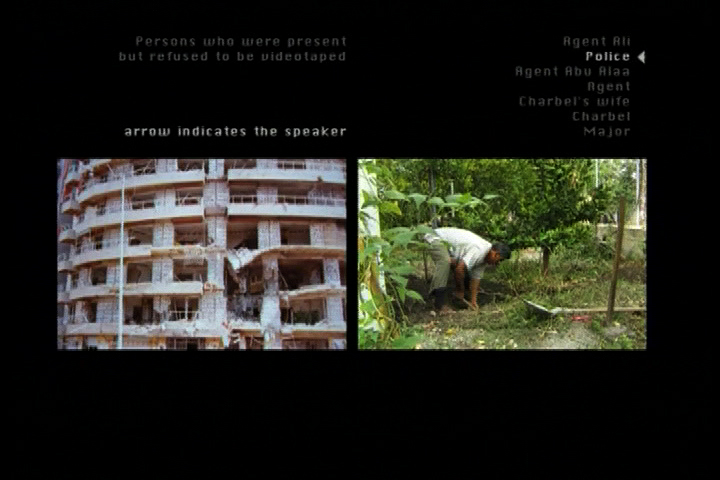
Video still
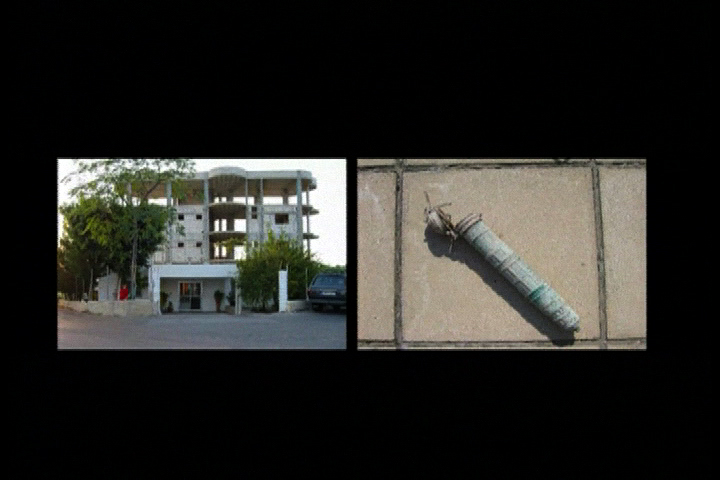
Video still
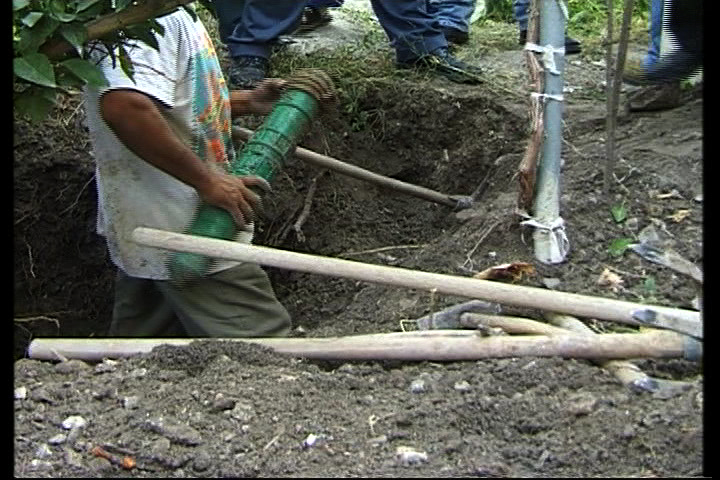
Video still
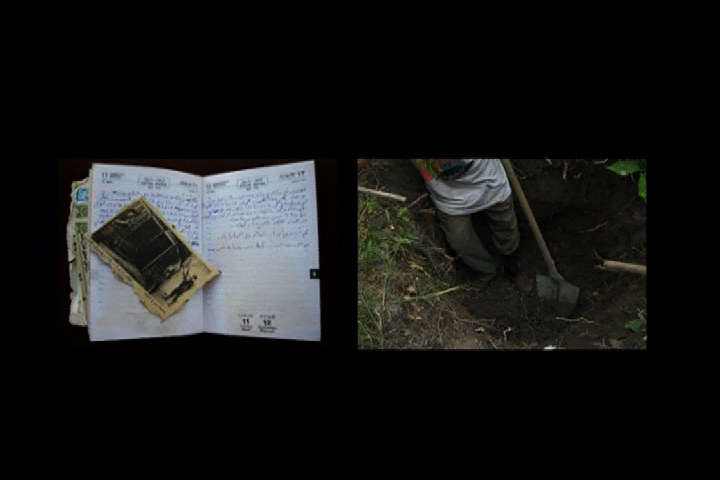
Video still
Video still
“In 2002 I started a research looking for documents from the Israeli invasion of Lebanon in 1982. I took notes in the form of a diary and started to take pictures during those times, so part of my interest was also looking at how people recorded what they went through and in which form. Part of this is an interest in technology of communication. This is how I met the main character of In This House, Ali Hashisho, a former member of the Lebanese Resistance.
The Israeli army invaded Lebanon twice, and occupied 12% of its territory from 1978 till 2000. Invasions caused huge damages, but also led to the formation of a Lebanese armed resistance. The military struggle that was started by the Palestinian Liberation Organization in 1970 and was forced out of Lebanon by the 1982 invasion was transformed into a Lebanese Resistance, first secular then Islamic with Hezbollah after the Taef agreement in 1991. The agreement imposed a disarmament of all other Lebanese parties except Hezbollah. Thus, Hezbollah became the only legitimate armed resistance party.
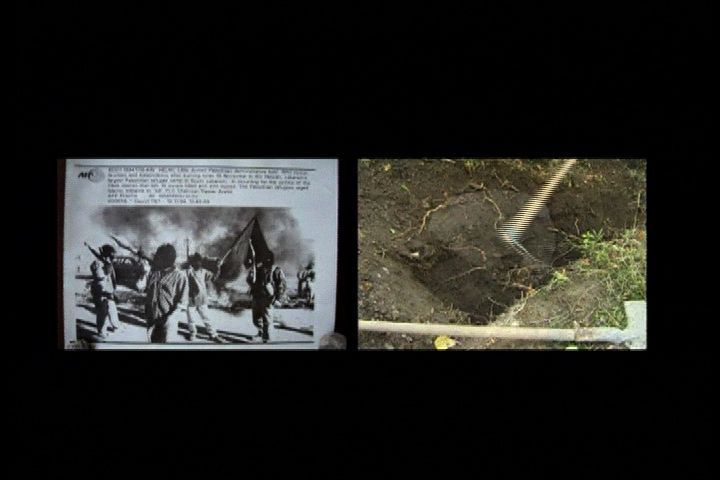
Ain el Mir, the village shown in the video, was occupied by the Israeli army in 1982. The Israelis withdrew from Saida and other parts of the South in 1985 but stopped in the facing hills. But ironically when the Israelis left, the village became dangerous because it became the front. So everybody left and the Lebanese Resistance used some of its houses as military basis. This occurred at a time when the Soviet Union’s power in the region was diminishing against a rising Iranian influence. That was when Ali left a letter to the owners of the occupied house buried in the garden.
In This House started as a documentary on five screens, produced as a video installation. I wanted to show different things taking place at the same time, so the split screen was inevitable. One for the digging after the letter, one for the interviews and other documents.
Other important factor is like many Christian families, the owners of the house decided to take refugee further South, in Marj-e-ayoun, which had remained under the Israeli occupation. The family returned back to their village and home in 1992, and like many families who lived in the Israeli occupied area, they were interrogated for possible collaboration with the enemy, until their records were cleared. And this is why this entire area remained for years under surveillance by intelligence services.
The family did not want to be interviewed. They were paranoid, and thought that being on camera might put them in danger. All the intelligence agents who were present on site while digging was taking place did not want to be filmed either. So I filmed the digging for two and a half hours and when a member of the army’s intelligence started to dig, I turned off the camera. At this point I was still not sure if I would find the letter. So when we found it only a few minutes later, I turned my camera on again and this is when the image turns full screen for the only time in the film.
The letter was a result of the times, and the conditions around its making. I see it as an act of leaving a trace. It is exactly like taking a picture, like recording a sound. It is an act that have to do with freezing a moment in time; a Time Capsule indeed.
This film is an important shift in my work because it is there where it became performative. I often argue that the work is a performance work, and the film is a result of an active presence of the camera with me. The performance is an intervention in this family’s life. After my visit the family knew things about their house and past that they didn’t know before. The work made Ali’s letter reach its destination years later. This work is a result of my dedication to documentary film and my personal curiosity, and interest in archaeology.
In all cases, the film’s interest lies in observing how an invasion and a withdrawal functioned under the microscope, that is, to give a testimony from a former front that is able to communicate the complexity of a political and geographic situation even twelve years after the return of the displaced family to their home and village. It aims to look at the geography of fear, and at the latent borders in that region. So it is also a work on the archaeology of invasions."
Edited with the artist from the interview published at Eyeline Magazine (August 2014)
In This House (2004) | Akram Zaatari
Video | 30'19"
Testimony Akram Zaatari | 11º Festival
Eduardo de Jesus, Marcio Harum | Unerasable Memories, 2014
Marcio Harum and Eduardo de Jesus give an overview of the participation of Lebanese artists in Festival editions, highlighting the works of Akram Zaatari, Rabih Mroué and Walid Raad
Teaser | Olhar sobre os Olhares de Akram Zaatari (2004) | Alex Gabassi
This video, part of the Videobrasil Authors Collection, reviews and comments on the production of the Lebanese artist Akram Zaatari
"My dedication to fieldwork, and my interest in archaeology is something that I developed while building the collection of the Arab Image Foundation, and I see little equivalent to this approach around me. But talking about the Lebanese generation of artists I come from, we share the question of history and the questioning of documents and narratives. Walid Raad has been very supportive and inspiring while I was making this work. We worked together on Mapping Sitting while I was working on In This House, and the path each one took inspired the other over years.
I share attitudes and tools also with lamia Joreige."