(Índice 1, contiguidade não imediata)
2011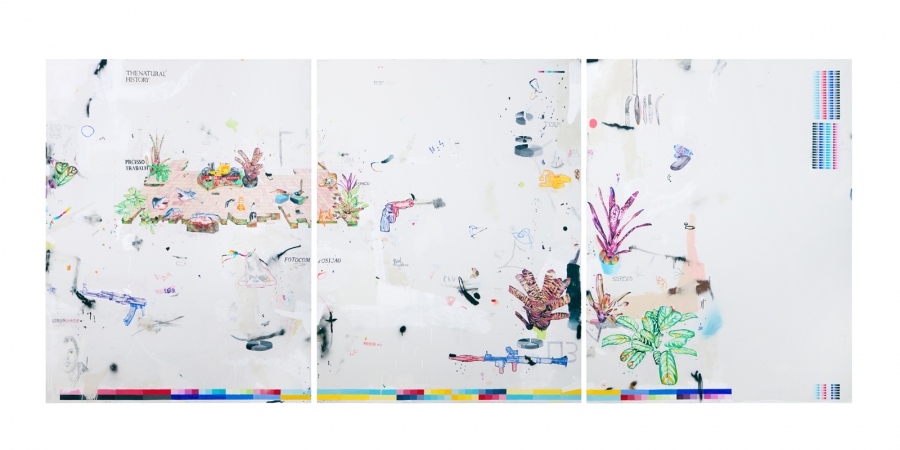
(Índice 1, contiguidade não imediata) (2011). Painting by Paul Nimer PJota on the occasion of the 1st Ateliê Aberto Prize, displayed at the 17th International Festival of Contemporary Art SESC_Videobrasil.
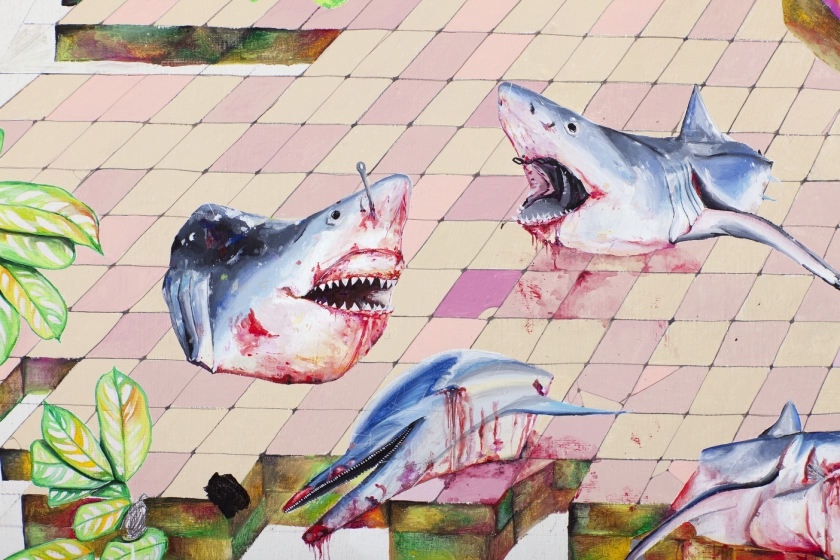
Detalhe da obra (Índice 1, contiguidade não imediata) (2011), realizada por Paulo Nimer PJota em ocasião do 1º Prêmio Ateliê Aberto Videobrasil, exibida no 17º Festival Internacional de Arte Contemporânea SESC_Videobrasil.
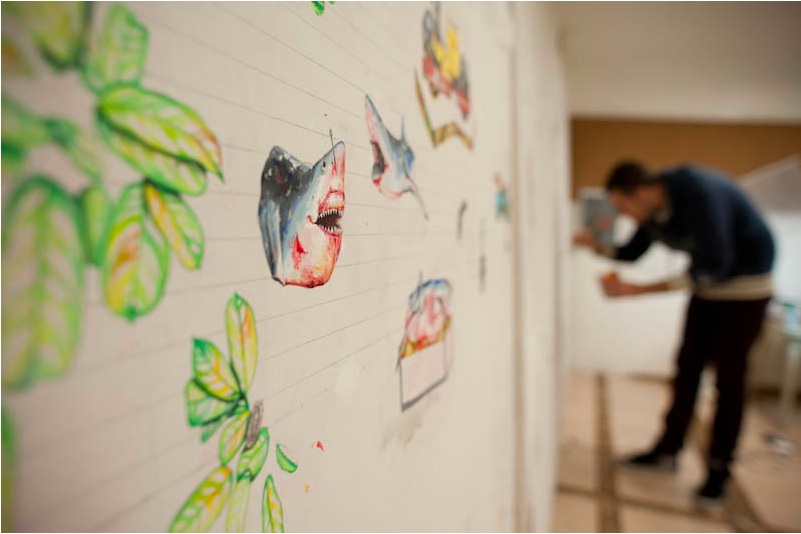
In residency.
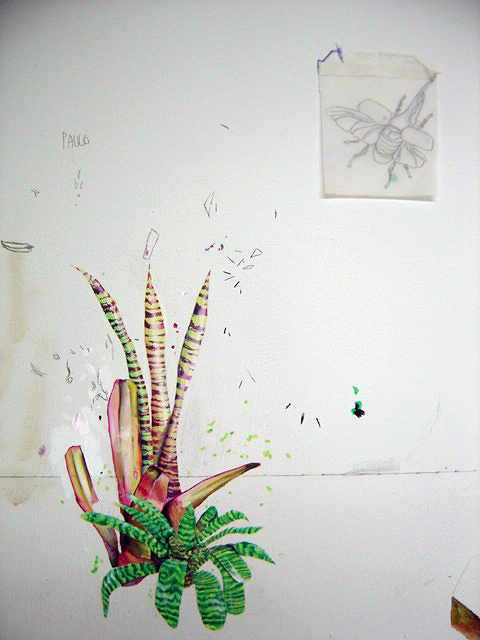
Processes.
During the residency I made some remarks regarding your work: punctuations as a transforming effect, the notions, relationships and flows between painting and drawing; what intervention meant to you; the work as an open space to collaborative noises. At one of our meetings, you said something that captured my attention: “my work is a place of register.” To me, these are visual notes taking place as a process... Just like any other work, of course, but I do get the feeling that the painting process and this register in layers over time are crucial. You question painting, even as it is your raw material and language.
That’s basically it, what you said. You cannot consider what I do as just painting or just drawing. And the languages get built over time. I find it important for my work to retain a character that accepts transformations and registers throughout its production. I have been in a residency for four months now, dedicating myself to one single piece of work. Maybe what I do in the first month may turn into something else by the fourth month. I want to add all these elements. I try to endow the work this characteristic of accepting new elements, accepting notes, accepting fields that aggregate elements which converse further, elements which converse less, using paint, pencil, pen, spray paint, all of these. And some of that diversity comes from my references in the city, based on which I can understand a bit of how these things come together, and how this composition is possible. I started my relationship with painting in the city, and I lean on that a lot.
Have you ever done graffiti?
I used to paint on walls and do graffiti when I was about twelve. That gave me the opportunity to understand that what interested me was not graffiti, nor painting on walls. It was the city itself, what the city discussed in terms of drawing, of collage, of assemblage, of aggregation...
As if the city was a skin undergoing these changes?
Yes! In São Paulo one cannot see the horizon, but I tried to see it from my window. I did that! The window can frame a picture and make everything 2D, and I change that framing into a division of colors. This has virtually become what my work is all about; I seek a composition, a few accumulations and a few voids. I remember that moment well: some buildings to the left, other buildings to the right, a piece of sky in the middle, and these accumulations of color, and another flat wall. I think about composition on these terms a lot.
Has that become a piece of work?
No, it hasn’t become a specific piece of work, but I always try and see it this way. One of these days I was looking at a garbage bin, there were some color structures, a pattern. And these things interest me. At some moments I’ll even do some pantones, divisions with various colors.
Color fields?
Yes, almost. Almost a color field, only color fields are flatter. What I do is a painting that’s a bit more realistic, with stains, modifications. That’s where it comes in, this discussion about what painting is, about what these color fields are.
Interview conducted by the researcher Galciani Neves with the artist Carolina Caliento during the residency program Ateliê Aberto #4, a partnership among SESC, Videobrasil and Casa Tomada.
(Índice 1, contiguidade não imediata), 2011 | Painting
Paulo Nimer Pjota
In residency - week 5.
In residency - week 1.
Galciani Neves blog on the project.
Paulo Nimer PJota blog on the project.
Book Em Residência, text about this residency on page 113 [pt/en]