Galho
2012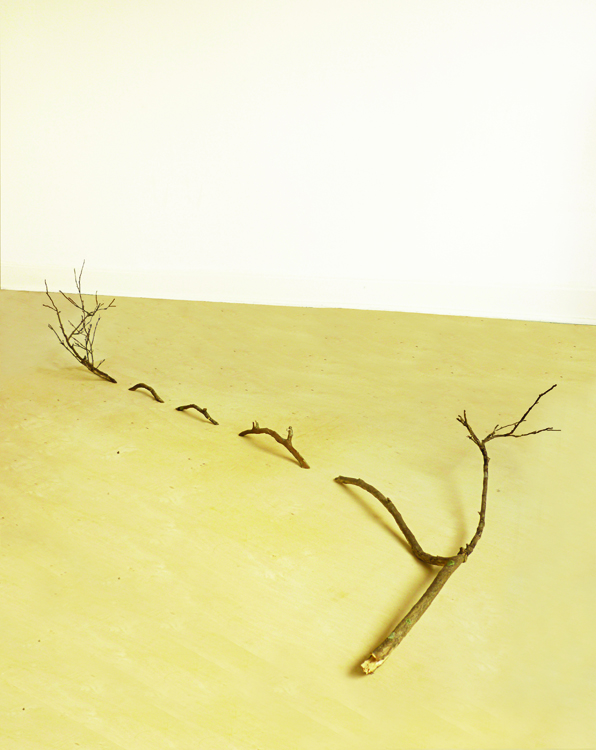
Galho (2012)
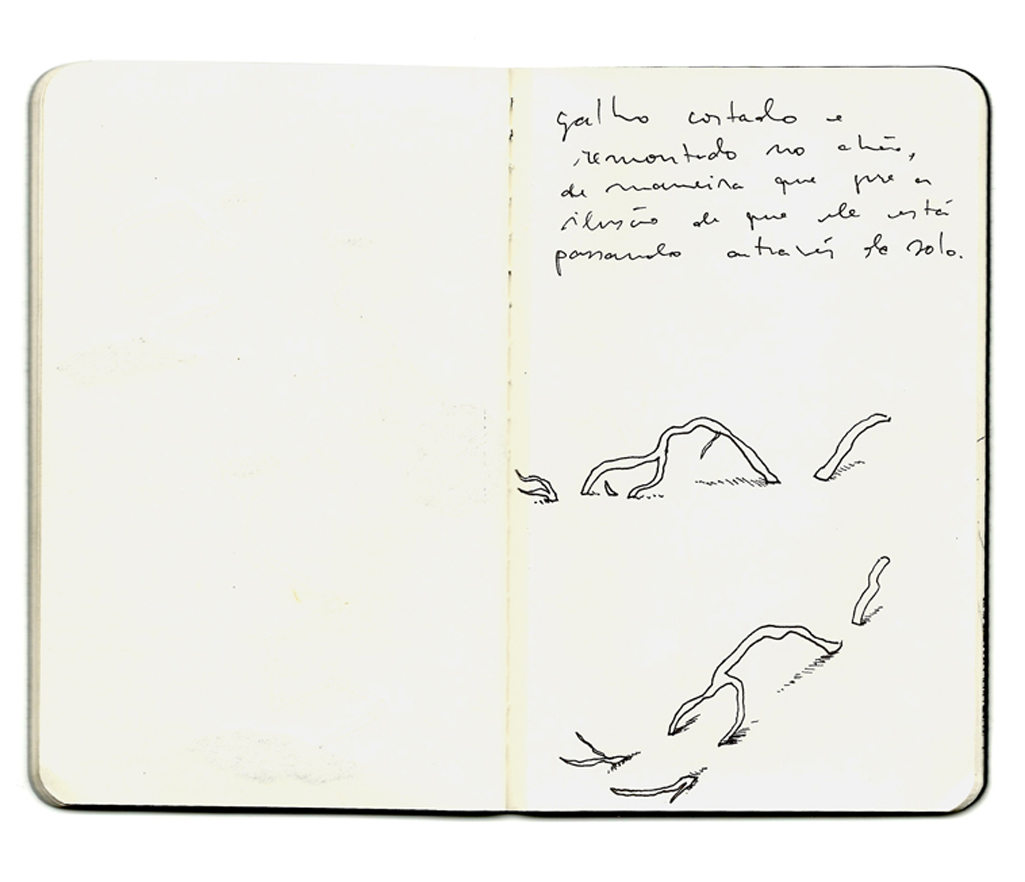
Sketches of Galho
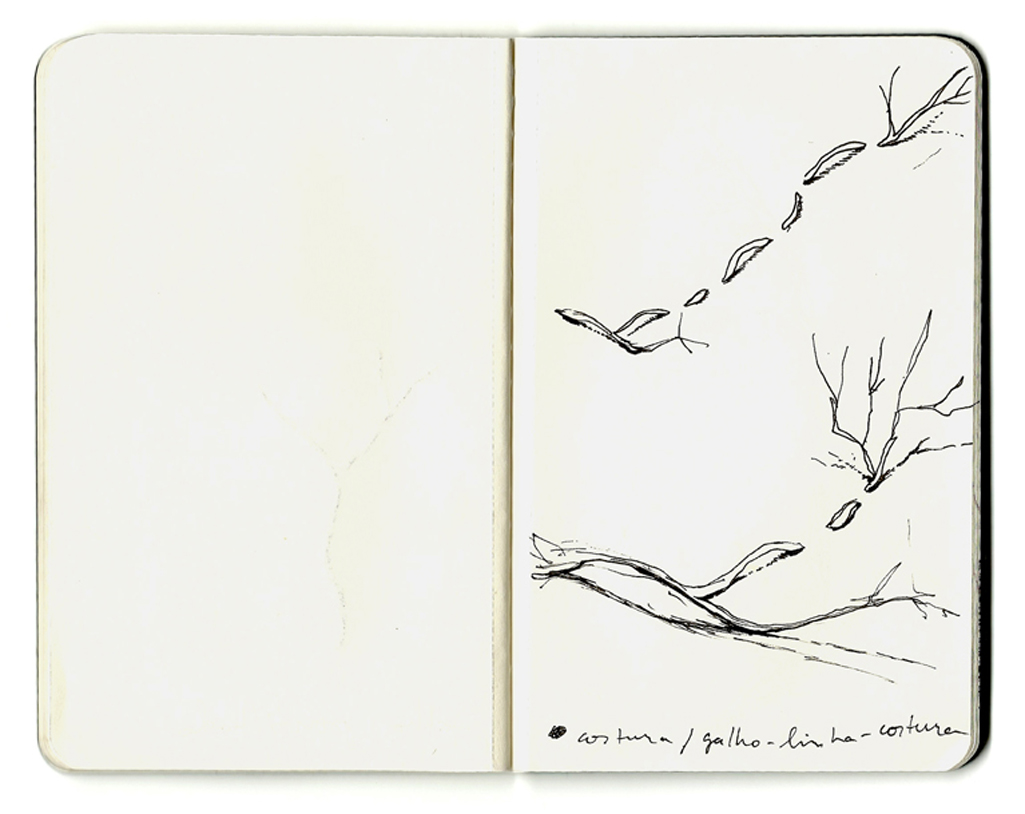
Sketches of Galho
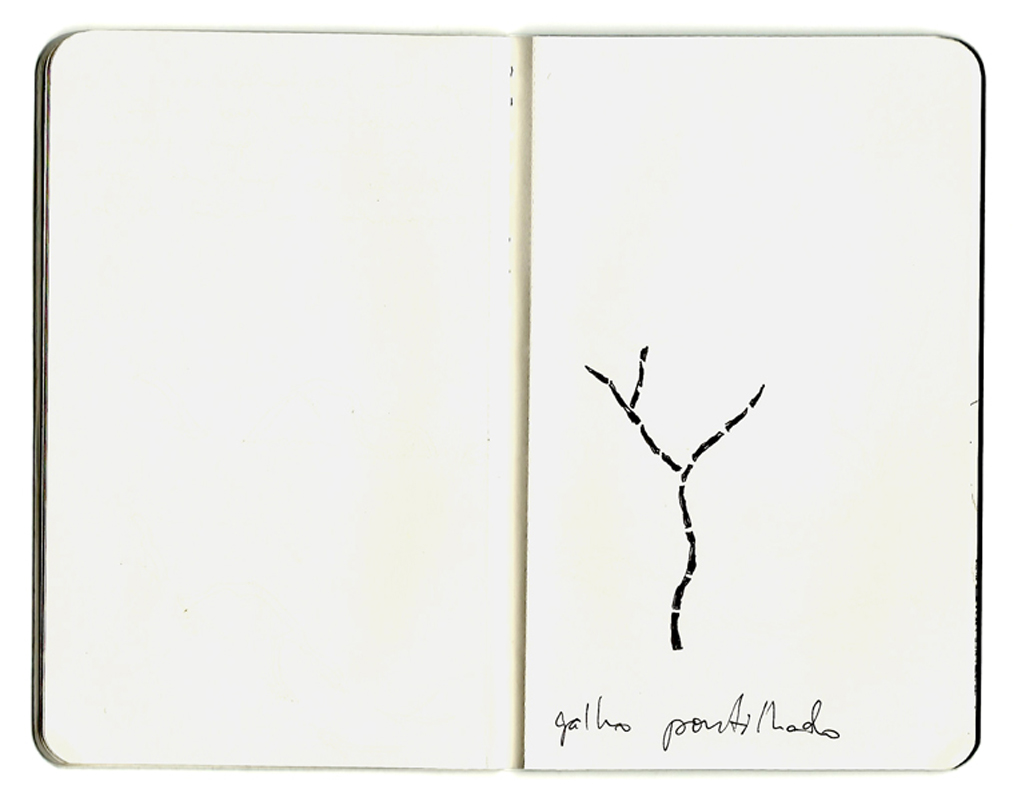
Sketches of Galho
“I believe chance is the great catalyst for Galho (Branch).
The starting point of the piece was a chance encounter, during a walk, with some fallen, broken tree branch lying on the sidewalk. Usually, in these walks, which are one of my means of research, I open myself to suggestion through relaxed attention (the 'softening gaze'), where orders are set loose and new relationships are established.
The branch concerned was broken in two; its tip was separated from the rest, but still in line with it. I believe the banality of the scene and the particular way in which the object was accidentally arranged attracted my attention. Out of that image, I started structuring a method for building and seeking a branch with the features required to create the intended illusion effect.
In order to create the piece, branches are found and collected in public spaces near my house. Their natural structures are altered: they are trimmed, sanded and arranged on the floor, forming a curved, dotted line which diagonally crosses the demarcated space.
I believe the most relevant issue here is the duality between appearance and reality – notions which pervade the history of Philosophy and Art. The artwork is built upon an illusion, founded on the mimetic appearance of the object used. The branch that composes the piece is a branch that has been taken from its habitual place in the world, and which is given a realistic aspect as soon as it becomes the body of the piece.
Besides, the way in which this element is rebuilt using an artifice intended to confound the senses, like a trompe l'oeil, where the notion of continuity derives from who is looking at it. A state of distrust is established at the moment the piece’s realistic appearance – reinforced by the descriptive title – clashes with the way that object extends into space, revealing a false reality.
This piece is part of a body of work that combines an expanded notion of drawing, as the appropriation of the objects’ original shapes. Despite its material and sculptural evidence, the branch that penetrates the floor is based on a graphic line of thought, and can be understood as a solid, fluid line drawn across the gallery.
I consider René Magritte and his reflections on the relationship between image and world as a key reference for this piece. His inversions of logical attributes of perception and representation unveil the mechanisms of production of illusion, and the confusion between image and object. In realistic fashion, the artist would portray completely recognizable objects in unusual situations. In most of his work, Magritte aims to expose the fracture between language and the things it refers to, the unfathomable distance between representation and reality, like in his emblematic piece The Treachery of Images (1929).''
Alexandre Brandão in a statement to PLATFORM:VB (October 2013)
Galho (2012) | Alexandre Brandão
Object | Tree branches cut and fixed to the floor, 30 × 200 × 45 cm approximately
Galho (2012) setup details at the exhibition space of the 18th Contemporary Art Festival SESC_Videobrasil
Testimony Alexandre Brandão | 18th Festival
The artist discusses the notion of transfiguration featured in his piece Galho, shown in the 18th Festival. He tells of how he sets out to reproduce in the exhibition setting the way nature arranges space
Alexandre Brandão comments two books that were references for Galho:
"The book Magical Experiments or Science in Play (1892), by Arthur Good, is a collection of instructions for experiments and little tricks using common household objects. Its illustrations carry the atmosphere of Magritte’s work, where the conventional order of those familiar objects is destabilized."
In Manual da Ciência Popular (1982), the artist Waltércio Caldas builds highly poetical images around objects that 'everyone knows'. In an attempt at confusing the senses and inverting logical relations, the magic tricks are conceptually close to the illusionistic artifice used in Galho."