Liberdade
2011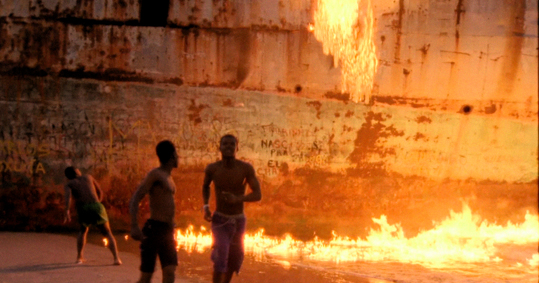
Liberdade video still
Liberdade video still
João Laia: Videobrasil defines the global South as its area of interest. It’s a geopolitical territory that does not exactly overlap with the geographical South, but spans a symbolic zone where you can most clearly observe, among other things, the impact of processes related to globalization. How do you see your work within this Southern context?
Gabriel Abrantes: I wanted to work in the ‘global South’ because I was attracted by peripheral or nondominant economies. On the one hand, I was searching for unusual and surprising content, but I also harbored a somewhat pathetically megalomaniacal utopic fantasy of invigorating or participating in the emancipation of repressed groups. I wanted to make films in places outside of the dominant centers of power and to work with marginalized groups, freeing them from the shackles of a hegemonic evil empire! Ironically, this was inspired by The Birth of a Nation, the racist epic by D.W. Griffith. I saw it much as I see The Lusiads by Camões, or the Iliad by Homer: nationalistic myth building through the telling of a ‘race’s’ story through the “mother tongue” of this nation. All of these were attempts to create a national myth and made by poets that saw the primary function of high art as the ‘creation of the identity of a race’. This is clearly a horribly outdated, but still quite persistent attitude, in a time when the economy is highly globalized, and mass migration is significantly increasing. When I saw The Birth of a Nation, I felt that Griffith had inaugurated the great propaganda machine of the 20th century, and had tried to model the myth of his nation through this medium according to his bigoted perspective. I was interested in how since then movies had become the medium of choice for spreading US values throughout the world, and I wanted to play with this manipulative form. I wanted to create a parallel and antagonist myth and underline the out‑of‑datedness of notions of ‘national culture’ that were still common currency (i.e., in art events such as nationally organized biennials and film festivals), in a time when the notion of nation‑state, father country, and mother tongue were all but completely dissolved. I wanted to play with some of the codes and strategies of ‘Hollywood’ but apply this to protagonists and contexts that were usually suppressed by the dominant culture.
JL: I’d like you to address the way you explore the idea of transit in the contemporary context; the transit of people and goods, but especially of forms of symbolic discourse. For example, Birds refers to two symbolic forms of trance: Dionysian tragedy and rituals like voodoo. What is your interest in these hybridisms? What comes from these juxtapositionings?
GA: All of my films seem to relish in some adulation of hybridity and ambiguity. I’m not so interested in ‘creating’ hybrids, but I want to underline the fact that everything is already a hybrid and that unchangeable standardized identities are a fiction. Ornithes plays with this, but at the same time it also plays with the adverse reactions this might get from people. The film happened in a very fast serendipitous way. I went to Haiti for a twenty‑one‑day location scout for In Pursuit of Happiness and thought it was a good idea to make a short 16 mm film at the same time. I wanted to arrive with no idea and develop, write, and produce the movie during the brief sojourn, which ended up being ridiculously stressful, having to rewrite the entire script at 5:00 a.m. before shooting, cutting out half of the scenes because we weren’t able to shoot fast enough, etc. My dad was working in the reconstruction effort after the earthquake at the time, and much of the location scouting I was doing while on sort of ‘take your child to work’ day trips with him. One day we traveled north to visit Palais Sans Souci and La Citadelle fortress, UNESCO heritage sites built deep in the mountains to defend the newly formed republic after the slave revolt in the early 19th century. A middle‑aged Haitian man was introduced to me as one of Haitian voodoo’s high priests. He was currently in charge of renovation projects on heritage sites and was accompanying us as a sort of misanthropic chaperone. His irritation grew in tandem with my father’s excitement: his face soured as my dad outlined plans for safety handrails, handicap access, ATMs, and a paved road from the nearby Royal Caribbean Cruise Resort. We all got taken up the steep hill atop donkeys pulled by young Haitian boys. I remember looking back and seeing my dad and his coworker snapping photos from their iPads. I tried to make small talk with the former minister by asking about Haitian voodoo. He ended our quick chat immediately by responding, ‘If you want to see a voodoo ceremony, all you have to do is give a group of people a bottle of rum’. I had taken Aristophanes’ comedies to Haiti and was studying the ritual use of alcohol in ancient Greek culture. I was interested in the fact that alcohol had been this cross‑cultural mass‑empathy drug, which had probably been used in the very earliest manifestations of art. (The secret of the monomyth is hidden in yeast!) In the ancient festivals at Dionysia, men, women children and slaves would dedicate themselves to days of binge drinking till they experienced trance‑like communal ‘catharsis’, and apparently in Haitian voodoo (as in countless other shamanic rituals), trance states were induced by a combination of rhythmic dancing and intoxication. A week later I was walking around Jacmel, a large coastal town in the south, also mostly destroyed by the earthquake, and one of the carnival centers of Haiti. The city is home to many artisans making the characteristic papier‑mâché costumes they wear during carnival. I met one artist who specialized in making bird costumes, and a choreographer who was the head of a bird‑dancing troop. The clothes looked a lot like the costumes depicted on a Greek amphora that was on the cover of my edition of Aristophanes. I was reading Birds, which tells the story of two Europeans who travel to the ‘free land of birds’ in order to run away from Athenian taxes, and end up enslaving all of the birds and taking over their land (the sky) in a bid to charge taxes to the God’s and human’s by creating a massive wall in between the heavens and the earth. It ends with the birds enacting a massive slave revolt. This seemed like a convenient parallel to the history of Haiti and I thought it was funny to imagine a young Haitian theatre director who wanted to stage Aristophanes’ comedies in the original Attic Greek as a smarty‑pants statement on the untranslatability of culture, but that it turned out to be a horrible flop, and no one really enjoyed his play and finding it too pretentious. It ends up being a close reflection on the reality of my film! I think this project came as a result of getting a bit of flak for working in countries or contexts that I’m not directly related too. Ben [Benjamin Crotty, visual artist, filmmaker, screenwriter, and codirector, with Abrantes, of the film Liberdade (2011)] and I were heavily critiqued in the state‑run Luanda newspaper for Liberdade. They called us ‘American garbage directors, only interested in filming a negative and poor vision of Angola’. On the other hand, there was a clear tentative by Portuguese newspapers to label me as a ‘Portuguese artist’, which I also don’t agree with. I am always surprised at the still‑dominant nationalistic overtones in the organization and consumption of culture: how is there such a persistent and forceful denial of hybridization and cultural creolization, such an intense nationalism, even from a metropolitan elite, after five hundred years of mass migrations of populations across oceans, and the rise of ‘trans‑national’ corporations as the dominant forces of the economy.
JL: You feed off forms of Hollywood narratives, which your characters then deconstruct. There seems to be a clear interest in using an ideological tool that has been the arch symbol of American dominance since the latter half of the 20th century; but what other motives led you to adopt these discursive genres?
GA: There’s a quote by Godard: ‘Le travelling est une affaire de morale’. I think this probably was said tongue in cheek since he seems to have consistently questioned stable systems of meaning and morality, but it was very inspiring to me. In his film Contempt [Le Mépris], he plays with Hollywood techniques and codes, such as Technicolor, exotic locations, fast cars, and busty blondes. The film opens with a long tracking shot showing a cameraman operating an enormous Panavision rig riding down a hundred feet of rails set up in a cinema backlot. We hear the credits Filmé avec des cameras Panavision en Cinemascope et dans Technicolor [shot with Panavision cameras in Cinemascope and Technicolor]. At the end of the shot, the operator flicks one of the wheels on the tripod head, and the camera swivels 180 degrees towards the picture plane smoothly. He flicks another wheel making the camera tilt slightly until the lens is pointed directly at the screen, breaking the fourth wall. It is a beautiful moment of ‘cinema on cinema’, a camera looking in the mirror. Godard had a fascination with Hollywood, with the magic factory, with its easy pulp. He saw the perverted power of this institution and wanted to play with it. I felt a strong attraction to this attitude, to the pop appropriation of pulp, to the glorification of low culture, and a reveling in the easy trashy attractions of Hollywood. I was also interested in flipping this on its head, and abusing these codes, displacing them so that they would cease to function or function in a queer way. I wanted to grab a stock character, a pulpy one‑liner, a ‘war‑movie’ action sequence, and displace it into a low‑budget production system, or use a nonprofessional actor, or shoot in an economically marginalized zone. This displacement has many effects. Sometimes it seems funny, sometimes it seems dynamic and new, sometimes it seems naughty, and sometimes it seems to be a sort of melancholic questioning of the moral questions that might be associated with Hollywood’s massive economy, glossy aesthetics, fast‑food ideologies, and imperialistic history.
JL: Your films often feature monuments and spaces of high symbolic power and importance in the creation of historical narratives and national identities. You’ve shown temples in Sri Lanka, the buildings of Brasília, Moorish castles in Portugal, and then you subvert them with characters that problematize their functions. It seems you’re opposing the idea of petrification with a shifting concept of history, showing how these spaces are symbols in mutation. Is that what interests you?
GA: I have always been interested in architecture and was very interested in utopic architecture, from modernist attempts at producing the perfect city, from Bauhaus to Niemeyer’s Brasília. I was interested in how all of these mass social projects, sincere attempts at creating a well‑thought‑out urban plan and building construction to make modern man’s life better, had been disastrous failures. I was greatly inspired by Rem Koolhaas’ thesis project Voluntary Prisoners of Architecture that ironically plays on the absurdity of creating a mass design solution for better living. I have also always been interested in philosophy about natural utopias, from Eden to Thoreau’s Walden, the fantasy that man could return to a non‑urbanized state of grace in nature was touching. A History of Mutual Respect is very much about these two things. I filmed it in 2010 with Daniel Schmidt, and it was the first film where I shot in the ‘real world’, outside of constructed ‘movie sets’ that I had been making in galleries. I wanted to shoot in the Brazilian Jungle and Brasília’s modern urban landscape, as I saw those two as characteristic of failed utopias. My interest was in reinvesting some sort of perversion, or deviated meaning into these attempted utopias by misusing them. In History, I play a North American sexual predator that has come to Brazil to find a native lover. This dumb ‘bro’ wanders aimlessly, aloofly, through these majestic landscapes, through these failed utopias, with no awareness of the history of these places. It is a sort of sacrilege against modernism, sacrilege against utopic fantasies. Later on, I have the Moorish characters in Palácios de Pena fondling each other’s genitals in a nook at the Castelo dos Mouros. The intent was also to reinvigorate a static and morally monolithic structure by reappropriating and having it used for ‘obscene’ acts. It is a technique that I use a lot, which is a childish technique, but that sometimes has some fruitful results: which is to play ‘naughty’ with a sacrosanct subject, territory, or character. People were a bit scandalized when in the first five minutes of my film Taprobana I depict Camões, a Portuguese Renaissance poet and the national icon, defecating on his girlfriend. But I think that the scatophilic scene is actually quite tender and moving, and when you read Camões’ letters you can tell he was a bit of a naughty boy himself.
JL: The use of contrasts, such as between grand historical narratives and the characters that populate your films, also occurs in formal terms, like in the helicopter shot in Liberdade, which depicts miserable living conditions with all the stylistic bombast of a mega production. What interests you most in these contrasts? What’s your reading of that camera movement in Liberdade?
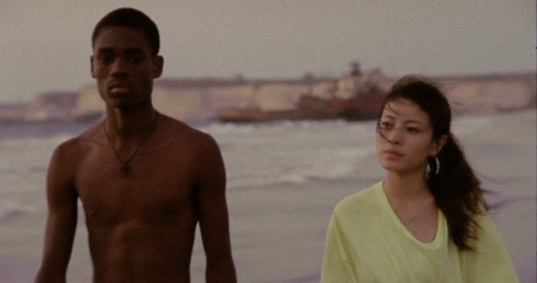
GA: In 2006, I moved to Trás‑os‑Montes, an economically depressed backcountry in the north of Portugal. My father’s family is originally from this zone, and my great‑grandfather’s run‑down house was still there, barely standing, with broken windows, no phone, no hot water, a real bohemian dream! I wanted to live there and establish my practice in this small village, making films with the people who lived there. I had a fantasy of constructing a peripheral utopic film studio in my grandfather’s house. I fantasized about the eccentric and hopefully invigorating results of my future collaborations with the villagers, hoping to work with them on the narratives and have them be the protagonists of the films we would make. The horrible failure of the first film I tried to make there ended this fantasy. One of the reasons for the failure was the megalomaniacal ambition of the project: we wanted to make an apocalyptic sci‑fi film about global warming, where all of Portugal had already been inundated due to rising sea levels and all that was left of the Iberian Peninsula was the high‑altitude mountain ranges in Trás‑os‑Montes. I was convinced that the application of the narrative standard of the Hollywood ‘disaster movie’ to this peripheral community was a grand political gesture, that I was a cultural Robin Hood, stealing a cultural form with mass appeal and giving it back to the rural poor! This was somewhat inspired by Pasolini’s notion of Epic Cinema, where he wanted to elevate the most disparaged, oppressed, and marginalized people of Rome into saints by film ing them in heroic narratives and soundtracking them with Bach’s religious music. Pasolini wanted to sanctify the subproletarian pimps, prostitutes, and thieves living on the outskirts of the city. I had some similar ambitions, however misguided, when I moved to Trás‑os‑Montes. The ambition in Liberdade is similar, but I think already a little less hopeful. Benjamin and I wanted to film in Luanda, Angola, which suffers from extreme inequality, and was one of the fastest‑rising economies in the past decade, due to its recently ended civil war and its petro wealth. We wanted to make a short romantic drama in a smooth commercial aesthetic as an ironic misuse of a tone, genre, and look by setting this in a peripheral African petroeconomy. We decided to use Steadicam, to film almost exclusively at the golden hour, and with high‑production veneer such as the heli‑shot of the Kinashishi Tower, a vertical favela. There is something grotesque about this shot that enthralled us. At this point, the use of the Hollywood aesthetics, or genre tropes, was more of an ironic joke. We thought it was funny, in a gross way, to have a glorious helicopter shot, a silly love story, and sunset lighting in this territory that suffers one of the highest rates of inequality and government corruption across the globe.
JL: Themes related to sexual identity are recurrent in your work; issues of orientation, gender, representation, etc. You also tend to create a web of relations between major current political themes. There seems to be a will to use sexuality to underscore the interdependence between the politically micro and macro. Could you elaborate a little on that?
GA: At some point, I had a huge reactionary bent and any mention of sex in a book or film annoyed me. But then something clicked, I was reading Gravity’s Rainbow [by Thomas Pynchon], and Slothrop, the main character, is being coerced to have intercourse with his girlfriend, and it goes horribly wrong, and her dog is biting at his pants, which are around his ankles, and he backs up into the bathroom trying to shake the dog off, and inadvertently plops his other leg into the toilet bowl, and when he tries to yank it out the whole toilet comes off the wall, so now water is spraying everywhere, and he is standing there with a dog growling and tugging on a pant leg, the toilet on his other leg, his girlfriend with her legs around his hips still trying to come. Then twenty‑four hours later a missile hits her apartment. We find out that the V‑2 rockets are mysteriously hitting targets where Slothrop is having intercourse. I thought this was so funny, that someone’s inane flirts and hilarious sexual misadventures could be intrinsically linked to the blitzkriegs in London. I thought it was a nice metaphor for how private desires have a direct role in public issues. I think it also unblocked something, if sexuality was explored as something humorous, I could palate it a little more easily, and so I started playing with strong sexual overtones in my films, but usually used in a funny way. And then this is stupid to say, but sex really does motivate so much of what we do. The Trojan War starts because someone stole someone else’s girlfriend. Electra kills her mom because she cheated on her dad. Clinton is impeached because his semen was found on Lewinsky’s dress. People willingly commit suicide because of promises of seventy virgins in the afterlife. I am now researching a project that I want to do with indigenous groups in the Xingu River basin in Brazil, and I came across an excel sheet made by anthropologists at the University of Michigan that lists all of the recorded indigenous homicides in the region. The vast majority of them are because someone slept with someone else’s partner. These are all stupid examples, although I find them funny. I think I am saddened and disheartened that so much of what motivates us to involve ourselves politically comes from extremely self‑centered and individualistic impulses, and that we then go through such a massive effort to hide this from ourselves, and convince ourselves that we are sincerely altruistic. But laughing is good! I think that is why I am trying to make comedies.
Interview with João Laia, via e‑mail on occasion of the 19th Festival (July 2015)
Liberdade, 2011 | Video, 17’
Gabriel Abrantes
co-authored with Benjamin Crotty | Produced by A Mutual Respect Productions
The Birth of a Nation (1915) | D. W. Griffith
When I saw the film, I felt that Griffith had inaugurated the great propaganda machine of the 20th century, and had tried to model the myth of his nation through this medium according to his bigoted perspective", clarifies the artist
Contempt (1963) | Jean-Luc Godard
"Godard plays with Hollywood techniques and codes, such as Technicolor, exotic locations, fast cars, and busty blondes", explains the artist