Funfun
2012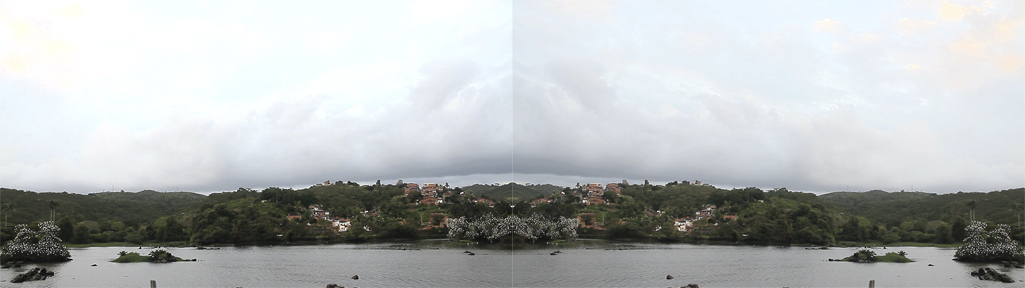
Funfun (2012)
"On my way back to Cachoeira, in August 2012, after a stay in São Paulo, where I was attending post-graduate classes at PUC, I found the old Recôncavo city immersed in a lot of grief and pain. The reason was the death, within a very short time span, of two major Candomblé priestesses: Maria Helena do Vale, known as Mãe Madalena, and Dona Estelita de Souza Santana. The city resented its huge spiritual and patrimonial loss.
Around the time Dona Estelita was buried, I was invited over for coffee at a friend’s house. On arriving, we went to the kitchen, in the back of the house. She opened the window, revealing the landscape along the banks of river Paraguaçu. It was late afternoon and a supernatural amount of white herons flocked to two big islands on the river. Unable to resist such beauty, I set up my equipment and started getting a few takes. My friend was making coffee and, noticing my bewilderment, she said: 'An ancient myth of Recôncavo da Bahia says that whenever an old black priestess dies, she metamorphoses into a white heron that carries her soul back to Africa. One of these herons must be taking Dona Estelita’s soul to the Orum.'
It was the eve of the Sisterhood of the Good Death Fest (Festa da Irmandade da Boa Morte), a celebration carried out by the sisterhood of black women who ritualize the cult of Our Lady through a 'baroque Catholicism' typical of Recôncavo's miscegenation. The party relates to life and death, and to the spiritual trip of the Aiyê to Orum.
The nearness of the party and deaths touched me deeply. I decided to pay a homage, a sort of requiem to the death, at age 105, of Dona Estelita de Souza Santana, the perpetual judge of the Sisterhood of Our Lady of the Good Death (Irmandade de Nossa Senhora da Boa Morte).
In the following week, I attended the first night of the party and caught the 'Funfun night' on video. Funfun is the white color in Yoruba language, and it dominates the first night of the ritual wake in the Sisterhood's festival. Funfun is also the color of mourning for some Western peoples, and it is the color of the black god Obatalá – god of purity and sanctity, maturity and wisdom.
During the mass, in which the image of the dead Mary is mourned, I was taken by an energy, a sense of presence of the recently deceased Dona Estelita. Afterwards, I edited the video installation with footage of these experiences, in two screens, and they gave me a reminder of how thin the line that separates art from life is.
Funfun is a piece that lies at the boundary between ethnography and mythological narratives."
Ayrson Heráclito in a statement to PLATFORM:VB (October 2013)
Funfun (2012) | Ayrson Heráclito
Video installation | 2 channels, 4’08”, stereo, color, 16 : 9, loop
Funfun (2012)
Testimony Ayrson Heráclito | 18th Festival
When a very important mãe de santo dies, her soul becomes incarnated into a heron on the Paraguaçu River, and flies back to Africa. At the border between fiction and reality, magic and technology, Heráclito discusses his piece
Photographers that address the Afro-Brazilian mythology in Bahia, such as Pierre Verger and Mario Cravo Neto.
Contemporary thinkers, such as Paul Gilroy, Achille Mbembe, Patrícia de Santana Pinho, Wlamira Albuquerque.