Fluxorama
2012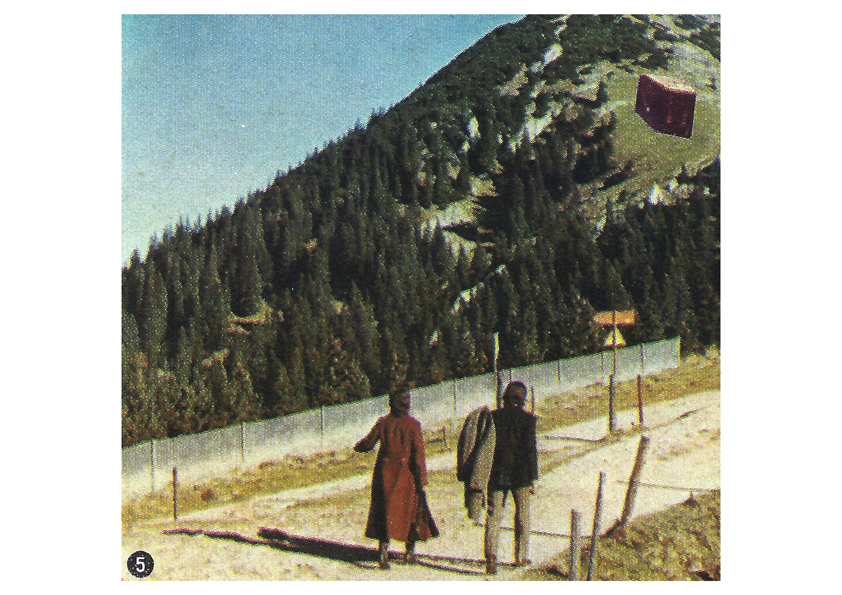
Atração dos sólidos [Fluxorama] (2012/2013)
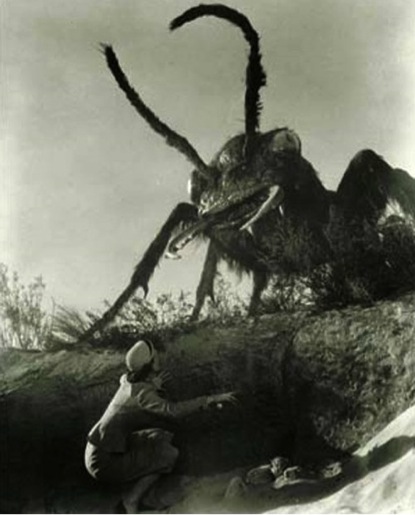
Artist’s references: Them! (1954), Gordon Douglas
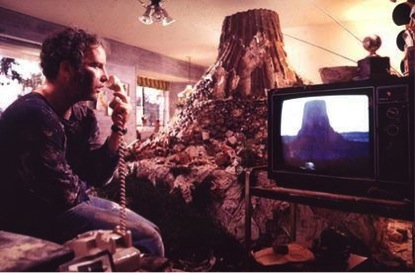
Artist’s references: Close Encounters of the Third Kind (1977), Steven Spielberg
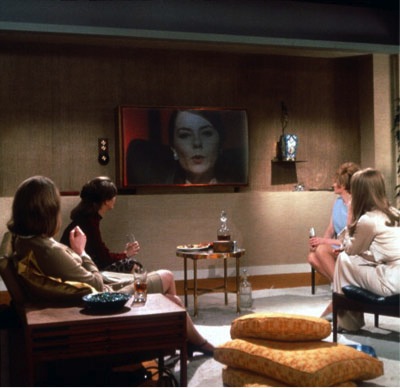
Artist’s references: Fahrenheit 451 (1966), an adaptation of Ray Bradbury’s 1953 novel by François Truffaut.
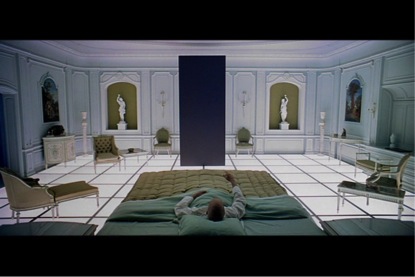
Artist’s references: 2001: A Space Odyssey (1968), Stanley Kubrick
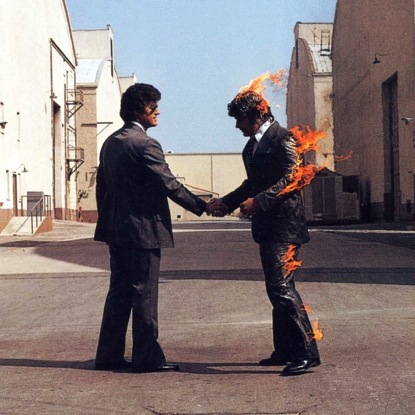
Artist’s references: cover of Pink Floyd’s album Wish You Were Here (1975)
“The series Atração dos Sólidos, Pedra-Filme and Fenômenos da Natureza em Paralaxe integrate the Fluxorama project, alongside 16 other series. Science books, didactic encyclopaedias and other types of publication dating from the 1930s to the 1970s are checked for illustrations that impart an interest of any sort, be it regarding the printing technique used (noise, out of focus, grain, reticulate, out of register) or the strangeness they might bring about (when removed from their original contexts).
An archive created with those pictures then gives rise to fictional constructs which are created in authorial texts featured in all series of the Fluxorama project. These texts may either be included in the series itself, as a part of the presentation (letters, accounts, news stories, statements, theorems) or may not be visible. In the latter case, the texts are used in the artist’s discourse. When he tells what his work is about. Perhaps like what will take place here...
For instance, in the case of Atração dos Sólidos, small handmade collages are created featuring human figures, placed on the landscape, walking toward solid bodies. The piece arose out of a news story I found in a 1970s magazine about different people, at different places in the world, who had supposedly disappeared for some time. On reappearing, all subjects claimed to have had contact with geometric solids.
In Pedra-Filme, a handmade, digitalized and printed collage, human figures are portrayed immersed in daily domestic life, so concentrated in the TV light or the movie screen that they fail to notice the presence of large stone blocks that float towards them. It is also hypothesized that the stones are perceived, but ignored.
Fenômenos da Natureza em Paralaxe, a scanned original, in high-resolution, with no digital processing, features images that were found in books and which question issues pertaining to optics or other fields of physics. Due to their perspective, angle, lens deviation, printing error or focal distance, these images create noises that relate to their source.
Situating these series within my poetics, I perceive a slow, natural transition from the literal scientific focus to a phenomenological approach to image. Naturally, the new series in the Fluxorama project are becoming corporally denser under the intuitive, abstract, metapsychic perspective of a guy who reads lots of books, but forgets their content.
I reckon that the time lag between the images I manipulate and their original contexts, related to either nature or science, trigger a dialogue that is closer to literature or cinema. And thus, keeping this perspective, I believe that the three series that have been presented deal with sensory experiences, which are very common in our daily lives, perhaps not perceived, but intuited. By that logic, the time lag between the images, their discrepancies and noises speak of a contemporary fiction in which visual culture, for instance, can be more interesting than art itself.”
Michel Zózimo in a statement to PLATFORM:VB (October 2013)
Atração dos sólidos [Fluxorama] (2012/2013) | Michel Zózimo
Collage and photography | 16 pieces, manual collage, variable dimensions
Fenômeno da natureza em paralaxe [Fluxorama] (2012) | Michel Zózimo
Photography | 3 images, digital print on cotton paper, 50 × 70 cm; 60 × 50 cm; 80 × 50 cm
Pedra-filme [Fluxorama] (2012/2013) | Michel Zózimo
Photography | 7 images printed on cotton paper, variable dimensions
Testimony Michel Zózimo | 18th Festival
In a statement made during the 18th Festival, the artist from Rio Grande do Sul discusses key aspects of his work
Carl Sagan e a Planolândia
Video of the American scientist Carl Sagan discussing the notion of "Flatland". [pt]
URI GELLER - Seeing is Believing
Documentary made in the 1970s, about Uri Geller’s displays of paranormality. [eng]
Sharp (Pássaros)
Sharp's advertisement of the 1980s are also among the artist's references. [pt]
"Cinema, television, literature, music, religion and science point out important references for the creation of this work." explains Michel Zózimo. "Besides, progressive rock album covers from the 1960s and William Foundation’s lysergic illustrations of the 1970s are of interest as a pictorial reference for the series."
Subgêneros obscuros...A ficção científica B dos anos 50 (Revista Zingu!, ed. 28, Jan. 2009) [pt]