Ensaio Ilú Obá De Min + Escolas
2016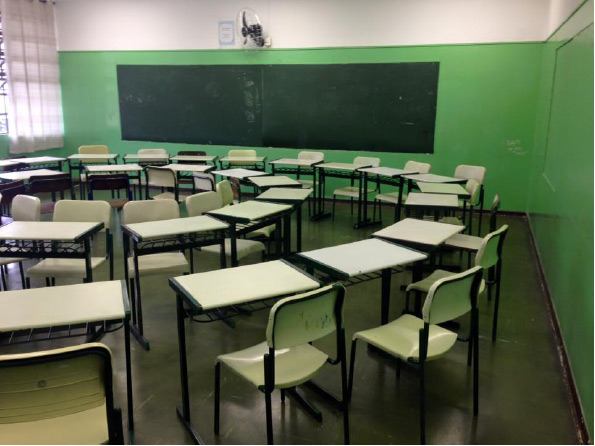
Ilú Obá de Min
I started working with this format of “excerpts”—videos comprised of a single take each—in the year 2000, when I and Mathias Fingermann, then my student of theater, founded A.N.T.I. cinema (read “anticinema”), whose acronym we agreed not to reveal. We simply said that A.N.T.I. cinema was interested in life, nothing more. As Dziga Vertov in 1923, we wanted to extract from everyday life fragments of authentic energy. Like Cesare Zavattini, we talked about leaving things as they are, almost by themselves, to create their own special meaning. We filmed uninterruptedly (with no cuts) for a long or short duration, subsequently choosing a single shot as the entire movie, and this shot could match the duration of the videotape (one hour) or last a few seconds. We used digital video, but even if we were working with VHS or with film, our technique would be the same: the “excerpt of A.N.T.I. cinema.” We signed our works as photographers, never as directors.
Since then, seventeen years ago, I have picked up bits of everyday life out there. The less productive moments were in the passage from my Sony Digital-8 (a camera that was already an extension of my arm, my body) to the larger model Sony VX 2100 and later, much worse, in the passage of this to a Canon 5D. I continued working in the form of excerpts—but mostly going back to raw tapes of records made between 2000 and 2007—to choose excerpts that are part of the archive of my work Projeto Mutirão [Collective Effort Project]. I never stopped recording new excerpts, but not with the same joy as before, and very rarely. In recent years, I rediscovered my practice with an iPhone 4S, which was the equipment used to record this Ensaio Ilú Obá de Min [Ilú Obá de Min Rehearsal].
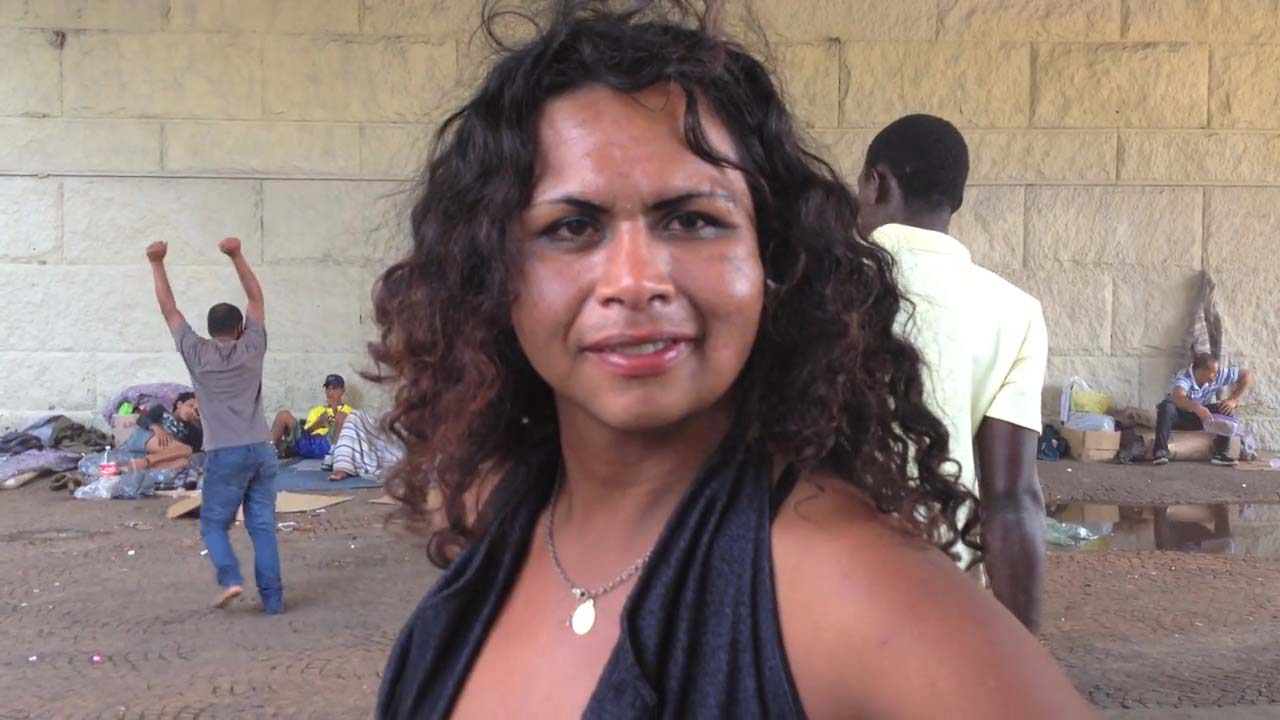
What I did here was just recording people who lived on the under the Chá Viaduct, in the Anhangabaú Valley, during a rehearsal of the women’s street carnival ensemble Ilú Obá de Min. It was the group’s last rehearsal before the 2015 carnival parade, in which they paid homage to the writer Carolina Maria de Jesus. Instead of recording Ilú Obá de Min’s women playing their drums and singing, I turned the camera over to the people who lived there and interacted with the rehearsal as public. The drums seem to have awakened the ancestry in those bodies—candomblé, the female, the entities and queens. I would rather not describe or comment too much, because I want people to watch the video and have (or not) their own enchantments. Recording on a single take is a way to make it possible for viewers to experience the duration of the action filmed, as if they had been there as well. But one thing I can say is that, at the current political moment, when social welfare policies are under real threat in Brazil, and the current mayor of São Paulo announces an increasingly intense privatization of the public space and practices of compulsory hospitalization of crack users, it becomes even more evident and relevant Ilú’s resistance practice, these black women who insist on performing their rehearsals on the street, under a viaduct, engaging the excluded portion of the city’s population. As my friend Juçara Marçal, singer and member of the group said, this record shows, at the same time, a harsh reality and a possible cure.
Note: I do not use the term “long take” to name the single takes, even when they are long, because, when he created this expression, André Bazin was referring to movie takes that fulfilled the dramatic role of the sequence of shots in the classic découpage. An analysis of my work requires another vocabulary in order to make it clear that what I do is only to extract a piece of raw material. “Excerpt,” in the Michaelis Modern Dictionary, means: (adj.) taken, extracted. (n.) fragment.
Escolas
During the occupation of schools by students in São Paulo, in November and December of 2015, in addition to attending some of them to witness and support this process, I began to collect images published on the Facebook pages of the self-entitled Schools of Struggle or Occupations—E.E. Ana Rosa, Dica (E.E. Emiliano Cavalcanti), E.E. Fernão Dias Paes, E.E. João Kopke, Mazé (E.E. Maria José), and E.E. Salvador Allende, among others—and also on the website of the collective O Mal Educado [The Miseducated]. My main interest was not images of street marches or police repression, but moments where I perceived a spatial change or collective actions and mutirões [collective efforts] for spatial transformation: school desks piled up at the school gates like barricades; chairs in circles (no longer in lines); classrooms filled with mattresses; students preparing meals in the school kitchen; students cleaning and tidying up; students painting walls...
Since 2003 I have been following a series of collective struggles for social and spatial transformation with a video camera and collecting raw footage made by others. Examples: people opening the back door of a bus to use public transportation without paying, without passing through the turnstile; occupying abandoned land or buildings; painting bicycle routes on the asphalt (before there were bicycle lanes made by the city hall, in the case of São Paulo); planting agroforests, among other actions. There are many hours recorded, which could yield one or more documentaries. Understanding these struggles as an endless process—I did not want to set an end to this work. People struggling for change rarely get to experience what their struggle conquers, when it conquers something. So I found it more appropriate to see what I do as a practice, an action that has continuity and is not directed towards a product. Each video of Projeto Mutirão consists of a single cinematic take with no editing. I call these takes “excerpts.” Each excerpt can be understood as a small piece, part of a larger process, devoid of articulation; in order for this articulation to be collective—in the sense of not being edited by me—, for over twelve years I have been taking the archive with these excerpts to the most diverse contexts and publics: it may be a children’s school, a rural settlement, an occupation of homeless activists, a film festival, a university, an indigenous village, an art museum, the street, and so on. To each specific context or audience, I choose some excerpts to show and spark conversation. All conversations of the project are recorded on video, and reflective excerpts from the meetings are incorporated into the archive and, as a result, into upcoming conversations.
Some of the takes that comprise the Escolas video are also part of the Projeto Mutirão’s archive, but one is independent of the other. So a major difference from the Escolas video for the set of my recent artistic production is that in it, I do the editing. I define the montage and order of the 26 takes. We can imagine other possible sequences, and I believe that the simplicity of the video can even teach others to make their own associations using these or other images. We can also talk after watching the video, and this has already been done in some contexts, with the participation of activist high school students. But the Escolas video exists as a video, whereas in Projeto Mutirão the meeting, the conversation, and the collective articulation are the very form of the work.
I felt really dubious about making a work appropriating uncredited images posted on the Internet, considering that the resulting work would be signed by me. But there can be creation and thought in appropriation. Mixed with the appropriated images, with the same treatment and without any indication, there are images made by me in the schools. I create a context and a combination for these images. The photo of a boy cutting carrots during the preparation of a vegetarian banquet, entirely made with the the cheapest produce sold at the end of a farmer’s market located near the school, is put next to photos of industrialized, low-quality products present in the school kitchen’s pantry, of such brands as Friboi, Swift, Tang, and Pullman. The photo of a parkour workshop held in one of the occupations turns, in the video I built, simply a boy jumping the school wall.
The Situationist International, considered by some historians as the last avant-garde of the 20th century, used different artistic procedures to criticize society and cities as they existed and to fight against the monotony of modern everyday life. Among these was detournement. The method consists of exchanging words from a sentence, changing its original meaning, or moving an image from its original context, giving it a new meaning. Any elements, no matter from where they have been taken, can be used to make new combinations. Perhaps inspired by the situationists and others who, before them, used the same method in their creations (the writer Lautréamont, the lettrist movement), I filmed photographs of a process of political struggle and today I shift these images into the context of art. I believe that there is not a single form of struggle, but several, which can strengthen one another. In a mutirão, for instance, all people help one another and work for a common goal, without necessarily performing the same function. What is the role of the artist in collective, historical and political processes? What is the point of moving these images from the pages of occupied schools to an exhibition? Does this shift work in some way in the struggle for a real school reorganization, from the bottom up, by students and the whole school community?
I believe that this video, together with many other actions, has the potential to collaborate in the construction of a different imagery. The experiments conducted in these schools show us, in a spatial and concrete manner, that it is possible to create new forms within existing one. Seeing scenes of reconfiguration of learning spaces in an art exhibition can help us see them again on the horizon, in life.
Graziela Kunsch in a statement to PLATFORM:VB (September 2017)
Ensaio Ilú Obá De Min, 2015 | Video, 1' 40"
Graziela Kunsch
Escolas, 2016 | Video, 3' 45"
Graziela Kunsch
The images that make up the video were made by the artist in occupied schools in São Paulo in November and December 2015 alongside photographs downloaded from the internet, published without author credits. These images were on the Facebook pages of the self-called Struggle Schools or Occupations E.E. Ana Rosa, Dica (E.E. Emiliano Cavalcanti), E.E. Fernão Dias Paes, E.E. João Kopke, Mazé (E.E. Maria José), E.E. Rachid Jabur, E.E. Salvador Allende and/or on the page of collective O Mal Educado.
Exemplo de um Excerto de A.N.T.I. cinema (2014) | Graziela Kunsch
Túnel Av. Paulista - Dr. Arnaldo from grazi on Vimeo.
Example of an Excerpt of A.N.T.I. cinema (2014) | Graziela Kunsch
Refazendo escolas, by Pedro Fiori Arantes (Em Coletivo Contrafilé (org.). A batalha do vivo. MASP, São Paulo, 2016) [port]
Artist's website