Duelo dos deuses
1988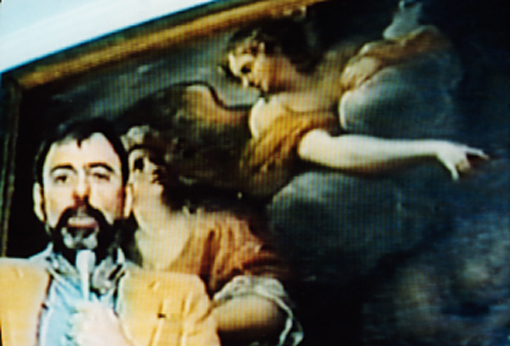
Duelo dos deuses (1988) video still
"Duelo dos Deuses was born by chance as I watched television, while getting up one morning, and saw an exorcism. Apart from feeling invaded by the scene at that time of day, I noticed that it was very crude and enacted. Then came a break and an invitation to a meeting at Pacaembu, 'Duelo dos Deuses', promoted by the Universal Church, where they would prove that their God was more powerful than others. I went to Pacaembu and was informed that I could not record the event. I did, though.
The research took place during the recording, the universe expanded and the documentary found its own route. I started researching the number of religious programs that had started invading television. It was 1988, and there were many. The Electronic Church was being born and promoted its miracles, among them, a palpable and real one: the multiplication of profits. It also made clear the abandonment of the population by the State and the Catholic Church.
Everything I forecasted in that work came true. The creation of an evangelical political body, with senators, state representatives and aldermen coming from the universal, world, Pentecostal, etc. Nowadays, the evangelicals elect the president.
The Universal Church, at that time, only had program O Despertar da Fé. From there, in a few short years, the church bought Rede Record and the television programs, which were already many, are now networks of programs covering several hours of the day, prime or not, world over.
I was able to notice that, in the beginning, they always operated seeking the poorer population, which had no medical, psychological or social support. They operated where there was lack of a State and in the face of the abandonment of the masses to their own luck. Today…
I think that Duelo dos Deuses carries the videoart mark in the structure of white sound in empty channels. It brings me back to AC/JC, VT Preparado, where the white, the blank screen, yelled the violence of silence.
Editing has always been the base of my work: the sound structures the timing, the 'channel changing', the color saturation, the use of material collected directly from the TV, the ‘rotten’ image reread, electronically repainted. I could only develop these things at TVDO, with freedom that working at TV stations would not allow. I structured the screenplay to look like zapping, despite not knowing what zapping was at the time.
The Universal Church tried to ban the broadcasting of the documentary. They even pressed the board at Videobrasil. When I went to show the video at ISER (Instituto de Estudos da Religião – Institute for Religion Studies), in Rio de Janeiro, I suffered terrific pressure/tension from audience members from the Universal Church. With their Bibles in hand, they swore my soul to Hell.
Duelo dos Deuses won the Rio International Film Festival, and attracted the attention of Globo and Manchete television channels to the theme covered by the work. They wanted to buy the images, but I would not sell them. After that, Globo TV broadcast that Globo Repórter program that generated the fight with Record.
It was only the beginning of the invasion of electronic churches. Not only the evangelical ones. The Catholic Church was also implementing its TV channels, free to air or paid. In Duelo dos Deuses, Walter Clark tells how TV Rio ended up in the hands of a church.
I decided to document the power that was accumulated in the hands of electronic preachers. Some of them preached that they considered other religions 'enemies'. That is against our Constitution.
The use of TV to ask for money, not only to social causes, but also to maintain the program on air, was something that no independent producer could do. They established channels and production companies with the funds sent to Jesus, which ended up going elsewhere. Cash free form taxes. It was cowardly in comparison with the cultural producers who pay a heavy tax burden. The power of TV would eventually take electronic preachers to the reactionary political parties we see today."
Pedro Vieira in a statement to PLATFORM : VB (December 2013)
Duelo dos deuses (1988) | Conecta Vídeo, Pedro Vieira
Video | 21’19”, U-Matic, NTSC, color
VIDEOJORNAL_04 | 6º FESTIVAL (1988)
In the first complete coverage of the Festival the director Pedro Vieira comments his work Duelo dos deuses (1988)
Russian movie and documentary maker Dziga Vertov was one of Pedro Vieira’s references for Duelo dos Deuses.