Bem-vindo, presidente! + DOPS
2016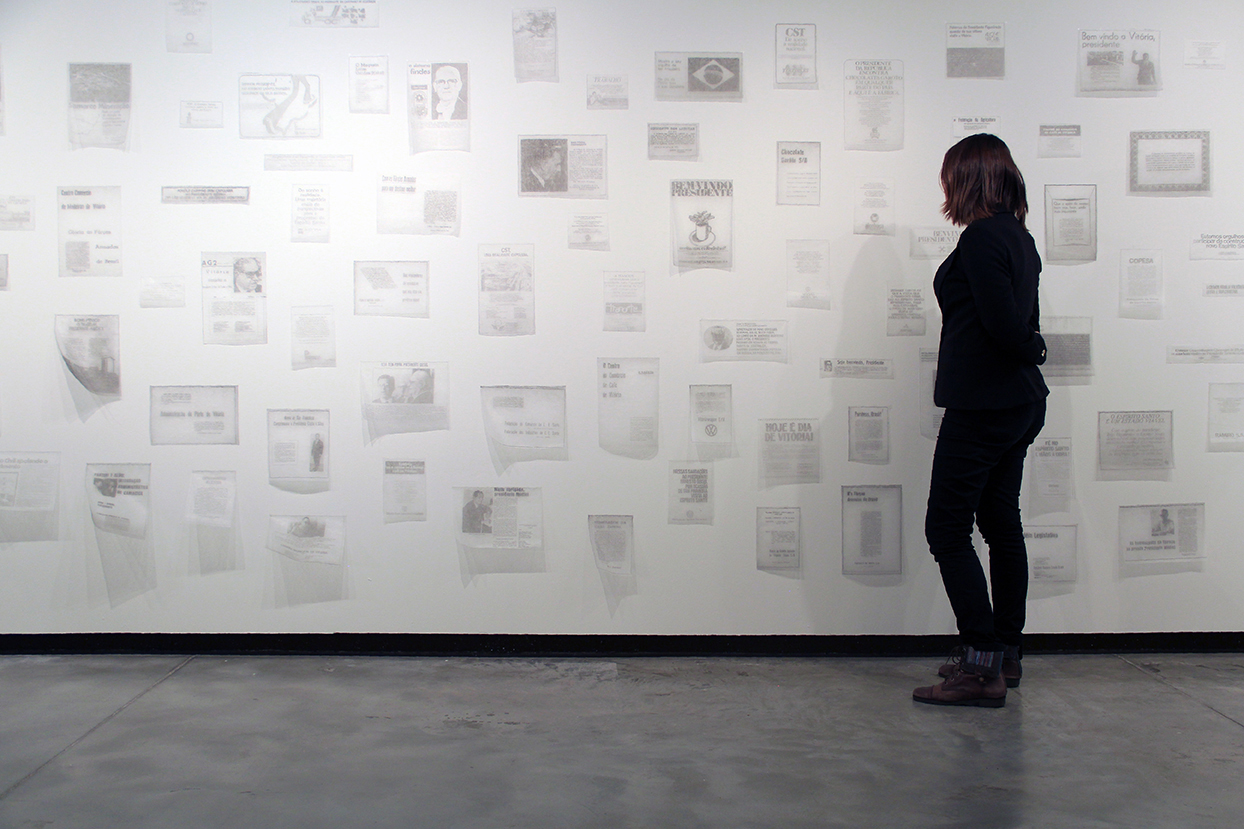
In 2013, after completing my master's degree in the UFRGS Graduate Program in Porto Alegre and passing the exams for the position of professor at the Arts Department of the Federal University of Espírito Santo, I moved to Vitória-ES. Moving and adapting to the new city led me to attempts at understanding the aesthetic, political and social context of the place.
As a teacher of the engraving discipline, I have a large number of students who, semester after semester, bring their history and life experiences, which were fundamental for my reflection on the historical context of the city. At the same time, these experiences made me wonder about the relationship between art and society. These conversations made me realize the marks of violence present in the daily life of the students and they contaminated me: stories of rape, robbery, unemployment, racism have made me reflect on the fragility of life and how those who wield the power manipulate it. In this context, I started a research that aimed to understand how the rates of violence in the city and state were historically structured. Thus, I was struck by how, since the 1960s, these numbers grew exponentially, at the same time that a great process of economic modernization, known in the context of Espírito Santo as Great Projects, began. This contrast led to the perception of a continuum, that violence was not structured as an isolated event, but as a historical condition. In this way, the notion of testimony seemed important to me: to think art as a way of questioning the present without losing the historical perspective in which it is inserted. Thus, the military dictatorship period seemed important to me mainly because of my lack of knowledge about the period. The awareness of my ignorance about my historical condition as a Latin American, of being born in 1985 and of not having a memory about this period, made me research the process of economic modernization throughout the military regime. In this context, ideology seemed fascinating to me—not the progress ideology, but realizing how it was constructed to help making a group and an economic model for the country emerge. When I talk about this, I do not mean only the tortured or the victims of the dictatorship, but the way a society is controlled by groups that wield the economic, political and military power. In the research, what interests me is the memory, the perception of the existence of an aesthetic behind the discourses of power; a memory that relates to the process of forgetting and that allows the questioning of a gap, why this story does not seem my own and how to appropriate it, how to make that mine too.
I live in Vitória and I am interested in the Brazilian reality, just as I am interested in the reality of any place that has social relations and conflicts. From this interest in the period, I approached a colleague at the university, a professor in the course of history and archival studies who is a reference in the study of the military period in Espírito Santo. This approach was important so that I could understand the complexity of the discussion of the local context and perceive the paths taken by other researchers, and how to think this debate in the field of art reflecting on the State of Exception. It was then that I came in contact with the documents of the Public Archive of the State of Espírito Santo, particularly with the archives of the Department of Political and Social Order (DOPS), responsible for the political and ideological repression throughout the military regime (1964–1985).
Both works that I will present at the 20th Videobrasil Festival (DOPS and Bem-vindo, presidente! [Welcome, president!]) are important because they represent two moments of the research. The work Bem-vindo presidente! indicates the relationship of part of the civil society, that is to say, local entrepreneurs and politicians who contributed in the articulation that implemented the regime of exception and the ideology present in the discourse of progress and economic development. A major part of the dilemmas present in the current context of the state of Espírito Santo—mainly problems associated with environmental crimes and concentration of power—have the military regime as a as historical background. The mining company Samarco, for instance, was founded and had its project implemented throughout the military period. The ads I cataloged in the microfilms of the newspaper A gazeta I found in the public archives present the aesthetics and ideology of progress and, at the same time, point to the continuing relationships, since many companies have published advertisements in different periods of the regime. It is possible to observe, even, how these same companies or business groups articulate politically to this day, presenting their voice and political influence, as in the campaign that demanded the impeachment of the then president Dilma Rousseff. The lightness of the ads printed on haini paper contrasts with the weight of the messages, creating an environment in which memory structures itself feebly. Thus the work, as it relates to the event, moves away from it, and through this distance it allows us to reflect on the construction of the events in the present and to perceive the marks of what has been lived.
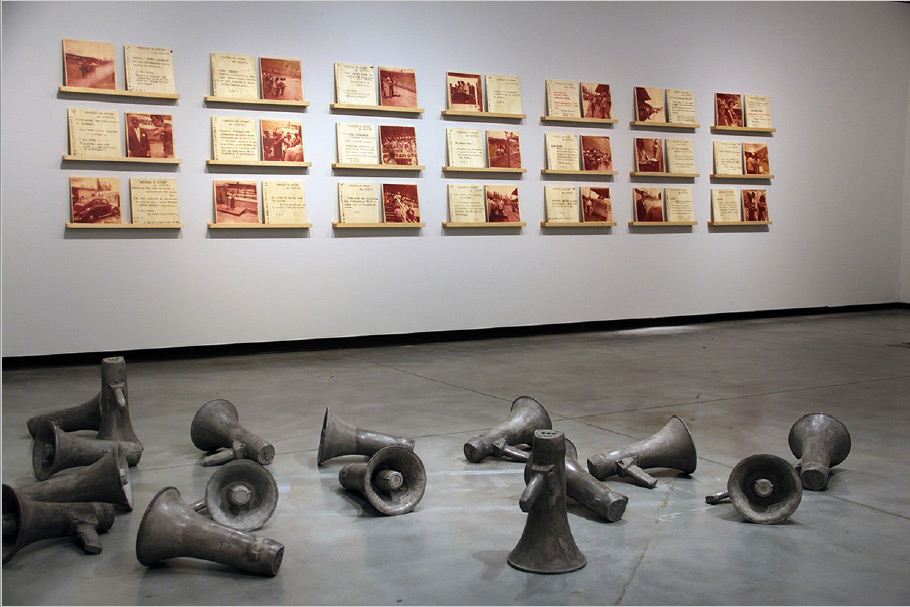
The work DOPS, on the other hand, presents the State as a repressor of social entities. The persecution of priests linked to the theology of liberation indicates the intolerance of the state to the desire for social transformation. The presentation of DOPS archives manipulated and recontextualized as art indicates relationships with the unrepresentable absence, silence, emptiness and death present in the censorship and self-censorship, very common in totalitarian regimes. The game relationship seeks to present the construction of the archive as something inaccessible and the faded photos indicate a faded memory, but which materializes in the present time in actions of the State, through the persecution and repression of social entities.
In this context, I think these works convey the relationship with memory, a recurrent discussion in my production, but with a more incisive historical and political perspective. Before moving to Vitoria, my production was structured in the discussion of memory from the reflection on the landscape of the south of the country, more specifically the transformations that occurred in my hometown, Caxias do Sul, Rio Grande do Sul, with the demolition of traditional wooden houses for the construction of buildings, a result of an intense real estate speculation. The engraving and its relations with photography were already present and continue to be an important device for articulating the formal problems present in my research, especially in relation to my search for new media, such as papers and different surfaces (wood, steel or the exhibition space itself ), or the procedures for printing, engraving, reversing, and transposing images. An important element that has increasingly interested me is the use of the State archives, thus questioning a supposed officiality of these documents and their implications in the debate about the past.
Perhaps the point I can highlight is the juxtaposition of distinct memories. I do not think that art can redeem anything or mend reality. The works report that there is a wrong time, a gap that needs to be worked on, researched, examined and that we can perceive the differences and the continuity of discourses. Art does not repair anything, and my research does not aim to do this, but rather to make it obvious that there is an aesthetics behind the construction of the totalitarian and repressive political discourse. In addition, I point to the interpretive and political possibilities behind the image. Images are discourses, they are ways of presenting the ideology that we fail to notice everyday. In this context, the images transgress when they are removed from official archives and recontextualized in the field of art. An advertisement from the contractor Odebrecht in the 1970s can give us information about the relationship and interests between State and private capital and thus help us to question the current Brazilian context, to make us realize that there is a violence of power, of economic groups that put their interests above any conception of society. So it is not a matter of promoting accusations or shouting mottos, but of finding in art a space for sensitive debate about the world’s issues. I believe that the artist is sensitive to the condition of the society in which he is inserted: it is not a question of forming the image of the enemy, but of presenting how images are permeable to their historical condition and how discourses of prosperity and economic development can hide group interests.
Rafael Pagatini in a statement to PLATFORM:VB (August 2017)
Bem-vindo, presidente!, 2016 | Installation
Rafael Pagatini
DOPS, 2016 | Installation
Rafael Pagatini
Several artists contributed—and contribute—to the development of my work. Among them, I can highlight Cildo Meireles, Artur Barrio and Antonio Manuel as historical figures that were important for the understanding of the problematization of art in the context of the regime of exception. Other artists who discuss issues about memory and the political context, such as the Colombian Doris Salcedo and the German Gerhard Richter, are important to think of historical traumas in the context of art. The production of artists such as Rosângela Rennó was also important to consider the use of archives in contemporary art and its historical implications.
In addition, the writings of René Dreyfus on the building of the 1964 military coup, as well as Artur Freitas’s essays on the concept of Frederico Morais’s Guerrilla Art contributed to the formation of the critical thinking about the period, as well as the writings of my fellow history professor, Pedro Ernesto Fagundes. I must mention the DOPS-ES chief of police Claudio Guerra, who met with me me countless times and told countless stories about the period in the state of Espírito Santo and in Brazil.