Domingo (os pequenos banhistas)
2013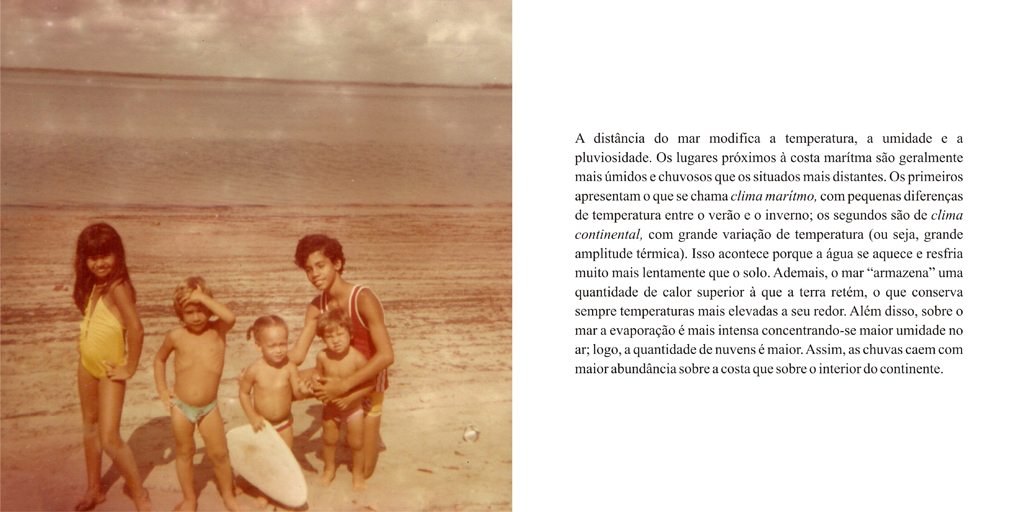
Domingo (os pequenos banhistas) nº 1 (2013)
"Photography is like a memory machine. Most of the times, they remain buried in family albums, under layers upon layers of memories, like an archaeological process, waiting for the time to get back to life, back on sight.
This sense of rediscovery, of resurrection, gave rise to the series Domingo (os pequenos banhistas) [Sunday (the little beachgoers)]. These are photographs retrieved from oblivion in albums. They depict a group of children on a Sunday beach trip in the 1980s. These images are placed alongside excerpts from a scientific description of geography and meteorology, taken from the Conhecer encyclopaedia, which was very popular in Brazil at that time, providing the photograph set with a sort of scientification of subjectivity: it is as though the encyclopaedia’s entries could provide some sort of explanation or justification to those simple, plain pictures of a day at the beach.
From the moment I conceived the piece, I had a clear-cut intention of going beyond photography. It wasn’t enough for me to simply recycle old images, make them up or retouch them, giving them a new presentation, a new life. The intention was to treat photography and text as an object that is a repository of time, of meaning, of memory. This is why the semiotic integrity of the photographic medium is very important; the full functioning of their stains, scratches and crumples, its exposure flaws, the yellowing of time and their handling marks.
These images serve as an allegory of myself. From the most evident, indicial aspect of photographs – they are actual pictures of my childhood –, these photographs have formed my subjectivity, occuping the albums I grew up leafing through at family reunions. By the same token, the Conhecer Encyclopaedia was my loyal companion in explorations and discoveries in a determinant stage of my formation.
Where does the photographic image take place? What happens with the image captured beyond the boundaries of the real, built by sight, with the intervention of the device? An image which, under the pretext of recording life, gives back subjectivities in a sensitive reflection. What happens here? An apparition? Something that used to be only imagined, impossible to measure or retain at first, something that will soon vanish from memory, leaving only traces.
You, me, anyone, suspended in time and contained in the frame of the photo. The image - in its own rhythms - is the vastness of nature, boundless; for a brief moment, it eternally becomes the place where the event occurs, a formerly inexpressible landscape, little kids at the beach, an illusion, a dream."
Fernão Paim in a statement to PLATFORM:VB (October 2013)
Domingo (os pequenos banhistas) nº1, nº2, nº3 (2013) | Fernão Paim
Photographic installation | 6 diptychs printed on satin photographic paper and 250 g matte coated paper, 20 × 20 cm each; mounted on Dibond
Fernão Paim mentions a number of texts and essays on the nature of the photographic act and image. His relations with “the real”, the memory and time are discussed in:
The Photgraphic Act (1994),
by Phellippe Dubois;
Camera Lucida (1984),
by Roland Barthes;
Estéticas tecnológicas: novos modos de sentir (2008),
by Lucia Santaella;
Fotografia e Memória (2005),
by Boris Kossoy.
The work Being and Time (1927), by the German philosopher Martin Heidegger, is also among the artist's references.