Doméstica
2012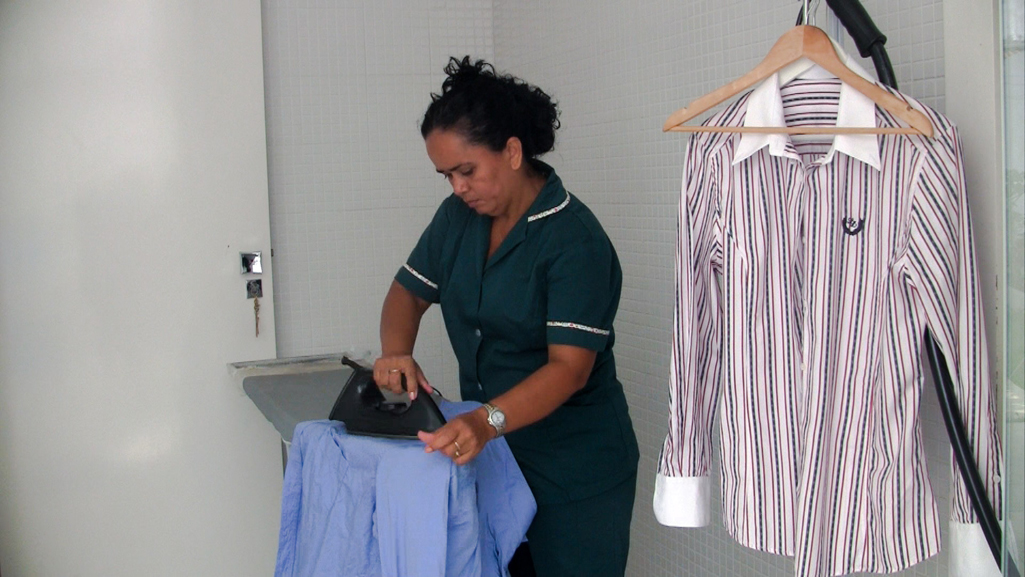
Doméstica (2012), film still
“In Doméstica (Maid), I was concerned with penetrating the complex relationship of affection and labor that permeates the daily lives of young people and their maids. The young people concerned were given the task of filming their maids and handing me the raw footage so that I could make a film out of it. The truncated intimacy of those relationships interested me, with regard to the power of sight.
Unlike the classic 'action' and 'cut' model of cinema, the challenge of this film laid in sharing subjectivities, scheduling meetings, elaborating procedures that would allow the footage to be filmed by others in order to create surprise and restlessness. The idea was to challenge those young people to invert their sight, to observe someone who had often observed them their whole lives. And, for a week, to bring about a renegotiation of roles.
Each family has a latent, deeply personal way to relate to the maid. The affection is negotiated in the personal sphere, in intimacy. Whether the young people took advantage of a power relationship in order to gain the maid’s intimacy, or the maids used this audiovisual artifice to self-fictionalize within the relationship, what makes me glad is the power of this imprecision the film exudes from start to finish. It is precisely from the resignification of these images, in my encounter with the young people and the maids, that a new view arises. And the film is also my own affective and political encounter with the result of the raw footage.
When I launched the film, at the 2012 Festival of Brasília, prejudice against maids was backed by the Federal Constitution itself. Maids were cut off from basic protections such as paid vacations, 13th month’s wage, unemployment insurance, accident insurance, overtime pay and maximum working hours.
In 2011, the Labor Ministry's figures showed that nearly 15% of the world’s domestic workers were in Brazil (amounting to roughly 7.2 million). Brazil had not yet ratified the convention of the International Labor Organization (ILO) on domestic workers.
At the beginning of 2013, a constitutional amendment bill called PEC das Domésticas was submitted to Congress. On May 1st, I released the film in the commercial film circuit, amidst a tornado of conservative backlash against the amendment that set forth a few timid improvements in reparation for centuries of the slave mentality that still echoes through contemporary Brazil.”
Gabriel Mascaro in a statement to PLATFORM:VB (October 2013)
Doméstica (2012) | Gabriel Mascaro
Video | 75’, stereo, color, 16 : 9
Doméstica (2012) preview
Testimony Gabriel Mascaro | 18th Festival
Mascaro gives his take on the deconstruction of the act of filming, whereby the director’s gaze is outsourced, or decentralized, a key process to all his video works
O que muda com a PEC das Domésticas? (Carta Capital, Mar. 2013) [pt]
OIT determina direitos iguais para domésticas (O Estado de S. Paulo, Jun. 2011) [pt]