Deviations, drifts, contours
2007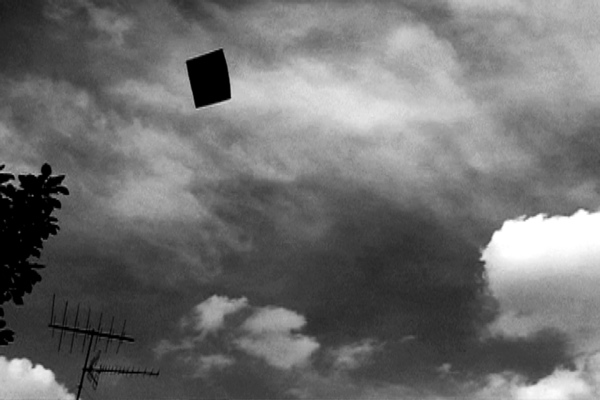
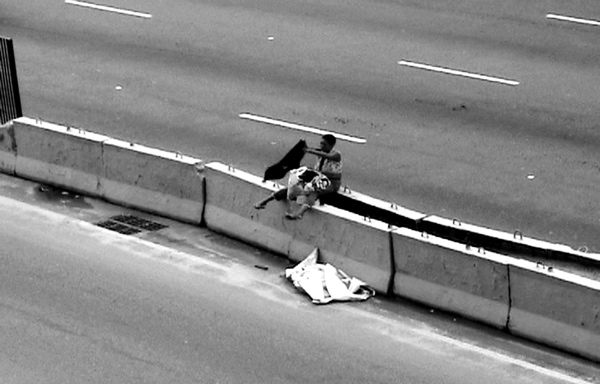
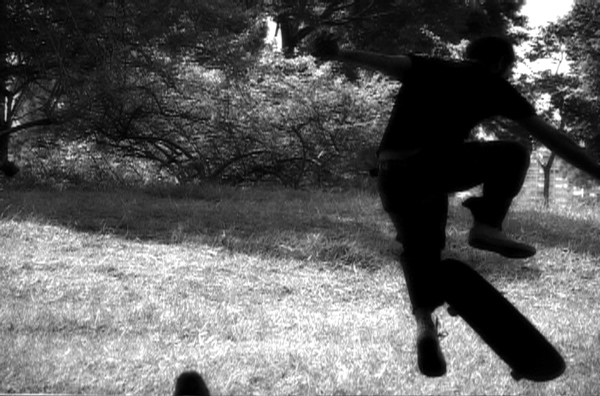
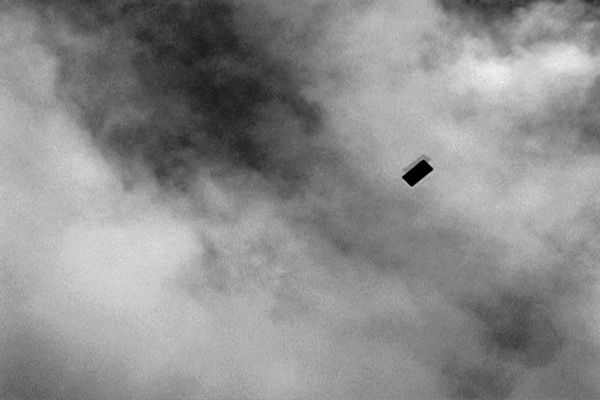
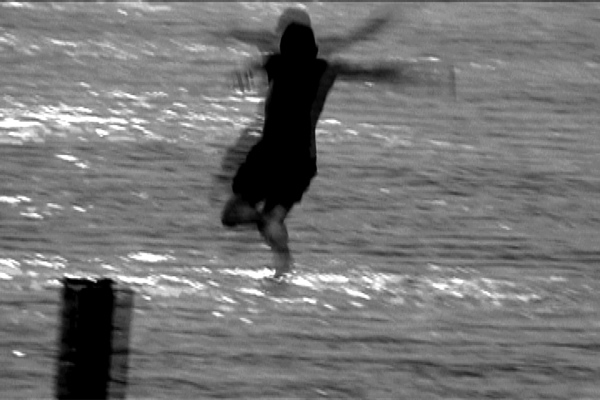
“Desvios, Derivas, Contornos [Deviations, Drifts and Contours] was largely produced with ‘accumulated’ material. It is a video that associates images with certain video art archetypes. At the same time, I refer to a personal state, a disenchantment with paved pathways, influenced by a certain emptiness or a disbelief in love as well. The images add up and, at a certain point, possible connections among them emerge. I often keep an open timeline, where I stock these possible affectionate, aesthetic or dissonant ties that occur to me.
A curious fact is that the images of things falling, which permeate the whole video, were initially created in a workshop for the reenactment of Flávio de Carvalho’s play Balada do Deus Morto [Dead God’s Ballad] by Livio Tragtenberg, in 2007, at the Oficina Oswald de Andrade. Livio had invited me to direct the images for a multimedia version, and these scenes were produced back then. Thereof, I thought about a series of messages falling from a building, as if they were sent from ‘beyond’ (or maybe casually derived from someone who dropped them on a neighboring building).
This video continues a set of works that articulate meaning from disconnected scenes, from ‘accumulated’ material. It is a process of creating relations in a timeline, freely associating ideas and thoughts, although intending to transmit certain concerns, to be an intimate comment, which can be openly shared, assuming new meanings for whoever watches it.
As I state in the video’s press release, the subtitle ‘Pra não dizer que não fui ordinário’ [Not to say I wasn’t ordinary] is a way to highlight multiple references, from a music title (‘Pra não dizer que não falei das flores’ [Not to say I did not speak of the flowers], by Geraldo Vandré), to video artworks by other directors, as well as other videos that present the word NO in their titles. My videos are: Ali é um lugar que eu não conheço [There is a place I do not know], 1995, Eu não posso imaginar [I cannot imagine], 1999, I have no words, 1999, and Aqui de novo [Here again], 2003. The last one is also a comment about the language of previous works.
Since the video was produced with ‘accumulated’ material, some scenes gain meaning as they are experimented along with the construction, which is gradually defined in the timeline.
I believe that this construction process applied on the meaning of the narrative may have been partially abandoned by the new generations of artists, who now develop videos with long takes or more conceptual situations. The scene that precedes the end of the video shows a man on a tree (near a gate to the University of São Paulo), with a rope around his neck. He is crying, clearly in despair, and he threatens to jump, thus hanging himself. There is a handful of people bellow the tree, and soon police officers and a fire engine arrive. One of the officers tries to dialogue with the man. I was walking by, and I recorded the scene by chance, from a hidden viewpoint, being careful as not to influence, at any point, the decision of a suicidal man. For everything suggested that there was a certain voluntary exposure, a spontaneous spectacularization, a negotiation between a personal drama and the pact that society urges us to make in order to live collectively.
It is worth remembering that this work starts with scenes of people seen from several windows, private lives that are exposed in their singularity, amidst a complex urban collectivity. The insertion of these scenes meant to point at a somewhat tragic perspective, which can be observed in the contemporary crowds.
This scene adds a certain weight to the work. It produces distinct meanings for the artwork’s different audiences. Producing meaning, producing articulations among the situations that are initially arranged by the video, is an exercise. It is like the radial drift of a city inhabitant. It is a contour, a dissent contained in the social pact, as if saying: I give up! It is a possible death, of someone who got tired of clashes and confrontations, who accepts the ordinary, sad and tragic condition of a life within a city such as São Paulo.
Using such disparate scenes and articulating a speech was, at some point, the big challenge for the narratives of the video, which refused to follow the logical path of short films, resembling the fictional cinema. It felt like saying that we could articulate (meaning we could play and experiment with) images in the same way poetry articulates words, sentences and linguistic structures. Maybe time will tell us how these languages are temporarily established, or how they reflect certain clashes (perhaps seasonal clashes) among media, techniques and ways of thinking and producing moving images."
Lucas Bambozzi in a statement to PLATFORM:VB (March 2016)
Desvios, Derivas, Contornos, 2007 | Video, 6’40"
Lucas Bambozzi
Aqui de novo (2003) | Lucas Bambozzi
AQUI DE NOVO from lucas bambozzi on Vimeo.
Eu não posso imaginar [I Have No Words] (2000) | Lucas Bambozzi
Otto (1998) | Cão Guimarães and Lucas Bambozzi
OTTO [I am another] from lucas bambozzi on Vimeo.
"The video refers to a series of references in its technical file: for instance, the use of my daughter’s voice makes me think of Carlos Magno’s videos, which directly feature his son; the airplanes crossing the sky in London at some point reminded me of a video by Wagner Morales, shot in Normandy. Although these images already existed before I got to know the work I connect with (subjectively, most of the time), when I use them, an association is produced, and I like to stress that. Thus, as I was saying, the use of black and white in the image treatment throughout the whole work may refer, according to some, to an option of treatment used by Carlos Nader in several works of his. However ‘untrained’, the fact that I am trying to ride a skateboard may suggest an association with the Australian artist Shaun Gladwell, a skilled skater. I produced scenes of things falling from the sky, and when I articulated a narrative marked by these scenes, I imagined I was using a tying device, as described by Cezar Migliorin. The intimate, sad and lyrical approach may have had something to do with Guillermo Cifuentes’ work, or Patrick De Geetere’s pieces, an influence I always embrace, as well as certain videos by Eder Santos. That is, the whole work is an articulation device, a device to explicit these references, while, at the same time, it poses the following questions: Are these mere aesthetic associations? To what extent does one thing influence the other? Why do we barely admit the influence of an artist over the other (I mean, many mention renowned artists, who are not among us anymore, but only a few emphatically name a living and active fellow artist). Hence, successively, I have been searching contact points. The use of silence and music in a dramatic way may be related to some works by Arthur Omar. There are many musical excerpts created by the group Feitoamãos (FAQ), which I used to be a part of. The use of recognizable noises and machines that do not appear on screen may have been inspired by the musical group O Grivo. There are samples taken from Godspeed You Black Emperor’s music, which also constitutes a comment about the way the group creates audio narratives. Such decisions range between the unconscious and a (supposedly conscious) determination. It ocurred to me then to turn it into a suggestion. That is the basis for the development of the video. The little accidents, like the spilled milk, were incited by a scene shot for the movie Otto (1998), carried out in partnership with Cao Guimarães. The slower scenes, the situations that are on the verge of a non-event, may be related to him, as well as other directors. Even though none of these directors ‘invented’ said resources, they have become the holders of certain patterns, which end up forming a certain style, from the point of view of the critics. At the same time, they are close and ‘accetable’ references; they represent a possible dialogue, even though this dialogue does not take place in a productive way like it could do (and I must say that PLATFORM:VB, for which this statement was requested, may be playing this role of interconnection among works, authors and influences).”
Text "Do invisível ao redor: o que se vê e o que não é aparente", of Lucas Bambozzi