Demolishing Rumor
2010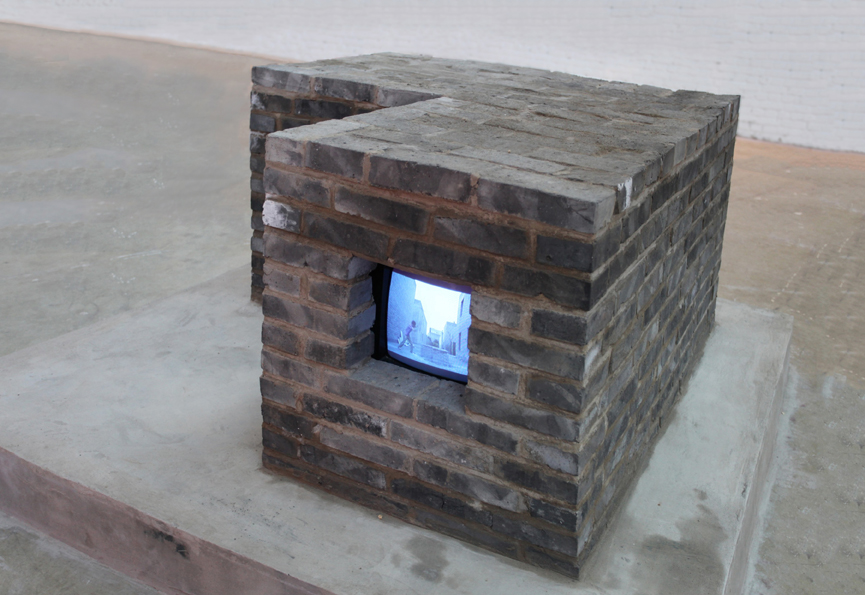
Demolishing Rumor (2010)
"The research for the conception of Demolishing Rumor relates to the absurdity and effort undertaken in carrying out a ‘durational performance’. It is through performance – usually durational – that I enter another state of mind and perceive a different dimension of time. This is significant to me, as sometimes I find myself experiencing ‘uneasiness with time and its measure’, a feeling that art historian Pamela M. Lee explained as the symptom of ‘chronophobia’.
Demolishing Rumor addresses the rumor of demolition of Beijing artist’s districts during the year of 2010. Caochangdi Art District, located in the city’s northeast area, started when the Chinese artist Ai Weiwei first built his studio on a former farmer’s field, in 1999. Soon, other galleries or artists’ studios were erected.
It is not surprising that rumors about the destruction of the Caochangdi Art District started to circulate; this was something that also happened with another area in the city, the prominent 798 Art District. These are two examples of the side effects of the rapid growth of Chinese economy and its imbalance over cultural development or conservation; and this is a phenomenon that can be observed all over the world.
This work brought me to my first encounter with censorship in art. It happened in Beijing, in 2010, when it was shown at an exhibition featured in a festival organized with the local government. I proposed to show Demolishing Rumor because I was aware that I would be addressing issues related to the forceful demolition of an art district – an action that was happening all over Beijing at that time. It was clearly stated in my proposal, and in the work’s title, that the piece was politically challenging this very topic of demolition. However, it was only one day before the exhibition setup that I was told I would have to either exhibit another artwork or withdraw the piece from the show.
In the end, and after some negotiation between the curators and the organizing parties, it was installed as planned. This drama is still very impressive to me due to the level of cultural censorship in China, as well as the futility of being critical under a negligent government."
Morgan Wong in a statement to PLATFORM:VB (October 2013)
Demolishing Rumor (2010) | Morgan Wong
Video installation | Bricks, concrete, TV, 75 × 150 × 150 cm. Video, 13’22”, stereo, color, 16 : 9 to 4 : 3
Testimony Morgan Wong | 18th Festival
The artist discusses his impressions of São Paulo and the Festival. He comments on the tension between art and politics in contemporary China and on the country’s growing art scene
Public Programs | Focus 2: 18th Festival: vectors and inflexions | Territories of the south: experiences, cities and borders (Part 1)
Guests discuss issues pertaining to the shows featured in this edition of the Festival, and the core themes of the programs Southern Panoramas and 30 years
Public Programs | Focus 2: 18th Festival: vectors and inflexions | Territories of the south: experiences, cities and borders (Part 2)
One Year Performance 1980 -- 1981 (Time Clock Piece) | Tehching Hsieh
TateShots Issue 12 (2008) | Harrison and Wood
Tehching Hsieh, a Taiwanese artist who lives in New York, famous for his durational performance in the late 1970s to 80s, is an important reference for Morgan Wong. "He has done five legendary year-long performances, including One Year Performance 1979 - 1980, in which he punched a timeclock every hour for a whole year", explains the artist.
The artist also mentions the videos by the duo John Wood and Paul Harrison – "result of highly performative and absurd actions" – and also the paintings of numbers by Roman Opalka. Wong emphasizes that "by painting increasing numbers from 0 to 5607249, from 1965 to his death, in 2011, Opalka's work marks his life as an enduring action."
The publications Hong Kong Artists: 20 Portraits, edited by Cordelia and Christoph Noe (Verlag für moderne Kunst, Sep. 2012) and Yishu - Journal of Chinese Contemporary Art (Vol. 10, N. 3, May/ Jun. 2011), are also among the artist's references.
Morgan Wong's website.