Contestado, a Guerra Desconhecida
1985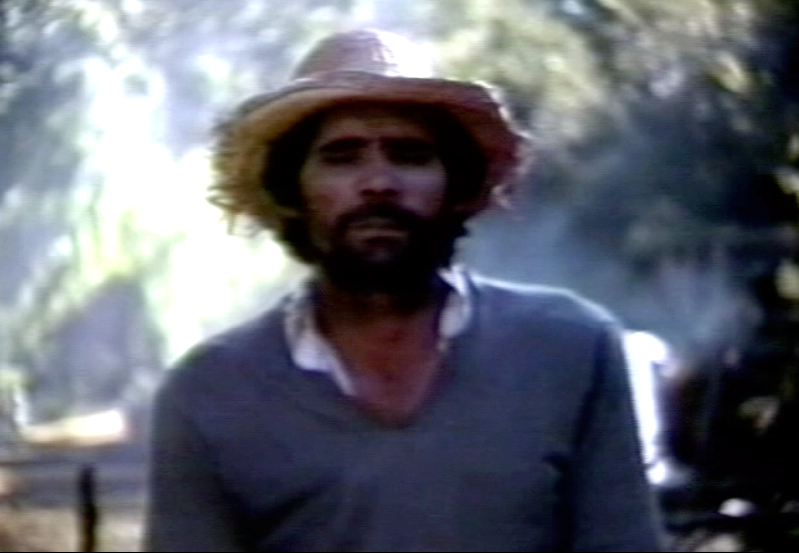
Video still
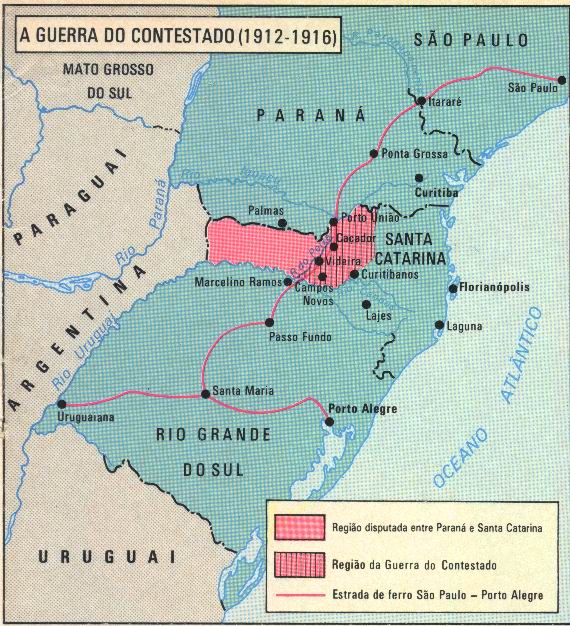
Map depicts the Contestado area and the São Paulo-Rio Grande railway line.
"The film was made during the re-democratization of Brazil, following the end of dictatorship, a time when social movements in the countryside were met with heavy repression. Here in Santa Catarina, there was a strong need to retrieve the memory of the state, and one of the watershed historical events had been the Contestado War, a fact unknown both within the state and on the national level.
The work started with research into historical photos, beginning with the collection of Claro Janssen, a Swedish photographer who had immigrated to Brazil, and with films by the Southern Brazil Lumber & Colonization company, which were kept in the Cinematheque of Curitiba. Afterwards, I and the team delved into the reason for the War, mostly focusing on the exploration of country dwellers, and the intervention of international capital in Brazil.
We also searched the old Lumber company headquarters, where we found a huge amount of abandoned documents. One could tell that the territory had been surveyed in depth, because the company was building the São Paulo–Rio Grande railway, and had 30 km to occupy along the railway line, using the strength of ‘ambassador’ Comblain, as the people used to say, in a reference to a shotgun brand.
By the time the documental research work was completed, the landless movement was gaining momentum, and the first scenes of the documentary were shot at a landless settlement in the Chapecó area. It was a way of showing that although it seemed only historical, the subject matter was current, and remains thus until this day.
Our field research was based on oral accounts. We travelled the countryside, covering approximately 12,000 km. We realized it would be extremely difficult to find people who had actually taken part in the events, since we were filming in 1985 and the war had taken place in 1916. We counted on the longevity and the memory of the witnesses. It was amazing, because people would refer one another; it felt as though each of them secretly knew where the others were.
One of the most poignant accounts is from Benjamim Scloss, a former elite army shooter. He says he used to shoot the ‘caboclos’ (peasants) in the head with a telescopic sight shotgun, and then discusses the grief and the anger he felt upon realizing he was killing poor people who were explored by those who were in power at the time. An ideological interpretation of the war had been imprinted upon him, for although he was an elite marksman, he was able to conjure a self-critique of his position and put forth a deeply political reflection.
It seems to me that the relationship between the land and society is a fundamental issue. Whenever the tie between individual and land is violently broken, people become asphyxiated and have to move away from their place. The moment they move into the city, their vast farming knowledge becomes irrelevant. They are told what they know is obsolete, devoid of cultural or economic value. This is one of the main reasons for the destruction of identity and for violence. Currently, the UPP-based ‘pacification’ project (in Rio’s favelas) is perhaps nothing more than the occupation of prime real estate in the big cities. The issue of land in Brazil remains. No longer in the rural areas, which have become somewhat stifled, but in the urban setting.
Back then, the São Paulo-Rio Grande Railway was a matter of national sovereignty, of occupying and exploring the wealth of the land. Now, when we look at Belo Monte, we realize history repeats itself, because the central power decides and no other options available are considered. The issue has not been revisited, and the sustainability policymakers themselves are in the cities. They are an elite and this is terrible, because the issue gets drained out of power. And the countryman’s worth cannot find its place."
Enio Staub in a statement to PLATFORM:VB (August 2014)
Contestado, a Guerra Desconhecida (1985) | Enio Staub
Video | 55'27"
Testimony Enio Staub | Unerasable Memories, 2014
The director and scriptwriter Enio Staub discusses his Contestado, A Guerra Desconhecida (Contestado, the Unknown War), a documentary featured in the 3rd Festival (1985)
CONE SUL (1983) | ENIO STAUB
Cone Sul, about Operation Condor, was Enio Staub’s first movie. It also addresses the issue of violence inflicted by the state on its own population.
“An American researcher, Todd Diacon, stayed with us through the filming and wrote Millenarian Vision, Capitalist Reality: Brazil's Contestado Rebellion, 1912–1916 about the Contestado War.
Maybe the closest thing in terms of occupation was Fordlândia, in North Brazil.”