Ciudad Maya
2016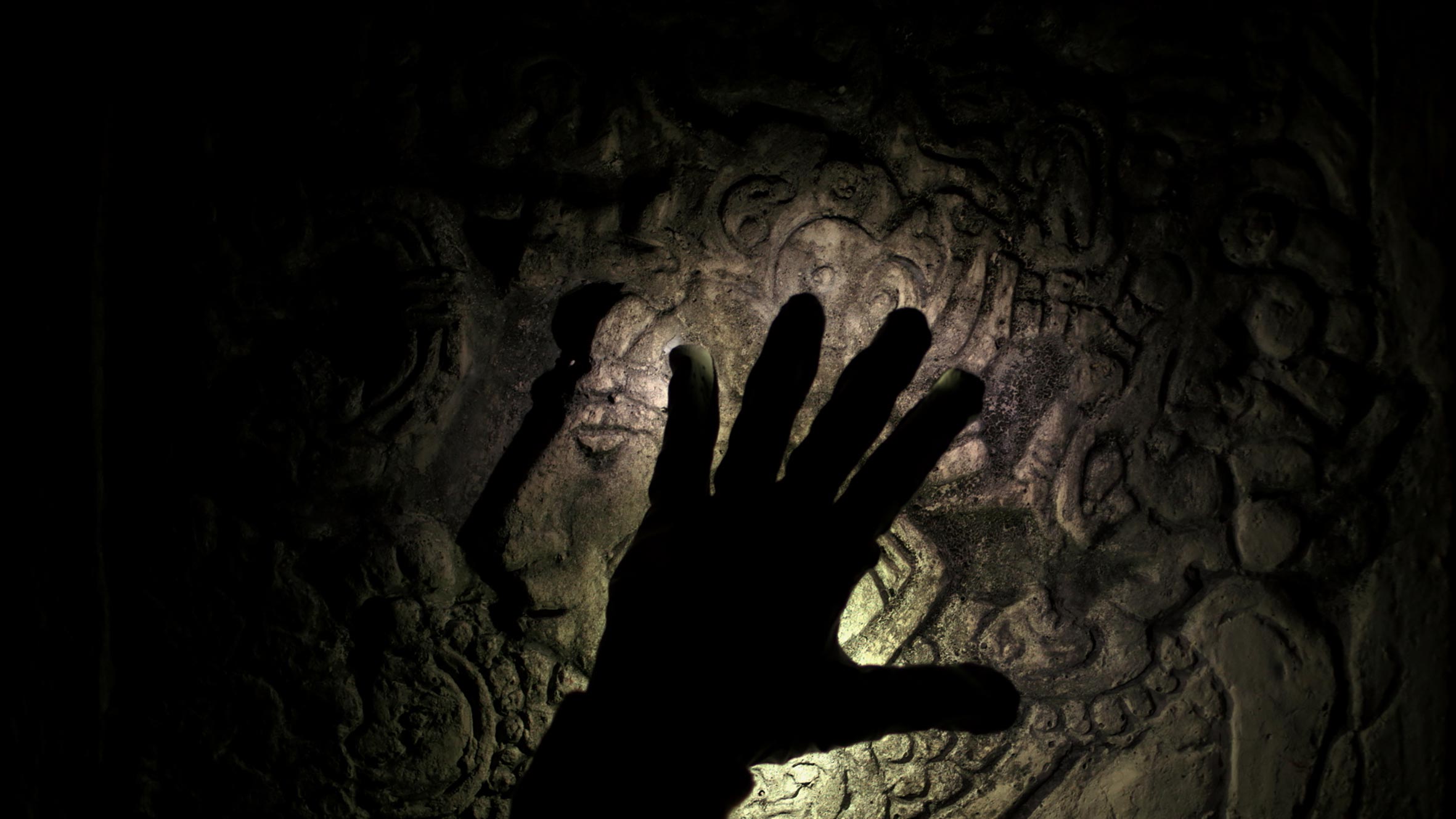
I started to look for modern and contemporary reproductions of Mayan monuments when I came across the architectural style known as neo-Mayan, a mixture of Mayan elements and art déco. This style flourished in the early 20th century as part of an official effort to create a homogeneous and modern Mexican national identity: the mestizo. “Theorists and politicians advocated the ‘third race’ as retaining the best qualities of each component—the enlightened European logic and civilization, and the spirituality and local heritage of the Indians.”[1] This idea has been operating ever since to cover an unresolved postcolonial conflict.
Along with a touristic boom in the 1970s and 1980s, replicas of pre-Hispanic constructions proliferated in the Yucatán peninsula, home to the Mayan civilization. These reproductions appeared as hotels, restaurants, waterparks, cabarets, etc. They hosted shows where locals disguised as ancient Mayas to simulate rituals, dances, and sacrifices for the tourists. Ciudad Maya[2] was one of those places. When I found it in 2015, I realized it was the ruins of the reproduction of a Mayan site in ruins. I thought this mise en abyme was very meaningful, as it worked as a metaphor of the cycle of depiction and exploitation this culture has been cornered in. I decided to focus my project on this place and to invite a group of young urban Maya to simulate an archeological survey of the building.
There are almost 800,000 native speakers of the Yucatec Maya language. The city of Merida is the biggest urban center in the region, to where the countryside population has been increasingly moving. I spent three months there researching the contemporary Mayan culture, meeting people and preparing the film. Through Merida’s art school and other cultural institutions, I started to meet young men and women that considered themselves as Maya and that were willing to participate in the process. The encounters were beyond my expectations—the characters turned out to be extremely interesting personalities that expanded considerably the scope of my research: a contemporary artist, a programmer, a rapper, a journalist and a poet, all of them working in Maya with a clear stance to vindicate their culture in the global context.
The working process with them resulted in collaborations for the project that made the film take a completely new direction: José painted a mural, Pat Boy composed a sci-fi rap, Sasil and Lorenzo created a glossary of technological neologisms and Feliciano co-wrote the voiceover of the film with me. Although I’ve been working with moving image for thirteen years, I would say Ciudad Maya is my first short film. When I started to think about this project, I was interested in the different layers of fiction when we talk about pre-Hispanic cultures. I also wanted to question the notion of authenticity when approaching indigenous cultures today.
In the project, there is a reflection about the way our present is going to be seen in the future. And especially what are the tools and the mechanisms we are using now to store our present for future consultation? I researched technologies used in current archaeology, such as 3D laser scanners (LIDAR) computer vision, photogrammetry, etc. Then I built a series of DIY devices inspired by these tools and partially implemented them. Using lasers, camera flashes and LEDs, these devices were conceived to be the only lighting sources of the film while the characters operated them.
Something I consider relevant for this film was to work on the edge between documentation and documentary. One layer of the project corresponds just to the documentation of the action of surveying this building with custom-made tools. But this framework creates the access conditions to a more documentary layer, in which the characters are not performing, but voicing their own concerns. The third layer the film portrays is the documentation of the collaborations we did, where we become co-authors of the work.
The project aims not only to demystify the total disappearance of the Mayan culture, but also to state its cultural integrity and its concerns in an urban society.
[1] Lauren Higbee in Maya Aesthetics of Mestizaje: Mexican Revolutionary Architecture in the Yucatán
[2] See text: Andrés Padilla Domene - Ciudad Maya Calle 84 #510 x 63 y 61. Merida, Yucatan, Mexico
Andrés Padilla Domene in a statement to PLATFORM:VB (August 2017)
Ciudad Maya, 2016 | Video, 24'
Andrés Padilla Domene
Hotel Palenque | Robert Smithson
Trailer of SUEÑAN LOS ANDROIDES (2014) | Ion De Sosa
Archaeology and science fiction have deeply influenced my work. Important references for the making of Ciudad Maya were:
Robert Smithson: Hotel Palenque
Jesse Lerner: Ruins
Ion de Sosa: Sueñan los Androides
Pierre Huyghe: The Host and the Cloud, A Way in Untilled (documenta 13)
Apichatpong Weerasethakul: Uncle Boonme Who Can Recall His Past Lives, Cemetery of Splendour
Ancient Aliens and Pseudoarchaeology theorists