Casa Blanca
2005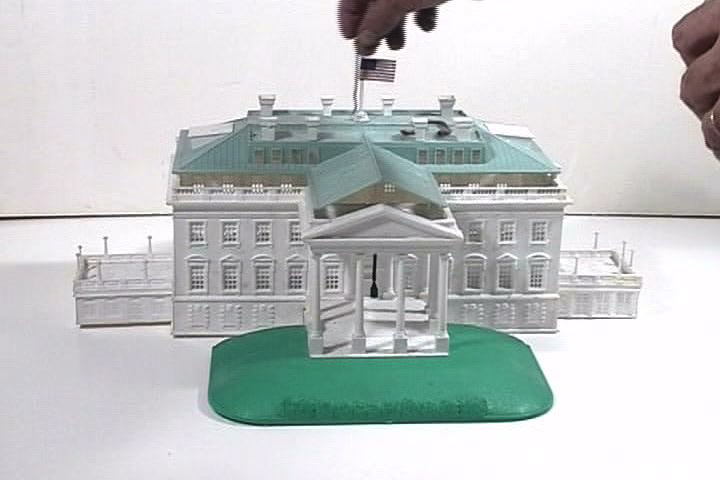
Video still
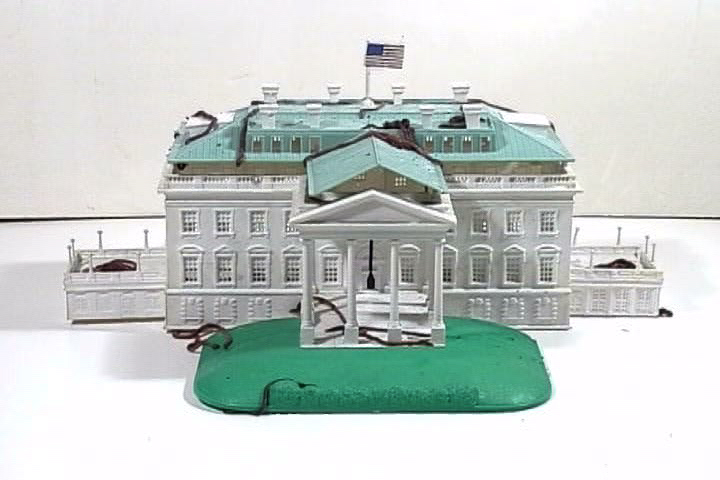
Video still
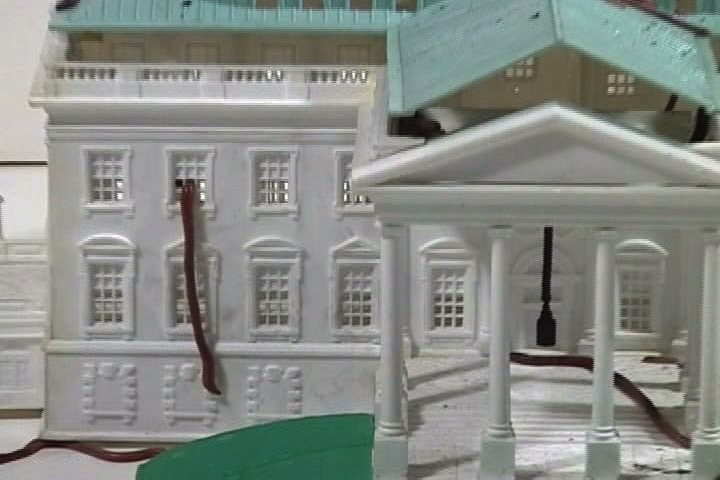
Video still
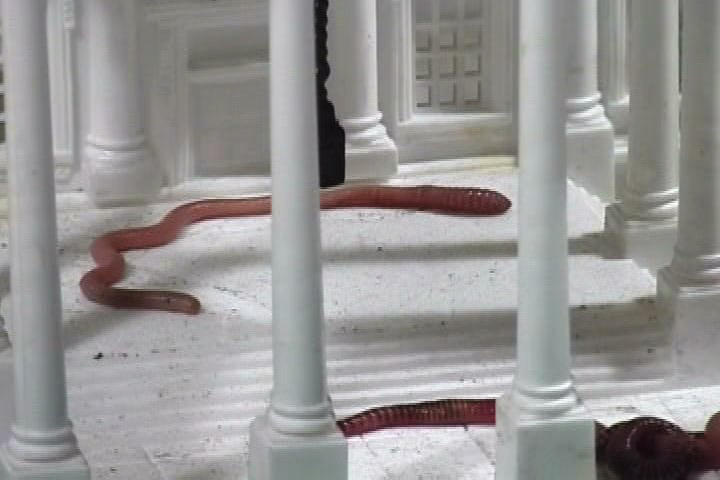
Video still
"I had my first contact with audiovisual production in the late 1980s, while producing soundtracks and doing editing for an independent filmmaking group. Since the mid-90s, I have been making videos and experimental documentaries. One of them, The Architecture of Madness, led me to meet León Ferrari. The documentary was commissioned by the University of Essex for an exhibition dedicated to León, featuring his work with invented calligraphies and his heliographies.
In the year 2000, Catholic fundamentalist groups left a bomb outside one of his exhibits in Buenos Aires, which was closed as a result. In 2004, he was scheduled to have a mega exhibition, his first following that incident. He said we should record a performance where earthworms were thrown onto a scale model of the White House, because many of his works at the time involved the idea of teasing viewers with insects desecrating religious and capitalist icons. The video was meant to be shown during the exhibition, at the Centro Cultural Recoleta.
One day we met very early at his studio. León had gone to fetch the 'actresses' at a fishing club. We arranged a very simple set, using a powerful lamp to convey the idea of an infinite background, and then he began doing the performance. I had total freedom with the camera, so I alternated between wide shots, which he had requested, and details that made the images more dramatic. We were lucky to find a worm on the USA flag.
The soundtrack was created using audio from a performance León had presented in Brazil in the 80s, where he struck one of his wire sculptures using various objects. The cold texture of sound worked really well with the image.
León has worked with the issue of power a lot, and power cannot be told apart from religion. What he says about the Church is not really about religion, the saints or Jesus as much as it is about its real power, its military power, about how the Church enforces its power through guns, through its own armies or through countries such as the USA. He associated the George W. Bush administration with the Church and the power of Western civilization.
The video Casa Blanca alludes to the echoes of anti-American sentiment left on several generations as a result of the US’s explicit participation in implementing the bloodiest dictatorship regime in our history. One of the direct victims of that massacre was Ariel Ferrari, León’s son – and León himself, who had to immigrate to Brazil in 1976, where he stayed until democracy was reestablished. So with this video, we were somehow bombing them back.
Casa Blanca was very successful. In addition to that major exhibit in Argentina, it was shown in the US, in a show called Violencia (Violence), curated by Graciela Taquini, and also in Mexico and Colombia. It is the first video in a trilogy. Lombrices, which has worms crawling over a white background, is the second. Both are corrosive, provocative and irreverent. The third video was not edited. It featured León throwing worms on pictures of the Sacred Family. I am especially endeared to León Ferrari for his generosity in inviting me to share these experiences with him."
Ricardo Pons in a statement to PLATFORM:VB (August 2014)
Casa Blanca (2005) | León Ferrari and Ricardo Pons
Video | 3'15"
Casa Blanca (2005)
Testimony Anna Ferrari | Unerasable Memories, 2014
Architect Anna Ferrari, the granddaughter of León Ferrari and one of the people in charge of FALFAA (Fundación Augusto y León Ferrari Arte y Acervo), discusses her grandfather’s works, especially Casa Blanca (2005)
THE ARCHITECTURE OF MADNESS | RICARDO PONS
Documentary about the work of León Ferrari. Directed by Ricardo Pons, the film led the two artists to meet. [es/eng]
LA CARRERA ESPACIAL DE LA URSS
Documentary on the space race in the URSS. Films about Russian cosmonautics have also influenced Ricardo Pons. [es]
CINEMA! CINEMA! DOCUMENTARY ON NEW WAVE – LA NOUVELLE VAGUE
Documentary on the Nouvelle Vague, a French cinema movement that revolutionized filmmaking and influenced the audiovisual production of Ricardo Pons. [eng]
"I recognize several artistic influences, including the Russian Revolution directors, the Nouvelle Vague filmmakers, Harun Farocki, impressionist and neoclassical music and jazz. All of the materials that inspire me, I use them, intervene, re-contextualize and reedit them."