Brisas
2008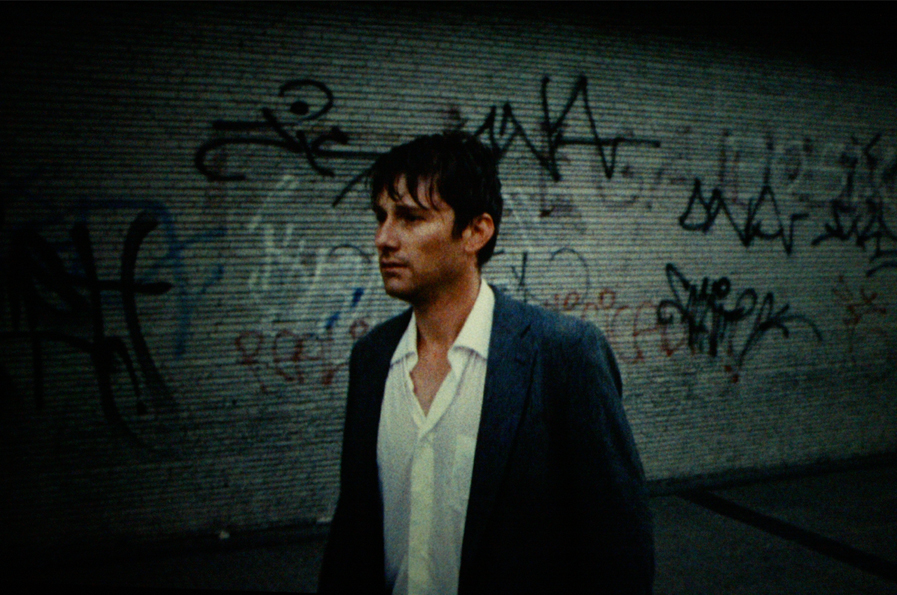
Brisas (2008), video still
"Chile’s Palacio de la Moneda is a symbol of joy and happiness. Paradoxically, La Moneda has its back to Santiago’s main street, La Alameda. In other words, the entrance is in the back. Therefore, in order to cross it, one must walk from Plaza de la Constitución towards Plaza de la Ciudadanía, but this plaza, whose name translates as ‘citizenship', has been fenced for a long time.
I started crossing La Moneda every day, trying to go around it and leave through the entrance, but a guard would always stop me and politely ask me to exit through the other side. Until one day someone stopped me and I inquired: 'what is the sense in always moving in the same direction?’ And the person who had told me to walk in the correct direction said: ‘The sense is that we cannot go back in History.’ For me, that was a decisive statement about my country. Chile has no memory and no interest in building one.
The man who walks in Brisas (Breezes) is a man that enters Palacio de la Moneda through the exit and heads towards the entrance; in other words, he makes the reverse trajectory, because he wants to remember, he wants to go back in history.
Form is very important to this piece, because it is a long shot where the viewer crosses the palace alongside the actor of the film. The dramatic and narrative timings here are one and the same, and this is crucial to me.
My works are political because they deal with memory, absence and the human aspect. I am interested in creating projects that connect to the viewer’s body and mind.
Brisas was conceived because our history vanishes. It is like the smoky fog in our cities; there is something that does not let us breathe calmly. We are a grey country, down to the core of our soul. In 1836, Charles Darwin made a magnificent remark : 'In this land (Chile), the people never smile, all they do is laugh at something or someone.' It seems that this sentence was written today. Nothing has changed in regards to this sort of sadness, which is neither melancholy nor the Brazilian saudade. It is grey...
My experience is based on real time, on my interest in long takes, in cinema as a driver of imagination. When image gets depleted, you have sound and literature, and so on and so forth... The words of the Chilean poet Enrique Lihn explain this very well: 'It is clear that the sun also enters through our ears, and this happens when we believe that we can hear visions’.”
Enrique Ramírez in a statement to PLATFORM:VB (October 2013)
Brisas (2008) | Enrique Ramírez
Video | 13”, stereo, color, 16 : 9
Excerpt from Brisas (2008)
Testimony Enrique Ramírez | 18th Festival
Ramírez expounds on his conception of memory, which is featured in his work, and its relationship with physical and geographical spaces and cities
The Weeping Meadow Part 1: Eleni (2004) | Theo Angelopoulos
The Tree of Life (2011) | Terrence Malick
Official trailer
"I have a keen interest in literature and film. Still, I could only name two people who have somehow marked my path: Raúl Ruiz and Guillermo Cifuentes. Both are no longer in this world. I am also a great admirer of the cinema of Theo Angelopolus and Terrence Malick."