Bare Life Study #1
2005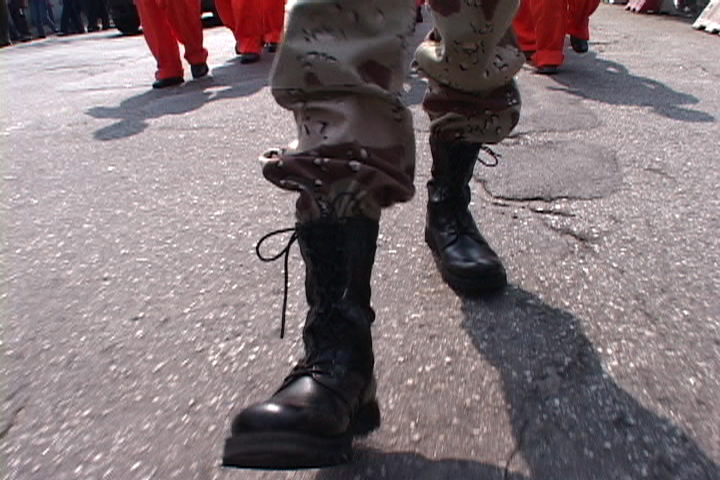
Bare Life Study #1 (2005) performance recording
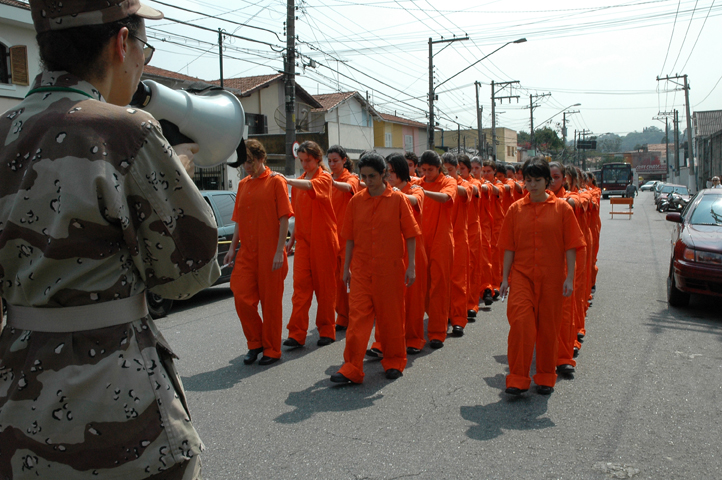
Performance documentation (2005). Photo © Isabella Matheus
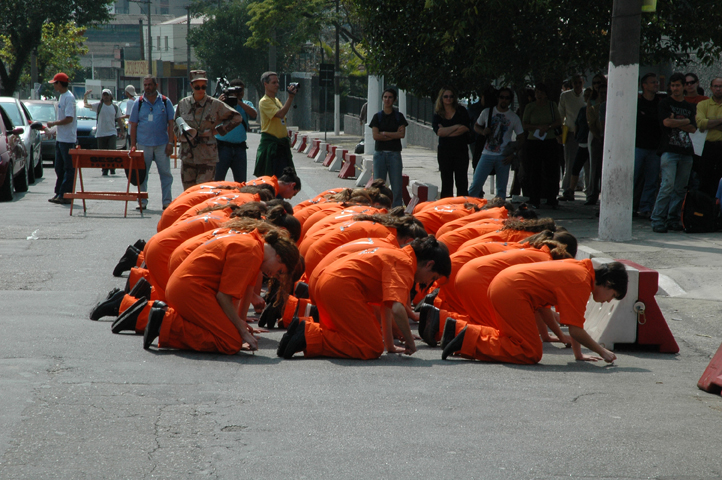
Performance documentation (2005). Photo © Isabella Matheus
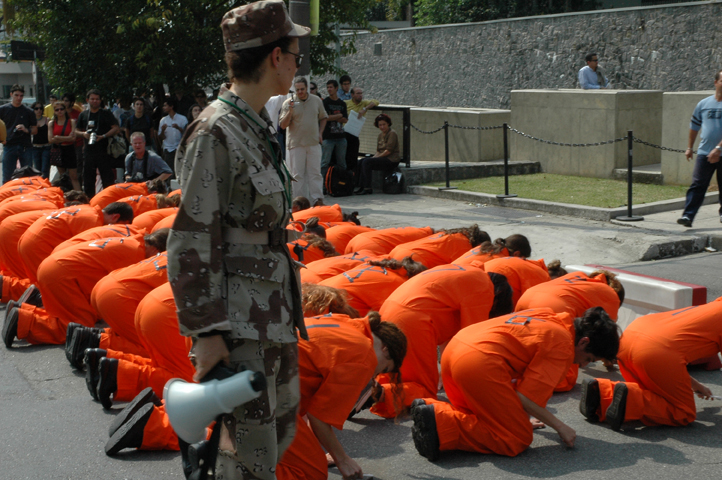
Performance documentation (2005). Photo © Isabella Matheus
“When I made Bare Life Study I was working in a long-term project that went on for 4 years, in which I was trying to explore what military interrogation was and, in a broader sense, what was happening in military prisons at that time. This was right after the revelation in the media of the abuse of prisoners in Abu Ghraib and as I studied the phenomenon it was very clear that the military prisons were very important sites that determined how the war would play out.
As part of that project, I took a course offered by retired military interrogators to learn what they do and how they behave. I learned a lot about how military police and the military interrogators work together. Bare Life Study was about the choreography of policing in those prison contexts. I was trying to explore a form political choreography that is dramatizes the subjection of the prisoners. I wanted to understand what was happening, why were we doing it, what was like, and why were the authorities trying to hide it. We only saw a very small portion of the amount of photographed material about prisoner abuse that is available. The US government decided to control American’s access to that material.
9/11 changed the social and political life of my country. The ideological transformation happened very quickly and it was really frightening. I felt at that point that what I wanted to do artistically was to think about the war and about what was happening to us, why we weren’t trying to stop the war, and what we didn’t understand about the war. Was it that we didn’t want to know about what was happening? Why did it seem that the government at that time was succeeding in convincing people that torture was necessary?
Bare Life Study was my way to open a Pandora’s box, to get people to see what we were doing. I was a child during the Vietnam War and I have very vivid memories of that period because I had neighbors whose sons were being sent to war, because it was on the news everyday. There was a lot more public awareness of the effects of war because we saw body bags with dead soldiers on television every night. Journalists were very effective in convincing the public the war was bad.
The four years that I spent working on military interrogation enabled me to bring a conversation about the war into the realm of art, and into the realm of performance. The pieces became ways for me to open up discussions about performative practices that are neither traditional theater nor art, but that contain elements of both. The interrogators who I studied with considered themselves to be good actors, as they have to know how to act to interrogate effectively. The prisoner also must adopt a role inside the prison and during an interrogation. Prisoners must wear costumes and assume a number as a new identity. Nearly every move they make must follow a script. They are inside one space all the time and on display all the time, just like an actor on stage. During an interrogation the goal is to make the prisoner produce the words that the interrogator wants to hear. The interrogator is a repressive script coach who forces the prisoner to “remember” his lines.
That was very interesting to hear but it was also to witness, how my teachers developed interrogator characters that they thought would be most effective for whomever they were interrogating based on what they understand about that person. It made me understand things about performance and its implications in these other fields. I could also take advantage of my familiarity with postcolonial discourses on Orientalism and the political uses of anthropology, since American interrogators were being given texts to read about Arabs and about Muslims that were quite problematic. I was able to use what I knew about Orientalism to understand a wartime situation and how intercultural issues get configured in such a context.
Reenactment is a prevalent element of American culture. So much of the culture of entertainment is about reenactment. Many documentaries now include reenactments to fill gaps in archive materials or to illustrate talking head testimony. It has become a way for people to connect to the past. It is not such an unfamiliar mean of communicating. It is similar to many rituals, and even many religions reenacts stories from sacred texts such as the Bible.
I think sometimes artists intent to engage in political commentary but sometimes they don’t and it happens without the artist having intended it. To give an example, when Picasso painted Guernica he sought to show the horrors of war. I think when the copy of Guernica was covered in the United Nations in 2003 so that Colin Powell, who was Secretary of State at the time, could make a speech in favor of going to war without having that infamous depiction of war as a backdrop, the work was serving a different political purpose there, and affecting politics in a different way."
Coco Fusco in a statement to PLATFORM:VB (August 2014)
Bare Life Study #1 (2005) | Coco Fusco
Video | 13'58" | Performance recording
Bare Life Study #1 (2005) | Coco Fusco | 15º Festival
Performance recording
TESTIMONY Coco Fusco (2004) | VCA
While preparing to shoot the Videobrasil Authors Collection documentary Coco Fusco: I Like Girls in Uniform, director Wagner Morales interviews the Cuban artist.
GHOSTS OF ABU GHRAIB (2007) | RORY KENNEDY
This documentary investigates the abuse of prisioners in Abu Ghraib in 2004. [eng]
At the time, there was a lot of discussion of Giorgio Agamben’s work. His concept of bare life was very important for understand the political condition of a growing global underclass or people such as enemy combatants, refugees and undocumented people who were stateless and existing without being able to enjoy basic human rights.
I think the Stanford Prison Experiment was about the question of an individual with absolute authority over others will exercise it ethically or be seduced by power and abuse it. What the experiment showed was that individuals were likely to abuse power in those situations.
Training for military interrogators does include some anthropology about the culture of the enemy. The idea is that interrogators should know enough about the prisoner’s culture to be able to craft an effective interrogation strategy. Familiarity with common rituals, notions of family, cultural taboos, etc. can all be useful in an interrogation to either establish trust or coerce a prisoner. At the beginning of the war in Iraq interrogators were given some material that was quite racist about Arabs and Muslims. One book in particular called The Arab Mind, which was published in the early 70’s, is supposed to have been influential in determining interrogation strategies.
The first story about Abu Ghraib was published in the United States by Seymor Hersh, who was also the journalist who revealed the My Lai Massacre during the Vietnam war.