A Arca dos Zo'é
1993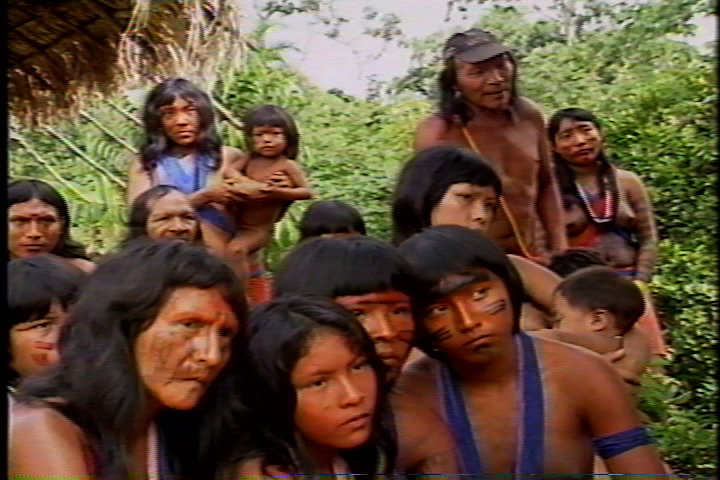
Video still
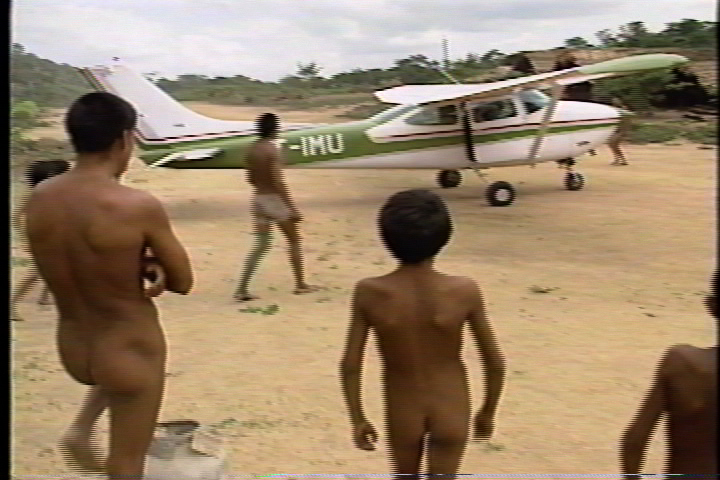
Video still
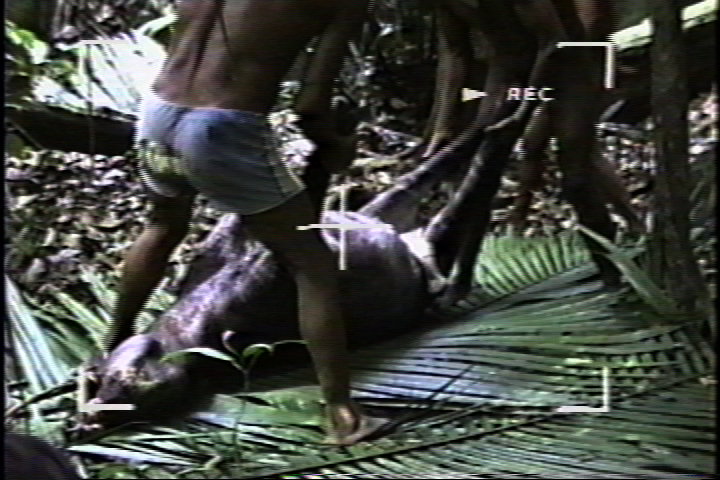
Video still
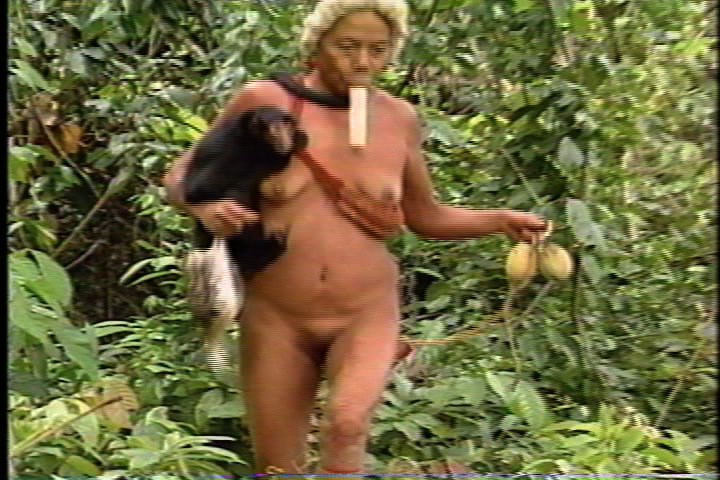
Video still
“I believe my contact with indigenous people is part of my background as a person. It was a radical experience meeting the Xicrin, an isolated tribe in Pará, at the age of 16. I always think of the moment we first landed, in a small plane, and I had a kind of flashback of the origins of humanity, a very powerful thing. When I discovered the Indians, I became fascinated with everything I saw. That’s when photography became a type of register, an urgent, pressing memory of something completely unknown to most of the world. That was when my career as a documentary photographer began, I would say.
After living with the Xicrin for a long time, I joined FUNAI (Brazil’s National Indian Foundation) in 1971, a very traumatizing episode. In the mid-1970s I left and took part in establishing the Center for Indigenist Labor, an NGO dedicated to alternative indigenism, and at about the same time I joined the Ecumenical Documentation and Information Center, now called the Socio-Environmental Institute, to conduct image research for the first reliable databank about the reality of indigenous peoples in Brazil. That was when the realization came to me that the memory of indigenous peoples, dispersed and appropriated by third parties, could be regrouped and returned to them, and this would be of the utmost importance to the younger generations.
In 1986, when we created the VNA, the main idea was to film and then show the footage immediately. The Indians understood that the manufacturing of image was possible and instantaneous, and embraced it euphorically. My partnership with Dominique Gallois in working with the Waiãpi allowed for an in-depth translation of the reflections that the work elicited, because she had been working with them for several years and spoke the language fluently. We embarked upon an experiment that gave rise to a series of films, including O Espírito da TV, which led to A Arca dos Zo’é.
In O Espírito da TV, Wai Wai, the tribe’s chief, decides to tour the Waiãpi villages in a sort of campaign. The projections of the footage we took were like a resonance box for his discourse of cultural resistance. He would present to the others a highly sophisticated reflection on what they saw, and also on how they should manipulate images, since he wanted to understand their repercussions in the world outside.
A Arca dos Zo’é is a development of O Espírito da TV, because the images I projected included footage by TV channel Globo of the earliest contacts with the Zo’é people. The differences in dialect notwithstanding, they spoke a Tupi language, understood what the Zo’é said, and were fascinated by it. It became a desire of Wai Wai’s to meet the Zo’é and film them. Since he didn’t have a camera to present the younger ones with images of his grandfather, meeting and filming them would allow him to bring home images of their ancestors.
The film was simply about fulfilling Wai Wai’s deep-seated desire; he was a brilliant character, an Indian intellectual. At the end, I returned to his village to show the footage of the Zo’é and to film the comments and analogies he drew between the Waiãpi in the world today, with all their new, hybrid forms of experience and customs, and the Zo’é, their ancestors. These two films are the keystones of the project, or at least its first stage.
Ten years later, we embarked upon a project of training indigenous filmmakers. Today, our workshops originate immediate products recognized by any audience or critic as the revelation of a new perspective of indigenous reality. And from a political standpoint, another burning desire of indigenous peoples takes on an important dimension: putting an end to their national and international invisibility, and being recognized not only as Indians, but as specific peoples with specific languages and cultures.”
Vincent Carelli in a statement to PLATFORM:VB (August 2014)
A Arca dos Zo'é (1993) | Vincent Carelli and Dominique Gallois
Video | 21'25"
A Arca dos Zo'é (1993)
Testimony Lilia Schwarcz | Unerasable Memories, 2014
The Brazilian anthropologist, historian and curator Lilia Schwarcz discusses the video A Arca dos Zo’é (1993).
THE MAD MASTERS's EXCERPT (1955) | JEAN ROUCH
A medium-length film in which Jean Rouch investigates the resistance strategies employed by colonized people towards their colonizers. The direct cinema developed by Rouch starting with this film bears resemblances to the method created by Vincent Carelli.
“In 1988, an article was published stating that there was a clear analogy between myself and Jean Rouch, and I didn’t even know who Jean Rouch was, or what direct cinema was.”